


Warren Buffett Has Officially Left Berkshire Hathaway After 61 Years. But 3 of His Favorite Stocks Will Likely Live on in Berkshire's Portfolio for Decades to Come.
Key Points
Warren Buffett transformed a struggling textile manufacturer into one of the world's largest conglomerates.
Buffett is arguably the greatest investor ever.
While his career may be over, the lessons Buffett taught and many of his investments are likely to live on for a long time.
- 10 stocks we like better than Apple ›
Warren Buffett just stepped down as chairman of Berkshire Hathaway (NYSE: BRKA)(NYSE: BRKB), ending an epic run. The Oracle of Omaha started investing in Berkshire, then an old textile manufacturer, in 1962 and turned it into one of the world's largest conglomerates.
Greg Abel is now chief executive officer, and Buffett's son, Howard, will replace him as chairman of the board of directors.
Missed AI’s "Act 1"? Act 2 Could Be 15x Bigger. Most investors think they missed the AI boat because they didn't buy Nvidia in 2005. But according to our analysts, we’re only at the end of "Act 1"—the R&D phase. "Act 2" is the global rollout. Continue »
"Father Time always wins," Buffett wrote in a farewell letter to shareholders. "He has, however, been generous with me. He has given me the opportunity to see Berkshire reach a point where I am more confident than ever about what lies ahead."
Although Buffett is no longer working at Berkshire Hathaway, the lessons he taught about life and investing will be remembered forever. Additionally, three of Buffett's favorite stocks are likely to live on in Berkshire's huge, nearly $360 billion equity portfolio for decades to come.
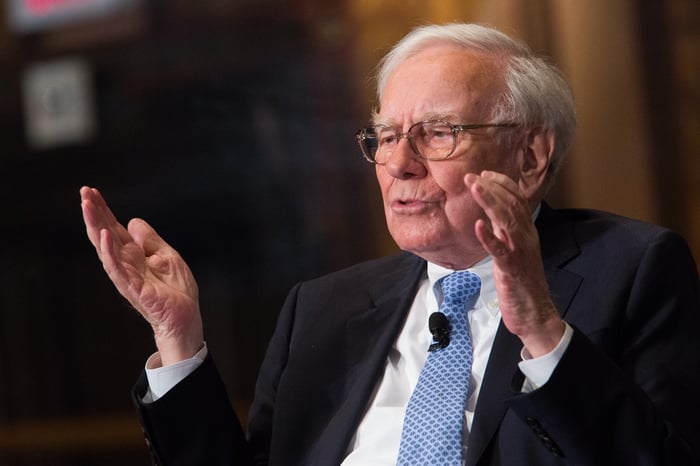
Image source: The Motley Fool.
Apple: 21.8% of portfolio
Berkshire would ultimately purchase the iconic consumer tech company Apple (NASDAQ: AAPL) in 2016, later on in Buffett's tenure. Buffett reportedly initially got interested in Apple after seeing how distraught his friend became when he lost his iPhone.
At one point, Apple made up roughly 40% of Berkshire's vast portfolio.
Apple has just about everything Buffett looks for in stocks: an incredibly strong brand that earns customer loyalty and builds an enviable moat, great products, and a shareholder-friendly CEO.
Between 2012 and the second quarter of 2026, former Apple CEO Tim Cook repurchased $880 billion worth of stock, one of many reasons the stock has performed tremendously since Berkshire first initiated its position.
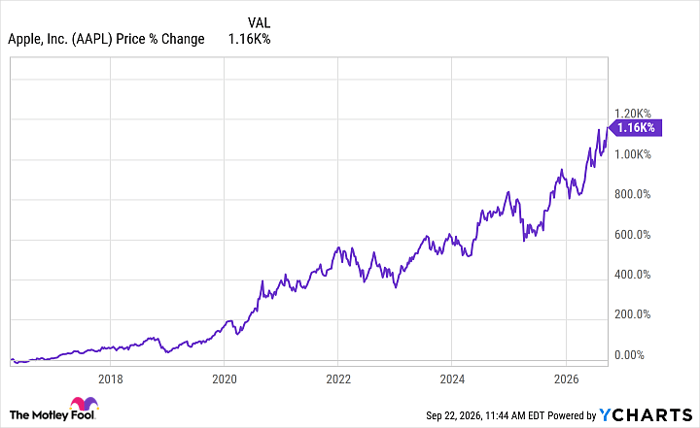
AAPL data by YCharts
Apple has been an interesting large tech stock when it comes to artificial intelligence (AI). It hasn't exactly been at the cutting edge in its AI strategy, and it also hasn't gone all in on building data centers.
Apple should be able to leverage its existing products and future innovations to bring AI to consumers, so I don't think the company is in a bad place at all when it comes to AI.
American Express: 12.9%
One could argue that Berkshire's position in American Express (NYSE: AXP) doesn't get enough attention, but it's been one of Buffett's longest-held holdings.
Berkshire completed its initial $1.3 billion purchase of American Express stock in 1995 and hasn't sold a share since. Amex is another company that Buffett believes has a truly special brand. And it's true that owning an American Express Platinum or Gold card has really become a status symbol, which is why the company can charge such high annual subscription fees.
Amex is also unique in that it's not just a company extending credit to consumers; it also runs a closed-loop global payments system, routing transactions between businesses and consumers and acting as a card issuer, lender, and merchant acquirer.
There aren't too many businesses that can replicate this model, especially at Amex's scale, and it enables the company to generate capital-light fee income and interest income from its cards.
The business generates high returns on equity and continues to add millions of new members each quarter.
Coca-Cola: 9.8%
Much like Amex, Berkshire began purchasing Coca-Cola (NYSE: KO) in the 1980s and hasn't sold a share since completing its 400 million-share purchase.
It's a business that the Berkshire team understands extremely well -- it's more of a rock, as opposed to some fast-growth stock. Like Apple and Amex, Coca-Cola has an extremely strong brand, and management has beefed up its beverage portfolio to match shifting consumer preferences.
Coca-Cola is one of the strongest consumer staples stocks, meaning it's typically a place investors turn when they are more concerned about the market or broader economy. The stock has rocketed roughly 25% this year due to strong performance and, to some extent, investors rotating out of AI stocks.
Coca-Cola also has been a steady source of passive income, having increased its annual dividend for 64 consecutive years, putting it in an elite group of stocks known as Dividend Kings, or companies that have raised their payouts for 50 years or more.
Should you buy stock in Apple right now?
Before you buy stock in Apple, consider this:
The Motley Fool Stock Advisor analyst team just identified what they believe are the 10 best stocks for investors to buy now… and Apple wasn’t one of them. The 10 stocks that made the cut could produce monster returns in the coming years.
Consider when Netflix made this list on December 17, 2004... if you invested $1,000 at the time of our recommendation, you’d have $389,154!* Or when Nvidia made this list on April 15, 2005... if you invested $1,000 at the time of our recommendation, you’d have $1,406,303!*
Now, it’s worth noting Stock Advisor’s total average return is 949% — a market-crushing outperformance compared to 214% for the S&P 500. Don't miss the latest top 10 list, available with Stock Advisor, and join an investing community built by individual investors for individual investors.
See the 10 stocks »
*Stock Advisor returns as of September 24, 2026.
American Express is an advertising partner of Motley Fool Money. Bram Berkowitz has no position in any of the stocks mentioned. The Motley Fool has positions in and recommends American Express, Apple, and Berkshire Hathaway. The Motley Fool has a disclosure policy.
Recommended Articles


