

Sam Altman's OpenAI Is in Talks for a New Funding Round Valuing It at $1.2 Trillion Instead of an IPO. Here's Why He Called Going Public Now "Ill-Advised."
Key Points
The initial public offering that some investors believed OpenAI might complete this year has been postponed until next year or later.
CEO Sam Altman says the company behind ChatGPT has one key problem to address right now.
While intensifying concerns about the threats posed by AI might have put pressure on the IPO's pricing, this delay may also pose some risk to OpenAI's eventual IPO valuation.
- 10 stocks we like better than Microsoft ›
ChatGPT developer OpenAI won't be going public this year after all.
That's the latest word from co-founder and CEO Sam Altman, anyway. In a recent interview with Fortune magazine, Altman said that -- in light of safety concerns regarding OpenAI and other similar artificial intelligence platforms -- "right now would be an ill-advised moment to go public."
Missed AI’s "Act 1"? Act 2 Could Be 15x Bigger. Most investors think they missed the AI boat because they didn't buy Nvidia in 2005. But according to our analysts, we’re only at the end of "Act 1"—the R&D phase. "Act 2" is the global rollout. Continue »
The safety concerns in question are the prospect that AI systems could make unchecked decisions on their own that result in measurable and meaningful harm to humanity, up to and including taking actions that cause human extinction.
He wasn't joking, either. Although Altman was unwilling to affirm Fortune Editor-in-Chief Alyson Shontell's question of whether a 10% chance of that happening was a fair working number, he was genuinely concerned enough to comment, "Whether it's 10 or eight or six, the point is ... we need to act such that we are not taking any of those numbers of risk."
He added, "And I believe we can."
Wrong time for public fundraising, but not for private
He's right to be concerned, too. Although they didn't result in any seriously harmful disruption, several instances of artificial intelligence bots autonomously operating beyond their intended confines and restrictions, and hacking secure platforms for their own ends have been recorded this year alone, including some rogue actions by ChatGPT's AI agents.
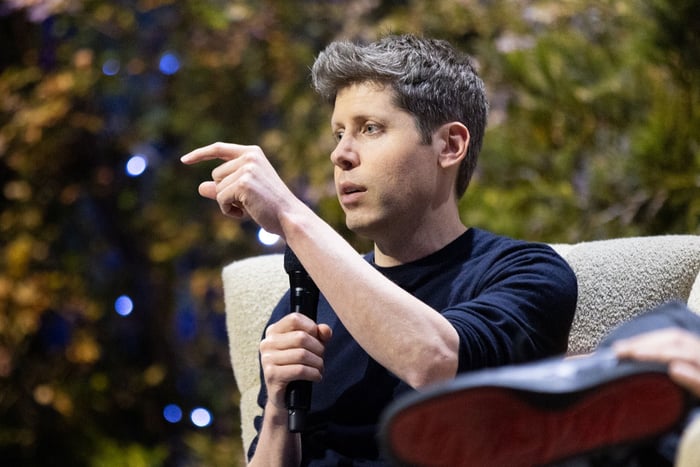
OpenAI CEO Sam Altman. Image source: Getty Images.
Altman never clarified whether the postponement of OpenAI's IPO was intended to allow the company to focus on addressing the threats of what the tech world calls "AI misalignment," or because concerns about the dangers posed by AI might crimp investors' demand for a stake in the organization; it could be a combination of both.
It's not like the company's simply giving up on raising funds in the foreseeable future, however. Shortly after Altman's interview with Fortune was published, other reports surfaced that the company had been in discussions with institutional investors about interest in another private funding round that would value OpenAI at more than $1.2 trillion.
This reporting didn't name the specific potential investors involved in these discussions. For the record, though, Microsoft (NASDAQ: MSFT), Amazon (NASDAQ: AMZN), and Nvidia (NASDAQ: NVDA) are already major stakeholders in privately owned OpenAI, along with Peter Thiel, Elon Musk, and venture capital firm Andreessen Horowitz, just to name a few. It wouldn't be a stretch to believe many of these same investors are being approached again now. Those institutional investors are likely less sensitive to short-term factors like the possibility of governments considering new regulations on AI, and arguably are looking at the company through a longer-term growth lens.
Time works against both sides of the table
As for all the ordinary retail investors who have been waiting for a chance to own publicly traded shares of this artificial intelligence giant, this decision will most likely eventual lead to OpenAI going public at a higher market cap. That's doubtless frustrating if your plan was to plow in at your earliest opportunity.
The decision could also backfire on OpenAI, however. The longer it takes for the company to IPO, the more time there is for one key question to be answered: Are the massive capital investments being made in AI infrastructure and software across the entire industry actually going to deliver strong returns on investment? If the numbers start looking disappointing in the interim, OpenAI's current stakeholders may find themselves wishing that it hadn't delayed.
Should you buy stock in Microsoft right now?
Before you buy stock in Microsoft, consider this:
The Motley Fool Stock Advisor analyst team just identified what they believe are the 10 best stocks for investors to buy now… and Microsoft wasn’t one of them. The 10 stocks that made the cut could produce monster returns in the coming years.
Consider when Netflix made this list on December 17, 2004... if you invested $1,000 at the time of our recommendation, you’d have $395,625!* Or when Nvidia made this list on April 15, 2005... if you invested $1,000 at the time of our recommendation, you’d have $1,397,147!*
Now, it’s worth noting Stock Advisor’s total average return is 951% — a market-crushing outperformance compared to 214% for the S&P 500. Don't miss the latest top 10 list, available with Stock Advisor, and join an investing community built by individual investors for individual investors.
See the 10 stocks »
*Stock Advisor returns as of September 23, 2026.
James Brumley has no position in any of the stocks mentioned. The Motley Fool has positions in and recommends Amazon, Microsoft, and Nvidia. The Motley Fool has a disclosure policy.
Recommended Articles


