


Berkshire's Energy Holdings Are Worth More Than Most Stand-Alone Utilities. Here's the Math.
Key Points
Berkshire Hathaway owns a surprisingly big power utilities business.
Although not a major profit center right now, it could become a significantly more serious contributor.
CEO Greg Abel is particularly knowledgeable about this business.
- 10 stocks we like better than Berkshire Hathaway ›
Berkshire Hathaway (NYSE: BRKA) (NYSE: BRKB) manages a portfolio of hand-picked stocks. You might even keep tabs on these holdings -- and how they change -- in an effort to poach a few ideas for yourself.
What many investors might often forget is that Berkshire's stock holdings are only part of what this company is -- and does. It is first and foremost a conglomerate consisting of several dozen businesses including fast-food chain Dairy Queen, Shaw flooring, Duracell batteries, Fruit of the Loom, GEICO insurance, Pilot travel centers, and more. These wholly owned privatized companies are on pace to contribute nearly $50 billion in net operating earnings this year alone.
Missed AI’s "Act 1"? Act 2 Could Be 15x Bigger. Most investors think they missed the AI boat because they didn't buy Nvidia in 2005. But according to our analysts, we’re only at the end of "Act 1"—the R&D phase. "Act 2" is the global rollout. Continue »
And a big chunk of these profits comes from its energy holdings -- the utility company Berkshire Hathaway Energy in particular.
Where Berkshire's energy business fits in
Berkshire Hathaway Energy isn't the single-biggest Berkshire-owned enterprise by a long shot. That honor still belongs to its insurance operations, followed closely by a large collection of manufacturing, service, and retailing enterprises like Dairy Queen and Pilot.
Berkshire Hathaway Energy is certainly no slouch, though. The parent company to PacifiCorp, MidAmerican Energy, and NV Energy serves 13 million customers and owns an interest in multiple natural gas pipeline networks. It turned a fairly typical $11.2 billion in revenue during the first half of 2026 into pretax earnings of $2.7 billion, and just a little more than $2 billion in after-tax profits. Moreover, the latter half of the year should look about the same, extending long-established steady growth for this business.
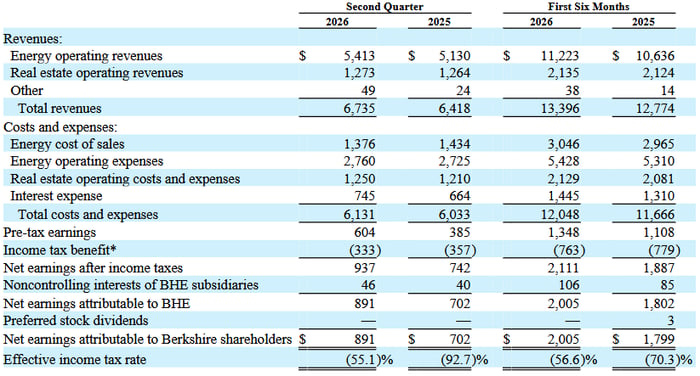
Image source: Berkshire Hathaway's Q2-2026 investor report.
That's not quite as big a mega-utility as Duke Energy, which produced $32.2 billion worth of sales in 2025, $8.6 billion and $4.9 billion of which become operating income and net income, respectively. Southern Company did $29.5 billion in business last year and reported $4.3 billion in net income.
NextEra Energy had $27.4 billion in revenue for 2025 and adjusted earnings of $7.7 billion, while Constellation Energy collected $25.5 billion in revenue in 2025. But Berkshire Hathaway Energy's results fall in right behind these titans' totals.
Don't be surprised to see it close the gap and maybe even eclipse some of its bigger brethren by capitalizing on the current power crunch. CEO Greg Abel said during an interview with CNBC earlier this month that powering artificial intelligence (AI) data centers is a "significant opportunity for Berkshire and Berkshire Hathaway Energy,"https://www.cnbc.com/2026/09/05/abel-two-ways-berkshire-hopes-in-cash-in-on-ai.html, adding that time-consuming work like permitting or site preparation is the big bottleneck right now.
That follows his comments at this year's annual meeting of shareholders, held in May, about one of the core inputs to all those data centers -- hyperscalers -- associated with AI is energy. "Our businesses have that opportunity in front of them at Berkshire Hathaway Energy," Abel added.

Image source: Getty Images.
And while Abel understands Berkshire Hathaway's entire business, he arguably understands its energy arm the best. He was already working as an executive at MidAmerican Energy when Berkshire acquired it in 1999, before changing its name to Berkshire Hathaway Energy in 2014. He might have a special affinity for this particular business, and as such, might be prepared to prioritize its growth.
Look for greater net impact
Energy still accounts for only a small part of Berkshire Hathaway's operating profits. It's on pace to produce about $4 billion in net earnings this year (https://www.berkshirehathaway.com/qtrly/2ndqtr26.pdf), which is only about 10% of the total operating earnings the company is likely to report for 2026. And that's just the privately owned enterprises it operates. Berkshire also still holds about $360 billion worth of individual stocks.
In other words, energy isn't exactly a game changer for the company. In time, though, it could certainly grow into something with a much greater impact on Berkshire Hathaway's total bottom line. It's definitely a division worth watching more closely in the conglomerate's future quarterly reports.
Should you buy stock in Berkshire Hathaway right now?
Before you buy stock in Berkshire Hathaway, consider this:
The Motley Fool Stock Advisor analyst team just identified what they believe are the 10 best stocks for investors to buy now… and Berkshire Hathaway wasn’t one of them. The 10 stocks that made the cut could produce monster returns in the coming years.
Consider when Netflix made this list on December 17, 2004... if you invested $1,000 at the time of our recommendation, you’d have $387,158!* Or when Nvidia made this list on April 15, 2005... if you invested $1,000 at the time of our recommendation, you’d have $1,365,749!*
Now, it’s worth noting Stock Advisor’s total average return is 932% — a market-crushing outperformance compared to 211% for the S&P 500. Don't miss the latest top 10 list, available with Stock Advisor, and join an investing community built by individual investors for individual investors.
See the 10 stocks »
*Stock Advisor returns as of September 19, 2026.
James Brumley has no position in any of the stocks mentioned. The Motley Fool has positions in and recommends Berkshire Hathaway, Constellation Energy, and NextEra Energy. The Motley Fool recommends Duke Energy. The Motley Fool has a disclosure policy.
Recommended Articles


