


Gold reclaims its footing as Oil retreat blunts Fed shock
- Gold rebounds despite Fed hike as Oil weakness caps the US Dollar.
- Ten-year yield nears 5%, keeping bullion upside partly restrained.
- October hike odds and Fed speakers shape next Gold move.
Gold (XAU/USD) price extends its gains on Friday, edging up 0.89% as Oil prices eased despite renewed concerns of supply shortages and despite a week that featured a rate hike by the Federal Reserve (Fed), which pushed the yellow metal to a nearly two-month low of $4,235. XAU/USD trades at $4,379 at the time of writing.
XAU/USD rebounds as softer crude offsets lingering pressure from near-5% yield
The yellow metal remains bid as risk appetite soured amid growing concerns that the Middle East conflict, which involves the US and Iran exchanging attacks in the Persian Gulf, while the Houthis and Saudi Arabia fight in the Red Sea.
Last week, the Houthis, an Iran-backed Yemeni group, attacked the Arabian East-West Oil pipeline, forcing its shutdown. This would delay Oil shipments to buyers in Europe, according to a Bloomberg article, which noted that Saudi Aramco has not confirmed the information.
Despite this, West Texas Intermediate (WTI) continues to trade subdued, capping the Greenback’s advance. The US Dollar Index (DXY), which measures the performance of the buck against six peers, is almost flat at 100.29.
The US 10-year Treasury yield is up nearly six basis points to 4.996%, boosted mostly by the Federal Reserve's 0.25% rate hike on Wednesday, following a unanimous decision.
Worth noting, the dot plot in the Fed’s projection materials showed that most officials expect at least one more rate hike. Fed Chair Kevin Warsh recognized that the economy remains strong, which justified the first rate increase in three years, with the Fed emphasizing the need to achieve the 2% inflation goal.
US data showed that Industrial Production remained flat from July to August at 0% MoM, falling short of July’s 0.2% and the expected 0.3% growth.
Money markets priced in a 55% chance that the Fed would increase rates again at the October meeting, according to Prime Terminal.
Recently, Kansas City Fed President Jeffrey Schmid said he supported the rate hike, noting that inflation continues to trend above 3% and that, excluding inflation, the economy is performing well.
The central bank bonanza ended with the Bank of England holding rates unchanged, while the Bank of Japan opted for a 25-basis-point rate increase to 1.25%.
Next week, the US economic docket will feature speeches by Federal Reserve officials, jobs data, S&P Flash PMIs data and Durable Goods Orders.
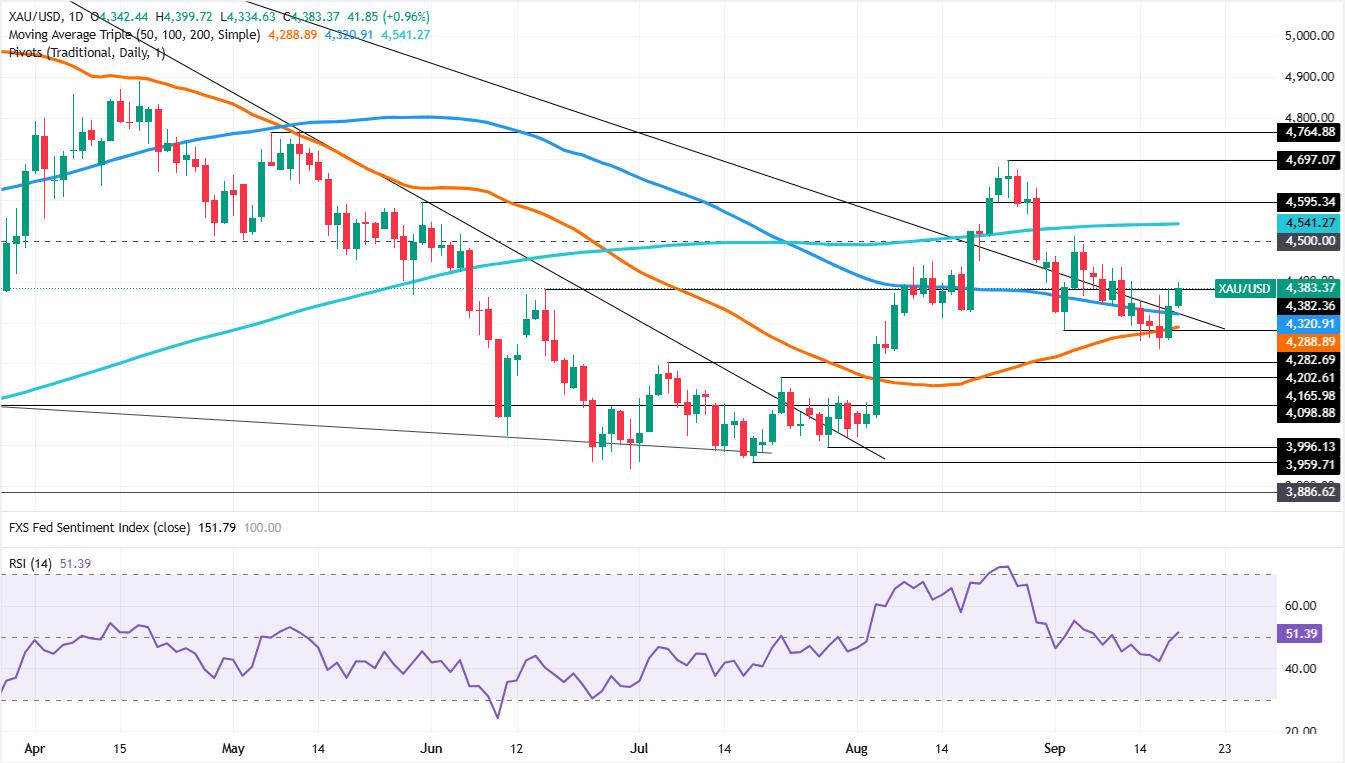
XAU/USD technical analysis: Gold struggles at $4,400; retreats despite remaining positive
Price action shows Gold facing stiff resistance at $4,400, with the yellow metal retreating after reaching a high of the day of $4,399. The Relative Strength Index (RSI) shows momentum favouring buyers, with the index turning bullish.
If XAU/USD clears $4,400, this opens the path to challenge key resistance levels like the $4,450 and $4,500 psychological milestones.
On the flip side, for a bearish resumption, Gold must drop below the 100-day Simple Moving Average (SMA) at $4,320, then the 50-day SMA at $4,288, and finally the September 16 low at $4,235.
Gold FAQs
Gold has played a key role in human’s history as it has been widely used as a store of value and medium of exchange. Currently, apart from its shine and usage for jewelry, the precious metal is widely seen as a safe-haven asset, meaning that it is considered a good investment during turbulent times. Gold is also widely seen as a hedge against inflation and against depreciating currencies as it doesn’t rely on any specific issuer or government.
Central banks are the biggest Gold holders. In their aim to support their currencies in turbulent times, central banks tend to diversify their reserves and buy Gold to improve the perceived strength of the economy and the currency. High Gold reserves can be a source of trust for a country’s solvency. Central banks added 1,136 tonnes of Gold worth around $70 billion to their reserves in 2022, according to data from the World Gold Council. This is the highest yearly purchase since records began. Central banks from emerging economies such as China, India and Turkey are quickly increasing their Gold reserves.
Gold has an inverse correlation with the US Dollar and US Treasuries, which are both major reserve and safe-haven assets. When the Dollar depreciates, Gold tends to rise, enabling investors and central banks to diversify their assets in turbulent times. Gold is also inversely correlated with risk assets. A rally in the stock market tends to weaken Gold price, while sell-offs in riskier markets tend to favor the precious metal.
The price can move due to a wide range of factors. Geopolitical instability or fears of a deep recession can quickly make Gold price escalate due to its safe-haven status. As a yield-less asset, Gold tends to rise with lower interest rates, while higher cost of money usually weighs down on the yellow metal. Still, most moves depend on how the US Dollar (USD) behaves as the asset is priced in dollars (XAU/USD). A strong Dollar tends to keep the price of Gold controlled, whereas a weaker Dollar is likely to push Gold prices up.
Recommended Articles


