


CrowdStrike Stock Price Forecast: Calls for AI Slowdown Unexpectedly Ignite Security Demand, How Much Upside Remains for CRWD?
TradingKey - Anthropic CEO Dario Amodei recently warned about the risk of artificial intelligence running out of control, unexpectedly igniting a rally in cybersecurity stocks.
On September 14, cybersecurity company CrowdStrike (CRWD) became one of the top-performing stocks in the S&P 500 Index, surging 13.8% in a single day and setting a new record closing high.
Amodei believes that the pace of AI model capability improvement is accelerating, and once models acquire "recursive self-improvement" capabilities—meaning they can train, optimize, and develop more powerful versions on their own—the associated risks could rapidly outpace current safety frameworks.
His views were supported by OpenAI CEO Sam Altman as well as Tesla and SpaceX CEO Elon Musk. These remarks raised market concerns that the pace of AI development might slow down, thereby weighing on the valuations of chip and computing power companies, while simultaneously reinforcing another investment thesis: regardless of whether AI progress slows, enterprises will need to allocate more resources to protect, manage, and monitor AI systems.
Why AI Security Warnings Drove CRWD to a New High
The sharp rally in CrowdStrike's stock price does not mean investors view AI risks themselves as a positive; rather, the market expects that the more complex AI systems become, the higher enterprise reliance on cybersecurity platforms will be.
Traditional cybersecurity primarily protects employee accounts, endpoint devices, servers, and cloud workloads. As AI agents enter enterprises, the security perimeter is rapidly expanding. These agents may obtain permissions to query databases, write code, send emails, and even execute transactions; if an identity is stolen, a model is misled, or operational permissions are misconfigured, the impact could be far greater than a standard account breach.
Therefore, enterprises must not only guard against external attacks, but also verify whether the identity, permissions, and behavior of each AI agent comply with requirements, while continuously monitoring their operations. Identity security, data governance, runtime protection, and automated response are transitioning from add-on features into prerequisites for AI deployment.
Evercore ISI analyst Kirk Materne noted that regardless of the pace at which enterprises adopt AI agents, these systems must be protected, governed, and monitored. As the market places greater emphasis on AI security, enterprises may increase investment in identity management, data protection, observability, and cyber defense, thereby boosting the durability of security spending.
This is the primary reason CrowdStrike has attracted capital inflows. Its Falcon platform integrates endpoints, identities, cloud environments, and threat intelligence to provide customers with unified security data and response capabilities. Compared to deploying a fragmented array of standalone tools, a platform-based approach makes it easier to track risks generated when AI agents run across systems.
AI Agents Are Expanding CrowdStrike's Market Space
CrowdStrike is not merely passively benefiting from AI security demand; the company itself is also accelerating the integration of artificial intelligence into its product ecosystem.
Positioned as an intelligent analytics platform for security operations centers, its Charlotte AI can automate alert triage, threat investigation, and response workflows. Unlike ordinary chatbots, Charlotte AI utilizes a multi-agent architecture that can simultaneously analyze endpoint, identity, cloud, and network environments while orchestrating investigations on a unified data foundation.
CrowdStrike has also launched identity management capabilities for AI agents, enabling enterprises to configure independent identities, access permissions, and audit logs for agents. As the number of internal AI agents grows within enterprises, these "non-human identities" may become new security vulnerabilities. Attackers may not necessarily need to compromise employee accounts; simply controlling an AI agent with elevated privileges could allow access to multiple enterprise systems.
Therefore, CrowdStrike's future growth potential is no longer limited to protecting PCs and servers, but is gradually extending to AI agent identity, automated workflows, and runtime security. The company is seeking to upgrade its Falcon platform from a traditional endpoint security tool into a unified security control layer covering human users, machine accounts, and AI agents.
Product materials released by CrowdStrike for Charlotte AI show that the platform can automate high-frequency security tasks and limit the operational scope of agents through privilege management, execution logs, and manual approval mechanisms. AI helps attackers increase attack speed while also helping defenders shorten response times, a dual role that could continuously expand enterprise security budgets.
CrowdStrike Stock Price Technical Analysis
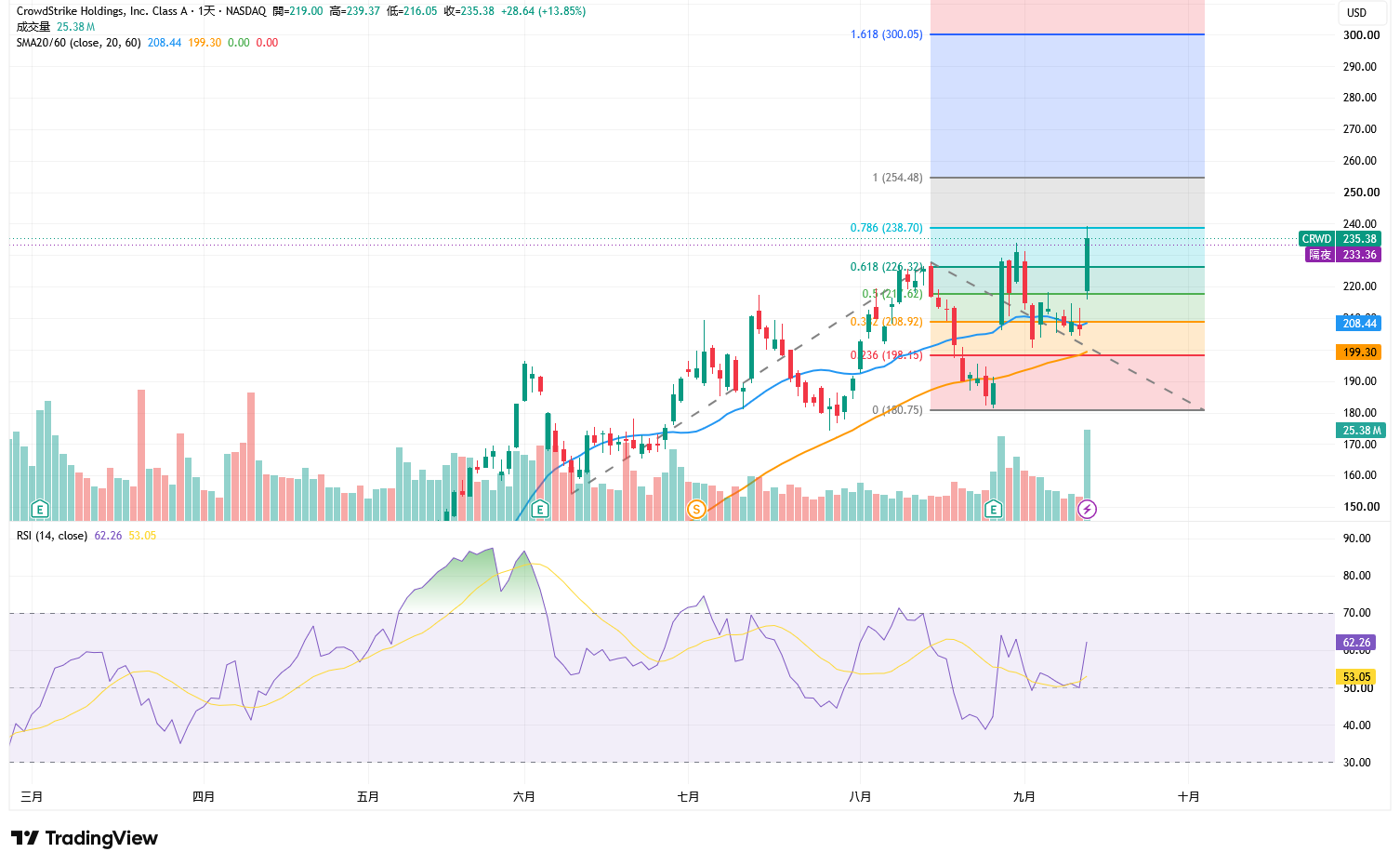
Source: TradingView
Looking at the daily chart, CrowdStrike closed at $235.38 on the 14th, touching an intraday high of $239.37, while trading volume expanded to approximately 25.38 million shares, indicating that the rally was supported by capital inflows and volume. The stock price reclaimed its 20-day moving average of $208.44 and 60-day moving average of $199.30, with the 20-day moving average remaining above the 60-day moving average, signaling that the overall trend has strengthened again.
CRWD is currently testing the 0.786 extension level of $238.70, which together with the $240 psychological level forms a short-term resistance zone. If the stock can close above $240 on strong volume, the breakout rally is expected to continue, with the next target at the 1.0 extension level of $254.48. Therefore, compared to $300, $250–$255 is a more reasonable technical target at this stage.
If CRWD breaks further above $254.48, the 1.272 extension level around $274 can be watched to the upside; the 1.618 extension level of $300.05 represents a strong medium-to-long-term bullish scenario, which gains higher credibility only after the stock sequentially breaks through $240, $254, and $274, and should not be used directly as a short-term target.
In terms of momentum, the 14-day RSI rose to 62.26, standing above the signal line of 53.05, indicating a significant strengthening in buying power while remaining below the overbought threshold of 70. However, given the substantial single-day gain, short-term profit-taking may still occur. On the downside, the first level to watch is $226.32; if the price holds above it after a pullback, the breakout structure remains valid. If it falls below $226, it may further test $217.62 and the 20-day moving average support at $208–$209.
Recommended Articles


