


Why Arm Stock Surged 8% as CEO Expresses More Confidence in $2 Billion AI Chip Demand
TradingKey - Arm Holdings (ARM) surged 8.6% on Thursday, becoming one of the most prominent chip stocks in the Nasdaq market. This rally benefited both from an overall recovery in the tech sector and positive signals released by CEO Rene Haas regarding the company's AI chip business.
In an interview, ARM CEO Rene Haas stated that compared to when the company reported earnings at the end of July, it is now more confident in reaching $2 billion in AI chip demand. Previously, ARM disclosed that customer demand for its first in-house data center chip, the Arm AGI CPU, had already exceeded $2 billion, covering fiscal years 2027 and 2028.
This means the market is re-evaluating ARM's growth potential as it extends from a traditional chip architecture licensor into an AI data center chip supplier.
Meanwhile, AI-related stocks had experienced volatility earlier this week following discussions over whether AI investment is overheating. However, as the market refocused on data center construction and the long-term demand for AI infrastructure, share prices of chip, server, and related hardware companies began to rebound, providing ARM with fresh momentum.
Why Is Arm Stock Soaring?
The core driver of Arm's recent rally lies in the market's renewed focus on the commercialization potential of the Arm AGI CPU.
Unlike in the past when it primarily licensed CPU architecture to chipmakers, Arm officially launched its own data center chip products this year. When the company introduced the Arm AGI CPU in March, it positioned the product as a data center CPU for AI and Agentic AI workloads, thereby entering the chip production market—a space historically unfamiliar to it.
Subsequently, customer feedback repeatedly exceeded initial expectations. In its earnings report released in July this year, Arm stated that customer demand for the Arm AGI CPU for fiscal years 2027 and 2028 had crossed $2 billion, compared with the $1 billion opportunity scale previously disclosed by the company.
Meanwhile, Arm maintained a relatively cautious financial outlook at the time, stating that it had secured sufficient manufacturing capacity to support the $1 billion opportunity while continuing to expand capacity with supply chain partners.
Therefore, the $2 billion figure is not a new sales target suddenly put forward by Arm, but rather the latest scale formed after customer demand grew continuously over several months.
If this demand growth ultimately converts into actual chip shipments, the Arm AGI CPU is expected to bring Arm a new revenue stream distinct from its traditional licensing and royalty businesses. For a company that historically relied primarily on IP licensing and chip royalties, this means its revenue structure itself could undergo a fundamental shift.
Arm Data Center Business Accelerates; AI Story Is More Than Just a Single Chip
ARM's AI logic does not actually rely entirely on the Arm AGI CPU.
The company's latest financial report shows that for the first fiscal quarter ended June 30, 2026, ARM's revenue reached $1.289 billion, up 22% year-on-year. Among this, licensing and other revenue was $574 million, up 23% year-on-year; royalty revenue reached $715 million, up 22% year-on-year. Notably, data center-related royalty revenue more than doubled year-on-year, indicating that the penetration of the Arm architecture in the server and cloud computing markets continues to accelerate.
This is also a key reason why the market is re-evaluating ARM.
If AI data center expansion continues, ARM can actually benefit from two avenues. On the one hand, an increasing number of data center chips adopting the Arm architecture can drive growth in traditional IP licensing and royalty businesses. On the other hand, the Arm AGI CPU allows the company to directly participate in data center chip sales, thereby opening up a new revenue channel.
ARM has previously disclosed that cumulative shipments of its Arm Neoverse data center business are growing rapidly. The company's latest letter to shareholders shows that shipments of Neoverse chips have exceeded 1.5 billion units, with the most recent 500 million units taking only 9 months, compared to about 6 years for the first 1 billion.
Therefore, from a business model perspective, ARM's current AI opportunity is not a bet on the success of a single chip, but rather that the expansion of AI infrastructure is simultaneously driving its IP, CPU architecture, and in-house chip businesses.
ARM Stock Price Technical Analysis
Source: TradingView
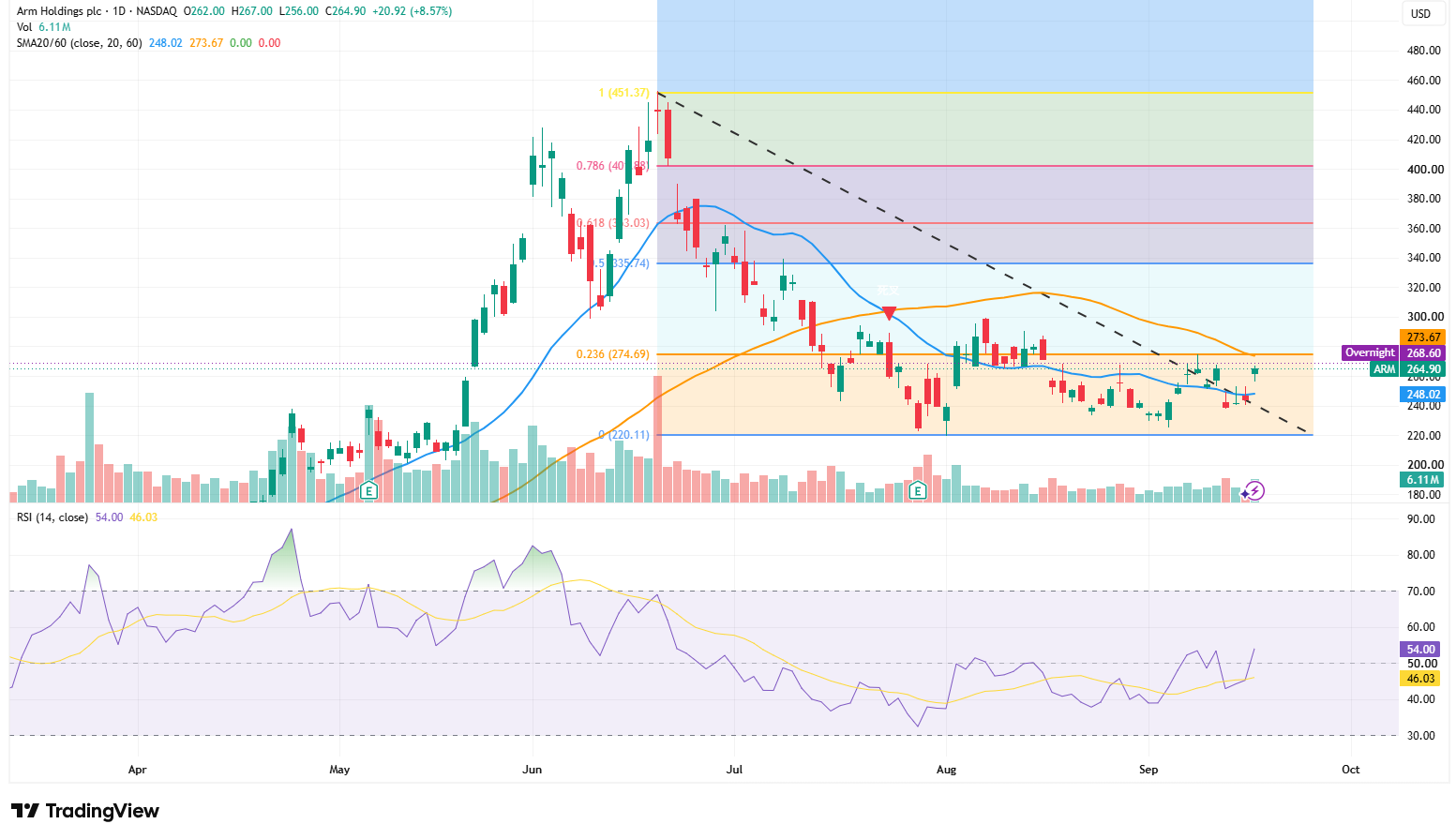
From a technical standpoint, ARM has broken above the downtrend line extending from its high of $451.37 and reclaimed its 20-day moving average at $248.02, indicating that the downtrend of the past several months is improving. Daily trading volume rose to approximately 6.11 million shares, providing volume support for the breakout.
However, ARM has not yet completed a medium-term reversal. The stock price remains below the 60-day moving average of $273.67, while the 0.236 Fibonacci level sits at $274.69, together forming a key resistance zone at $273–$275. The after-hours price of around $268.60 has also yet to break above this level.
In terms of momentum, the 14-day RSI rose to 54.00, above its signal line of 46.03, indicating that buying power is strengthening while remaining below the overbought zone. If ARM holds firm above $275 on higher volume going forward, the next target could be $300–$305; a further breakout could see the stock test the 0.5 Fibonacci level at $335.74.
On the downside, initial support lies at $248–$250, a zone containing the 20-day moving average and the breakout point of the downtrend line. If this level holds after a pullback, the rebound structure remains intact; if the daily chart falls back below $248, this rally could turn into a false breakout, with the stock potentially falling back to $235–$240 or even retesting the low of $220.11.
Recommended Articles


