


Warren Buffett Has More Than 50% of His Portfolio in These 3 Stocks. Which One Is the Best Buy Today?
Key Points
Apple has a great compounding business, and the iPhone Duo could help spark growth.
American Express' close-loop systems and affluent customer base give it a big edge.
Alphabet's complete AI stack, distribution, and ad network are huge advantages.
- 10 stocks we like better than American Express ›
While he stepped down as CEO of Berkshire Hathaway at the end of last year, Warren Buffett's wealth, and thus his portfolio, is still tied to the conglomerate and its stock portfolio. On that end, Berkshire's top-three positions -- consisting of Apple (NASDAQ: AAPL), American Express (NYSE: AXP), and Alphabet (NASDAQ: GOOG) (NASDAQ: GOOGL) (Nasdaq) -- make up more than half of its equity portfolio.
All three are strong compounding businesses with wide moats, but which looks like the best of the group to buy today? Let's take a look at each.
Missed AI’s "Act 1"? Act 2 Could Be 15x Bigger. Most investors think they missed the AI boat because they didn't buy Nvidia in 2005. But according to our analysts, we’re only at the end of "Act 1"—the R&D phase. "Act 2" is the global rollout. Continue »
1. Apple
Apple is Berkshire's largest holding, making up about 22% of its portfolio. The stock is a Buffett favorite because it has one of the best compounding business models out there.
Apple, of course, is best known for its iPhone and other devices. Smartphones and computers tend to have very predictable replacement cycles, which creates an almost recurring type of revenue stream for the company. However, the beauty of the business stems from its closed-garden ecosystem that helps lock in consumers, from which it then collects high-margin service revenue. This revenue comes from a variety of sources, including a search revenue-sharing deal with Alphabet, commissions on app downloads, Apple Pay, and subscriptions for things like cloud storage.
Apple has a great business model, and the recent introduction of its foldable smartphone, the iPhone Duo, could become another growth driver for the company. While foldable smartphones are not new, Apple's elegant hardware and software design are likely to invigorate the category and bring new customers into the fold.
2. American Express
American Express makes up over 17% of Berkshire's portfolio and is another great example of a strong compounding business. The charge card provider has become a status symbol for the wealthy, charging higher fees for affluent members to join its ranks in exchange for certain perks and privileges. Meanwhile, because its members spend three times more on average than other consumers, the company also gets higher fees from retailers as well.
Similar to Apple, American Express also controls the ecosystem. It runs a closed-loop system, where it acts as both the card issuer and payment network, letting it profit from both sides of the transaction and getting an enormous wealth of data. The bulk of its cards are issued to wealthy clients, and many are charge cards that must be paid off each month, limiting credit risk. American Express' business just continues to compound through the addition of more members and with spending naturally increasing over time.
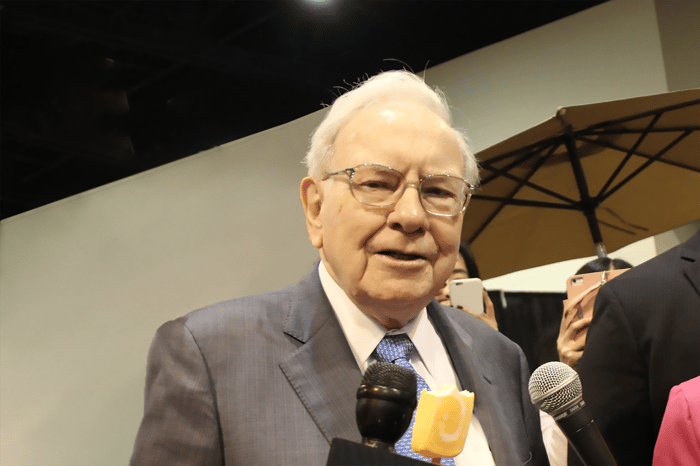
Image source: The Motley Fool.
3. Alphabet
Alphabet is Berkshire's third-largest holding, making up nearly 13% of its stock holdings. This was Buffett's last big investment idea before he "retired," and his successor, Greg Abel, has added to the position under Buffett's advisement.
Alphabet's biggest advantage is its comprehensive artificial intelligence (AI) stack, control over distribution channels, and strong ability to monetize consumers through its ad network. The company's custom AI chips give it a significant cost advantage in the cloud space, enabling it to recoup its AI infrastructure spending within a year when it uses its own chips. Selling these chips through its partner Broadcom to Anthropic is also becoming a large business, while it greatly reduces training and inference costs with its own models.
Alphabet then applies its models across its business, including Google Search. Here, its Gemini model is helping drive growth through new AI tools like AI Overviews and AI Mode. Meanwhile, Alphabet has a huge distribution edge through its ownership of the Chrome browser, Android smartphone operating system, and a revenue-sharing deal to be the default search engine on Apple devices.
The verdict
All three stocks have great businesses and are solid stocks to own, but if I had to choose one, it would be Alphabet. It is the cheapest stock on a forward price-to-earnings (P/E) basis, trading under 17 times, while it also has arguably the best long-term growth prospects.
Should you buy stock in American Express right now?
Before you buy stock in American Express, consider this:
The Motley Fool Stock Advisor analyst team just identified what they believe are the 10 best stocks for investors to buy now… and American Express wasn’t one of them. The 10 stocks that made the cut could produce monster returns in the coming years.
Consider when Netflix made this list on December 17, 2004... if you invested $1,000 at the time of our recommendation, you’d have $412,074!* Or when Nvidia made this list on April 15, 2005... if you invested $1,000 at the time of our recommendation, you’d have $1,314,319!*
Now, it’s worth noting Stock Advisor’s total average return is 932% — a market-crushing outperformance compared to 209% for the S&P 500. Don't miss the latest top 10 list, available with Stock Advisor, and join an investing community built by individual investors for individual investors.
See the 10 stocks »
*Stock Advisor returns as of September 17, 2026.
American Express is an advertising partner of Motley Fool Money. Geoffrey Seiler has positions in Alphabet. The Motley Fool has positions in and recommends Alphabet, American Express, Apple, and Berkshire Hathaway. The Motley Fool has a disclosure policy.
Recommended Articles


