


Oracle vs. Broadcom: Which "Picks and Shovels" AI Stock Has the Bigger Growth Runway From Here?
Key Points
Oracle and Broadcom have been growing at a nice clip due to the critical role they play in AI data centers.
Both companies are poised for accelerated growth.
Their attractive valuations and strong earnings growth potential could send them soaring in the long run.
- 10 stocks we like better than Broadcom ›
Oracle (NYSE: ORCL) and Broadcom (NASDAQ: AVGO) are two critical players in the global artificial intelligence (AI) infrastructure ecosystem, but both companies have been underperforming on the stock market.
While Broadcom stock has dropped 5% over the past year, shares of Oracle have lost nearly 52% of their value. However, both companies have been growing at a solid pace. That's not surprising, as Broadcom's chips and Oracle's data centers are playing a central role in the proliferation of AI.
Missed AI’s "Act 1"? Act 2 Could Be 15x Bigger. Most investors think they missed the AI boat because they didn't buy Nvidia in 2005. But according to our analysts, we’re only at the end of "Act 1"—the R&D phase. "Act 2" is the global rollout. Continue »
We will take a closer look at the prospects of both tech stocks in this article and check which one of them is a better pick-and-shovel play to capitalize on the AI boom right now.

Image source: Getty Images.
The market hasn't been giving Oracle and Broadcom enough credit for their solid growth and prospects
Oracle and Broadcom provide key building blocks for AI data centers. Broadcom's custom AI processors and networking chips are being deployed by major hyperscalers and AI companies in data centers. Oracle, on the other hand, is providing infrastructure-as-a-service (IaaS) to customers by aggressively building new data center capacity.
The importance of these companies in the AI ecosystem can be gauged from their impressive growth rates. Broadcom's AI semiconductor revenue increased by 221% year over year in the third quarter of fiscal 2026 (which ended on Aug. 2) to $16.7 billion. This robust growth led to an 86% year-over-year increase in Broadcom's top line to $19.6 billion.
Broadcom is on track to finish fiscal 2026 with AI revenue of $58 billion, up 186% over last year. Even better, Broadcom sees its AI revenue jumping to $115 billion in fiscal 2027 and $230 billion in fiscal 2028. So, the company expects its AI chip revenue to double in each of the next two fiscal years. The healthy increase in Broadcom's AI revenue will also boost its bottom line.
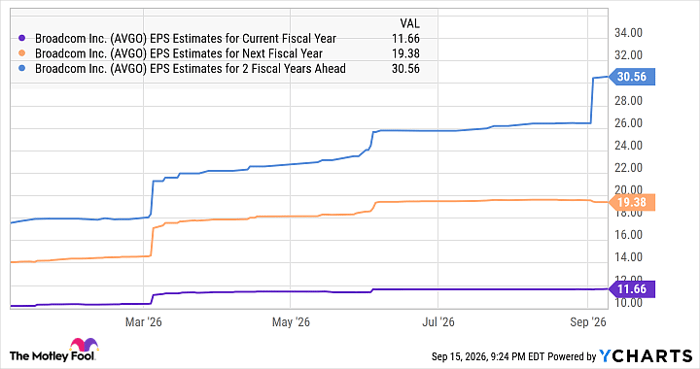
Analysts expect Broadcom's earnings to increase by 70% in fiscal 2026 to $11.66 per share, followed by solid double-digit growth over the next couple of years.
Data by YCharts
The fiscal 2028 earnings per share estimate is almost in line with the company's guidance of $30.00. Broadcom's strong earnings power is likely to inject life into the stock following its underperformance over the past year. A similar story could unfold for Oracle. After all, customers have been lining up to rent AI data center capacity from the company.
Its cloud infrastructure revenue increased by 121% in the first quarter of fiscal 2027 to $7.4 billion. Importantly, Oracle reported remaining performance obligations (RPO) of $664 billion at the end of fiscal Q1, a big jump over the year-ago period's reading of $455 billion. RPO is the total value of unfulfilled contracts at the end of a quarter, and the size of this metric clearly indicates that Oracle's cloud infrastructure business has incredible room for growth.
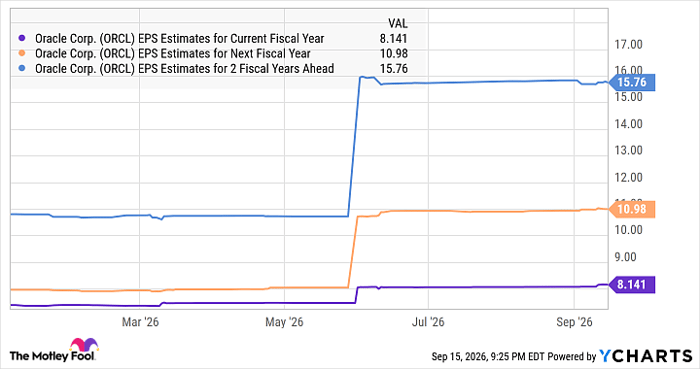
Oracle is focused on quickly adding more data center capacity so that it can accelerate the conversion of its backlog into revenue. The company expects to convert half of its RPO into revenue over the next three years. That would amount to $332 billion in revenue over the next three years, pointing to a significant improvement over fiscal 2026's annual revenue of $67.4 billion.
The uptick in Oracle's top-line growth will translate into stronger bottom-line performance, as evidenced by the following chart.
Data by YCharts
So, it is clear that both these AI pick-and-shovel plays are primed to deliver robust earnings growth over the long run. That's why we will take a closer look at their valuations to check which one of them is capable of delivering more upside.
The verdict
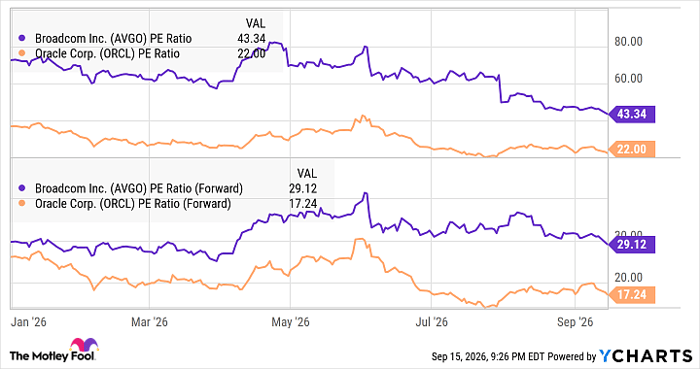
Oracle is cheaper than Broadcom based on their price-to-earnings ratios.
Data by YCharts
However, Broadcom is clocking significantly faster earnings growth than Oracle, and that justifies the premium it trades at. While Broadcom's earnings per share increased by 96% year over year in the previous quarter to $3.32, Oracle clocked 30% growth to $1.92. Moreover, Broadcom's earnings are poised to grow at a faster pace than Oracle's over the next couple of years, as evidenced by the consensus estimates shown in the charts above.
So, investors looking for an AI stock with stronger growth prospects could consider buying Broadcom stock right now, especially given its healthy upside potential. However, those looking for a cheaper way to play the AI boom can consider investing in Oracle as well. The projected acceleration in Oracle's earnings growth could lead the market to reward it with a premium multiple, paving the way for healthy upside.
In the end, investors won't go wrong with either of these AI infrastructure stocks, and they can consider buying one or both, depending on their risk profile.
Should you buy stock in Broadcom right now?
Before you buy stock in Broadcom, consider this:
The Motley Fool Stock Advisor analyst team just identified what they believe are the 10 best stocks for investors to buy now… and Broadcom wasn’t one of them. The 10 stocks that made the cut could produce monster returns in the coming years.
Consider when Netflix made this list on December 17, 2004... if you invested $1,000 at the time of our recommendation, you’d have $412,074!* Or when Nvidia made this list on April 15, 2005... if you invested $1,000 at the time of our recommendation, you’d have $1,314,319!*
Now, it’s worth noting Stock Advisor’s total average return is 935% — a market-crushing outperformance compared to 210% for the S&P 500. Don't miss the latest top 10 list, available with Stock Advisor, and join an investing community built by individual investors for individual investors.
See the 10 stocks »
*Stock Advisor returns as of September 17, 2026.
Harsh Chauhan has no position in any of the stocks mentioned. The Motley Fool has positions in and recommends Broadcom and Oracle. The Motley Fool has a disclosure policy.
Recommended Articles


