


Boeing Stock Breaks $204.50 as Production Delays Put $197 Support in Focus
TradingKey - Boeing closed at $201.96 on September 16, losing 3.69% from the previous day. It is almost identical to the supplied closing price of $201.94. Investors reacted negatively to Boeing CEO, Kelly Ortberg’s, comments about the production of the 737 MAX. Ortberg said Boeing is having trouble stabilizing production at 47 737 MAX aircraft per month, not that current production is 19 per month. Further, he said that production of the 787 is also increasing at a slower rate than expected. While demand for Boeing aircraft is very robust (as evidenced by Boeing’s record backlog), the real problems are generating cash flow to fund that ramp and meeting that demand in a timely manner.
737 MAX Production Is the Immediate Concern
Orbregk stated that Boeing is having issues with the production of wings, which limits the company’s ability to increase 737 MAX production to 47 per month. The company is aiming to increase production to 52 per month by 2027.
Each 737 delivery helps Boeing generate cash, and disruptions to the 737 production schedule reduces Boeing cash flow. Order disruptions impact the timing of cash inflows.
The recent decline in Boeing stock shows how cash flow sensitivity. The recent order disruptions caused by the Federal Aviation Administration’s (FAA) directive did not impact orders.
787 Ramp Is Also Slower Than Hoped
Boeing currently produces eight 787s a month and would like to increase production to 10 per month. Constraints caused by a lack of engines and the certification of premium cabin seats limit monthly production.
Boeing expects to deliver 90-100 787s this year. Just 4 787 deliveries occurred in August.
Narrowbody plane production is less profitable and limits cash flow. The 787 is marginally better. Further delays to production will increase the time before the delivery of planes recovers cash flow.
Free Cash Flow Outlook Has Softened
Boeing had previously indicated that it expected 2026 free cash flow in the range of $1 billion to $3 billion. After the recent production update, Boeing’s CEO Kelly Ortberg said about $2 billion is now a more reasonable expectation and that reaching $3 billion is highly unlikely.
A decline from $3 billion to $2 billion is not surprisingly bad, but it is a decline, and Boeing will really need to achieve positive free cash flow on a consistent basis to reduce its current net debt position of approximately $26 billion.
Until free cash flow and debt reduction positively trend for Boeing, I will utilize an unconventional valuation method to determine value, and will disregard conventional valuation methods.
Demand Remains Exceptional
On the other hand, Boeing’s order outlook is extremely positive. On September 16th, Boeing and Korean Air announced a $36.2 billion (list price) order for 103 Boeing aircraft. Additionally, Boeing is reportedly on the verge of finalizing a 150 737 MAX order with Turkish Airlines.
These reports all suggest the same thing: current demand does not constraint production.
Boeing finished the second quarter with the most orders in its history, including a record $597 billion commercial-airplane backlog; total company backlog was $715 billion. As of August, Boeing had delivered 418 commercial aircraft year to date.
Boeing has little trouble finding customers, it has issues delivering the planes that have already been purchased.
MAX 10 Certification Could Be the Next Positive Catalyst
The certification of the MAX 10 would benefit Boeing, as it would increase Boeing’s ability to fulfill orders against direct competition from the A321neo.
The MAX 7 received its certification earlier this year, so MAX 10 Certification would remove another regulatory hurdance, and perhaps facilitate more orders from airlines. The MAX 7 was certified by the FAA on August 3, 2026, while the MAX 10 had completed its final planned certification flight and was still awaiting final approval.
Delays and increasing costs of the 777x means it is likely Boeing's next generation aircraft will not be delivered to customers until 2027.
Q2 Showed Real Financial Improvement
Boeing's Q2 of 2026 reported Free Cash Flow of $631 million and revenue of approximately $24.56 billion. Free cash flow was positive for the quarter, although first-half 2026 free cash flow remained negative at $823 million. The Commercial Airplanes segment's revenue was $11.75 billion and operating loss was $322 million.
The Global Services segment continued its strong performance with revenue of approximately $5.34 billion and an operating margin of approximately 18.1% for the second quarter. The Defense, Space and Security segment also reported an increase in revenue; however, charges from fixed-price development programs negatively impacted the segment's operating margin.
Boeing Commercial Airplanes continues to negatively impact Free Cash Flow. While various programs continue to improve Free Cash Flow, the Commercial Airplanes segment is expected to drive the largest and most rapid improvements.
Boeing Technical Analysis: $197.12 Is the Immediate Downside Test
Boeing Company's stock closed at $201.96 on September 16, 2026. The stock broke below the support level of $204.53. The session low was $197.01, almost exactly testing the $197.12 support level. The stock is expected to test $189.35 in the near-term.
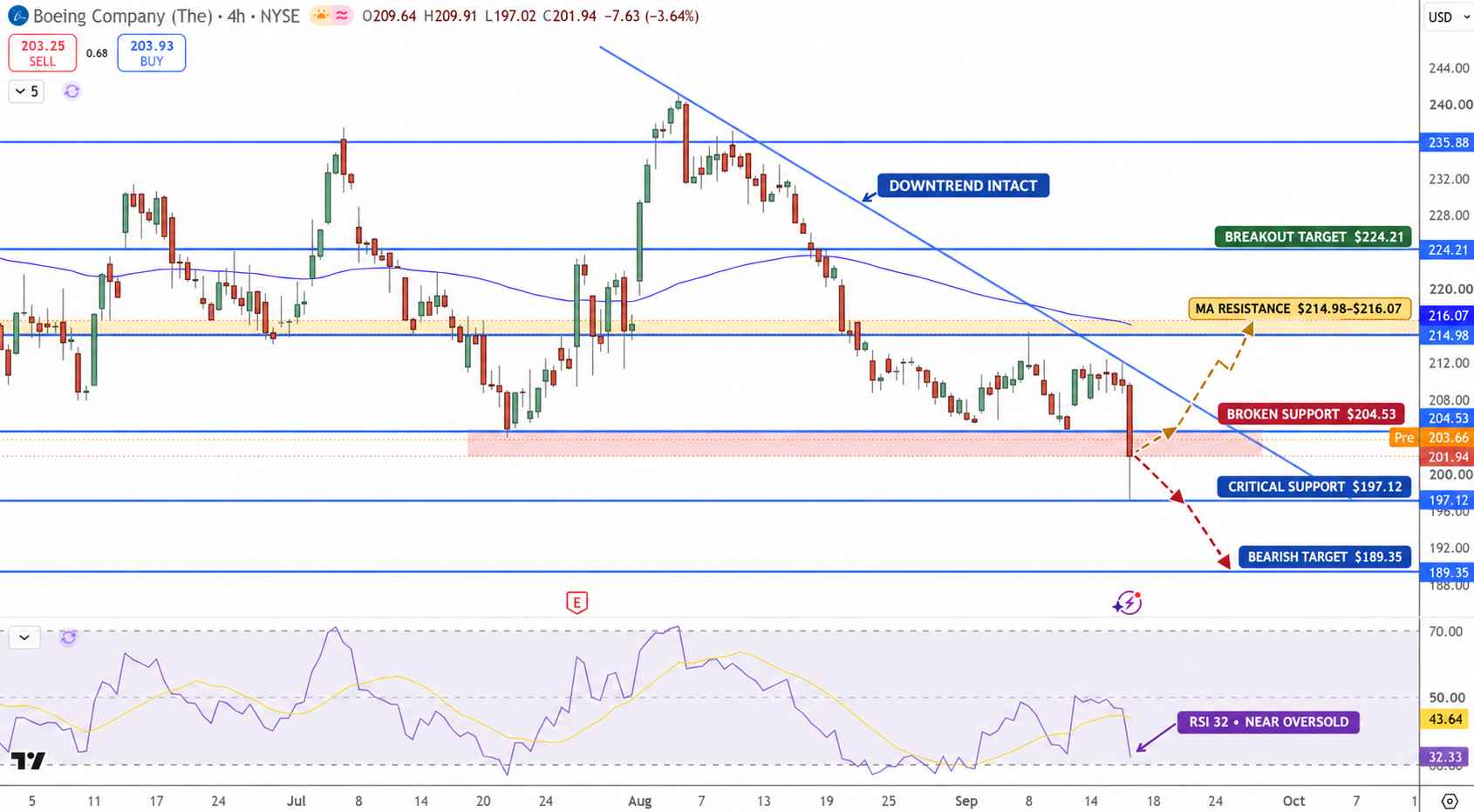
Boeing Stock Price Chart - Source: Tradingview
Continuing bearish sentiment is supported by the Relative Strength Index (RSI) of 32. RSI of 30 indicates that the stock is oversold. RSI around 32 is near, but not yet below, the 30 oversold threshold. From the oversold condition, a brief bounce is expected.
The oversold condition was last observed at $197.12. Further bearish movement is expected to carry the stock to $189.35.
Should the oversold condition continue, first resistance is expected at the support turned resistance level of $204.53. A break above this level would carry the stock to $214.98 and $216.07. A strong close above the resistance levels of $214.98 and $216.07 would shift the overall bearish trend to a bullish trend.
Key Levels
· Latest Complete Close: $201.96
· Immediate Support: $197.12
· Next Downside Target: $189.35
· First Resistance: $204.53
· Major Recovery Zone: 214.98-216.07
· Higher Resistance: $224.21
· RSI: Around 32, near oversold
Why is Boeing stock in focus now?
Boeing declined by 3.69% after the company stated the ramp up in 737 MAX production to 47/month and the 787 production ramp to 10/month was taking longer than anticipated. Slower production also negatively impacted 2026 Free Cash Flow estimate to ~$2 billion from prior estimates of up to $3 billion. Boeing also reported a record order backlog of ~715billionforthetotalcompany,including~597 billion at Commercial Airplanes and more orders for large aircraft.
What level confirms a BA recovery?
The initial point of selling pressure easing is expected at $204.53. Selling pressure would easing more substantially if the 214.98-216.07 recovery zone were to be tested. A break below $197.12 would support the bear case and target $189.35.
Bottom Line
Boeing's production and cash flow issues for 2026 are at the forefront for the near-term. Although Boeing has a record order backlog, and continuous large aircraft orders, rapidly converting those orders to production and cash flow positon remains a challenge. Recent production delays for both the 787 and 737 MAX remain more important than new customer orders. From a Trend following perspective, $197.12 is the key near-term support, while $204.53 is now first resistance. A break below $197.12 would support the bear case and target $189.35.
Recommended Articles


