


Warren Buffett Is Sounding Off on Market Risk and Investors Should Listen
Key Points
Warren Buffett is cautious about current market valuations and speculative behavior.
Berkshire Hathaway has a significant position in Alphabet, signaling confidence in one of the better-positioned hyperscalers.
- 10 stocks we like better than Alphabet ›
Warren Buffett has given a couple of interviews to CNBC in recent months that have provided some fascinating color on the state of the markets. Tangentially, they touched on the biggest debate in the market right now: the sustainability of the artificial intelligence (AI) spending boom and its implications for stocks like Alphabet (NASDAQ: GOOGL) (NASDAQ: GOOG) and Oracle (NYSE: ORCL).
My take on it is that there's definitely reason for near-term caution, but investors should look to take advantage of any significant market-led weakness. Here's why.
Missed AI’s "Act 1"? Act 2 Could Be 15x Bigger. Most investors think they missed the AI boat because they didn't buy Nvidia in 2005. But according to our analysts, we’re only at the end of "Act 1"—the R&D phase. "Act 2" is the global rollout. Continue »
What Warren Buffett said
In the first interview in May, Buffett noted that "we've never had people in a more gambling mood than now. But that doesn't mean that investing is terrible. It does mean that prices for an awful lot of things will look very silly."
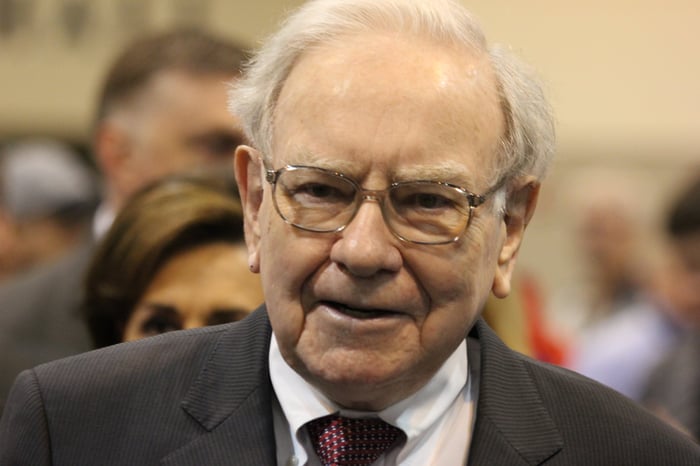
Image source: The Motley Fool.
A month later, Buffett was asked about Berkshire Hathaway's (NYSE: BRKA) (NYSE: BRKB) aggressive purchasing of Alphabet stock in 2026, a position that now represents about 12.6% of its public equity holdings. Buffett confirmed he had initiated it, with the decision made by Greg Abel.
Naturally, the interviewer then tried to discern why Buffett was comfortable buying Alphabet over other hyperscalers that are currently spending heavily on AI-related capital expenditures. Buffett's response was: "Yes, well, I don't want to sit around knocking the others. They don't have any choice, yes," and then confirmed he meant capital spending, before going on to say: "They're now playing a game in many cases where they, or some cases where they're playing a game they don't want to play."
What it means to the AI debate
Reading between the lines, it appears that Buffett is cautious on equity market valuations right now. He's also mindful that some hyperscalers have no choice but to invest heavily in AI, even if they might not want to. However, he's happy for Berkshire to build a near $38 billion position in one hyperscaler: Google's owner, Alphabet.
What the market is worried about
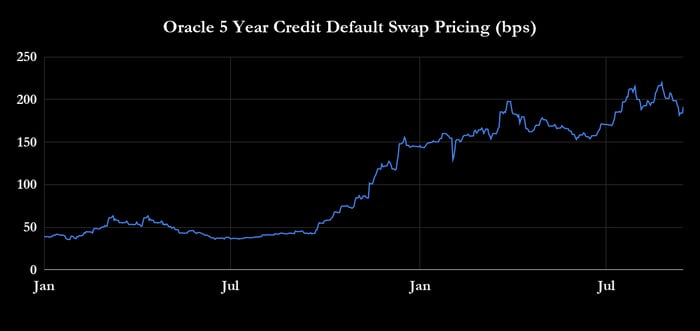
Based on the rising cost of insuring Oracle's debt against default, as measured by credit default swap pricing, bond markets are pricing in the possibility of a default. To put the current mid-market CDS spread of 192 basis points (where 100 basis points equals 1%) into context, the market usually assumes a 40% recovery rate on defaulted debt.
As such, the market implied default risk in one year is 3.2%. Cumulatively over five years, it's 14.8%.
Data source: S&P Global Market Intelligence, chart by author.
Those concerns stem from Oracle's exposure to OpenAI and the rising cost of its AI build-out. Moreover, as S&P Global Ratings noted when downgrading its rating on Oracle debt from BBB to BBB- (its lowest investment-grade rating), an industry downturn would result in Oracle performing "worse than other hyperscalers," and "Its competitors also generally have greater financial flexibility to outspend Oracle and weather industry downturns."
What it means to investors
Here's the thing: There's a risk of market effect from a slowdown in AI-related spending by hyperscalers with weaker balance sheets and underlying businesses than Alphabet's.
Although Buffett/Berkshire hasn't laid out an AI thesis, Berkshire's massive position in Alphabet should give investors confidence that there might not be a major economic contraction stemming from issues at weaker hyperscalers. As such, the correct response to any significant market-led weakness could be to buy into it with selected higher-quality stocks like Alphabet.
Should you buy stock in Alphabet right now?
Before you buy stock in Alphabet, consider this:
The Motley Fool Stock Advisor analyst team just identified what they believe are the 10 best stocks for investors to buy now… and Alphabet wasn’t one of them. The 10 stocks that made the cut could produce monster returns in the coming years.
Consider when Netflix made this list on December 17, 2004... if you invested $1,000 at the time of our recommendation, you’d have $412,074!* Or when Nvidia made this list on April 15, 2005... if you invested $1,000 at the time of our recommendation, you’d have $1,314,319!*
Now, it’s worth noting Stock Advisor’s total average return is 935% — a market-crushing outperformance compared to 210% for the S&P 500. Don't miss the latest top 10 list, available with Stock Advisor, and join an investing community built by individual investors for individual investors.
See the 10 stocks »
*Stock Advisor returns as of September 17, 2026.
Lee Samaha has no position in any of the stocks mentioned. The Motley Fool has positions in and recommends Alphabet, Berkshire Hathaway, Oracle, and S&P Global. The Motley Fool has a disclosure policy.
Recommended Articles


