


Palantir Calls Q2 "Otherworldly" and Raises Guidance — Will Jackson Hole Derail the AI Sovereignty Momentum?
TradingKey - Palantir Technologies (PLTR) started 2026's second half with impressive commercial AI results. Second-quarter revenue came in at $1.94 billion with a 93% increase over the previous year and beat analyst expectations of $1.8 billion. Adjusted earnings per share were $0.41 compared to $0.13 a year ago and analysts' expectation of $0.35.
U.S. Commercial revenue showed the strongest results. U.S. Commercial revenue was up 149% to $764 million and was driven by more enterprise adoption of Palantir’s AI Platform. Palantir raised its full year revenue guidance to a range of $8.15 billion to $8.16 billion, thus expecting an approximately 82% increase. The company also expects U.S. Commercial revenue to be more than $3.424 billion, thus expecting at least a 134% increase.
While a strong case presentation may edge Palantir higher, the stock will be sensitive to market dynamics. The upcoming (August 21-22) Jackson Hole Symposium of the Federal Reserve may affect valuation of technology companies and affect market spending. Currently, PLTR's stock has a weekly breakout above $159.58. So, technically, a target of $205.15 should be achievable with the support of the former resistance.
Q2 Results Strengthen the AI Sovereignty Case
The AI sovereignty strategy is positioned based on demand for organizations that want to leverage advanced AI models while retaining control over sensitive data, critical operational systems, and/or control over key business decisions. This positioning aligns with a variety of government agencies and companies that want to implement AI technologies within their core business.
The 93% growth in revenue suggests that this message is resonating with customers and Palantir is able to maintain especially strong profitability and efficiency while the business expands. Palantir reported a GAAP operating margin of 47% and an adjusted operating margin of 62% for the period.
The company scored 155 on the Rule of 40. This measure assesses the mix of revenue growth and operating profitability. A score above 40 is perceived as positive for software companies. At this rate, there is no doubt that Palantir is executing well. Their strong margins also give the firm the ability to fund product development and customer growth. This is where Palantir has an edge against AI companies that may be growing rapidly, but still show significant operating loss.
U.S. Commercial Revenue Becomes the Main Growth Driver
U.S. Commercial revenue grows 149% year over year and accounts for 39% of total quarterly revenue at $764 million. Two years ago, the total revenue was $306 million. As Palantir is no longer largely reliant on government contracts, it has demonstrated additional growth. The company achieved a total contract value of $3.37 billion. This is an increase of 49% on record breaking U.S. Commercial revenue of $2.13 billion. The remaining deal value for this segment of the business is also an impressive $6.24 billion, double the amount from the previous year.
Reserving deal values do not translate to revenue, as the date of contract value, customer options, and deployment of the product can affect revenue recognition. As deal values increase, we can safely assume signed contracts contribute to growth of revenue at an improved rate. Palantir’s U.S. Commercial revenue equates to future significant business at this projected rate. Management will be better able to plan based on the future business growth. The primary concern will be if management will be able to maintain these contracts and ensure revenue without extending project time or deployment and/or increasing costs.
Jackson Hole Could Affect PLTR’s Valuation
Even though Palantir contracts help with revenue visibility, the stock price reflects the unpredictable nature of interest rates. The stock of high growth tech companies will be valued higher when bond yields decrease, as more value is assigned to future profit growth.
Federal Reserve officials are meeting at Jackson Hole August 21-22, and investors are waiting for clues on inflation, interest rates, and the economy. A hint that the Fed’s policy might ease could help support growth-stock valuations. Some sense that the economy is expanding would help relieve fears that companies will cut AI spending.
A strong policy signal could mean the opposite. Even if Palantir’s operating metrics stay strong, rising interest rates would put pressure on valuation multiples. A more bearish economic outlook would also raise questions about discretionary commercial spending.
Palantir, however, has more protection than many of the companies that rely mainly on spending for transactions. So, from Palantir’s perspective, Jackson Hole might affect valuation, but not likely revenue.
PLTR Breakout Places $205.15 in Focus
Palantir is above the $159.58 level on the weekly chart, ending a long consolidation. Now that it was violated, that level is the first important support.
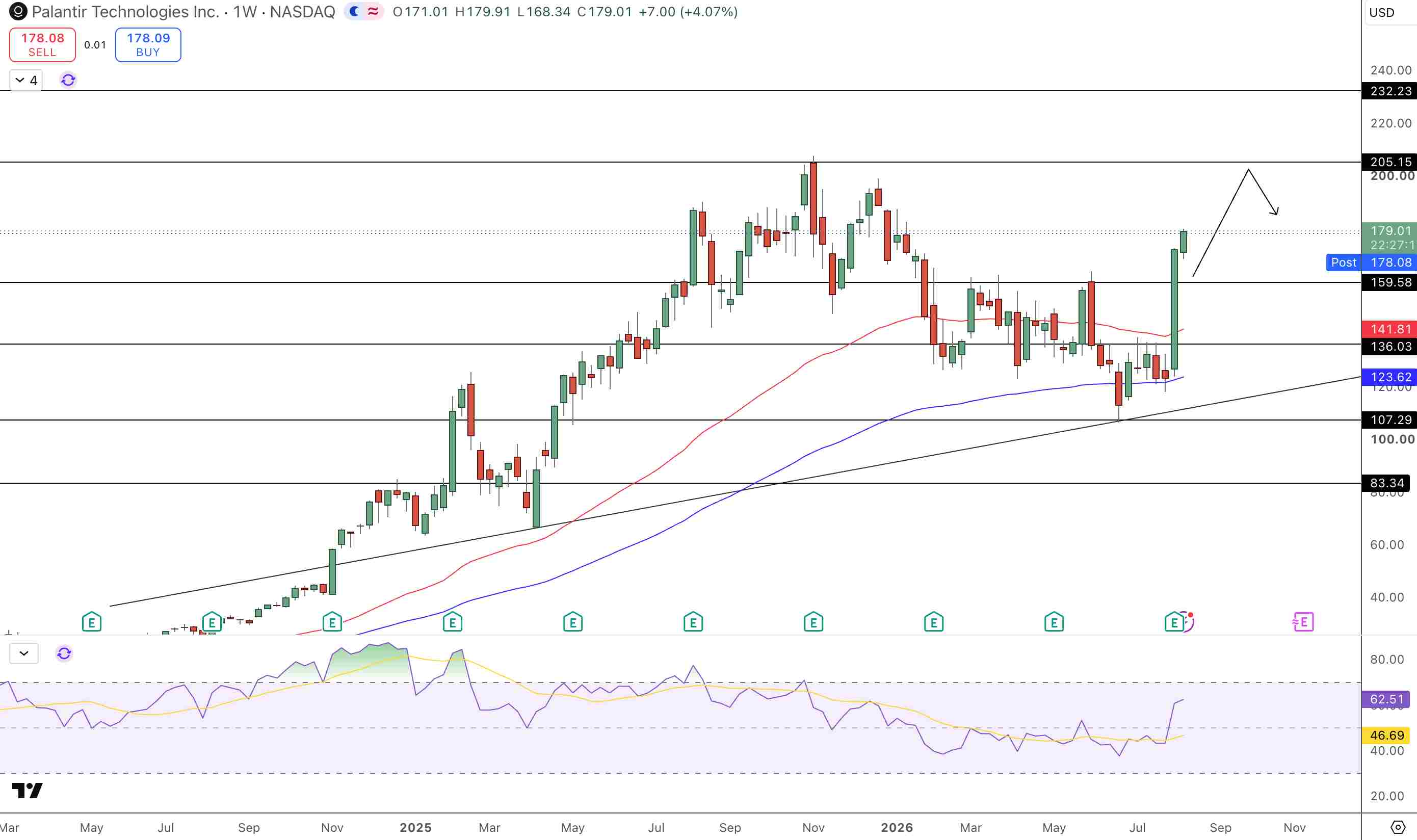
Palantir Price Chart - Source: Tradingview
Shares are above the major weekly moving averages at $141.81 and $123.62, confirming the positive nature of the trading trend. RSI at 63 is above the line (47), so the trend is positive, though, in the short term, some weakness is expected.
Above $205.15 is the next resistance level, with this level also being the previous significant high. A significant higher high would come in at $232.23. $159.58 losing support would also weaken the breakout and bring focus back to the $141.81 to $136.03 support range. The weekly EMA at $123.62 provides additional support.
What Matters Beyond the Fed
Investors want to see if other software and infrastructure stocks also experienced AI budget increases in their recent spending reports. Palantir’s view of enhanced demand is also supported by comments from the cloud companies and semiconductor and software vendors.
Progress is the key to positive contract deals. The growth in remaining deal value is moot if the contracts are not deployed on time and the associated revenue is recognized at an acceptable margin. For an extended period of time, important metrics will include U.S. Commercial growth, customer concentration and contract duration.
Bottom Line: August 16 Weekend Outlook
The investment case for Palantir is now stronger with the company showing 93% revenue growth, 149% US Commercial growth, 62% adjusted operating margin, and $6.24bn of remaining commercial deal value. The company appears to be heading towards the growth the management team anticipates. However, the company’s valuation is holding at a level that assumes that contract conversion and AI demand remain high. From a technical viewpoint, support at $159.58 is still holding. This means that the higher support levels at $205.15 and $232.23 are still possible. Support at $159.58 is unlikely to hold for much longer, and the whole level may drop to 141.81 and 136.03.
Jackson Hole may be the next valuation catalyst for the company, but the company’s valuation as a whole over the next few years will likely be more dependent on converting the company’s commercial obligations to revenue in a way that preserves margins. While the Fed’s messaging and the price reaction will give investors an idea of the potential entry risk, traders should pay close attention to $159.58 to see if the breakout is confirmed or not. This is just my analysis, not a recommendation.
Recommended Articles


