


Meet the Roundhill ETF With 26% of Its Assets Parked in Micron Technology Stock
Key Points
Memory is a critical component for processing artificial intelligence (AI) workloads in data centers, computers, smartphones, and even cars.
Micron Technology is one of the world's top suppliers of memory solutions, and its stock has rocketed more than 600% higher over the past year.
Micron is the largest holding in the Roundhill Memory ETF, accounting for 26% of the value of its total assets.
- 10 stocks we like better than Roundhill ETF Trust - Roundhill Memory ETF ›
Memory is a critical part of the artificial intelligence (AI) hardware stack in data centers, computers, smartphones, and even cars. It keeps data constantly flowing to processing chips during AI model training and inference workloads, preventing bottlenecks. Without sufficient memory capacity, users of AI chatbots, AI agents, and even self-driving cars would have a very laggy experience.
In April, Roundhill Investments launched an exchange-traded fund (ETF) that exclusively invests in memory stocks called the Roundhill Memory ETF (NYSEMKT: DRAM). It has already delivered an 80% return in just four months.
Missed Nvidia in 2009? This Rare Signal Is Flashing Again. In 2009, a "Double Down" signal flashed for a little-known chipmaker called Nvidia. For the first time in years, that same "Total Conviction" signal is flashing for a company 1/100th the size of Nvidia. Continue »
The ETF has more than one-quarter of its assets allocated to America's top memory company, Micron Technology (NASDAQ: MU), which has been a key driver of its returns. Should investors add this fund to their portfolio now, or have they missed the boat?

Image source: Getty Images.
Every leading memory stock is packed into one ETF
Data center operators are currently buying high bandwidth memory (HBM) hand over fist to power their AI workloads. It's causing a global shortage across all memory types because suppliers are reducing manufacturing capacity in some segments to prioritize HBM.
This is creating a bonanza for companies like Micron and its main competitors, Samsung Electronics and SK Hynix, because the shortage allows them to dictate prices. As a result, all three are experiencing blistering increases in revenue and earnings. Shareholders are reaping the rewards, with Micron stock soaring by over 600% over the last 12 months alone.
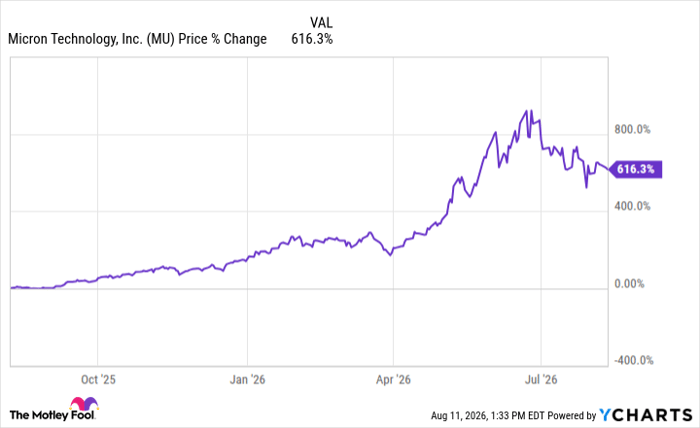
MU data by YCharts
The Roundhill Memory ETF holds 24 stocks, but Micron, Samsung, and SK Hynix, its top three holdings, account for a whopping 70.9% of the portfolio's value.
|
Stock |
Roundhill ETF Portfolio Weighting |
|---|---|
|
Micron Technology |
26.02% |
|
Samsung Electronics |
24.57% |
|
SK Hynix |
20.37% |
Data source: Roundhill Investments. Portfolio weightings are accurate as of Aug. 10, 2026, and are subject to change.
Micron, Samsung, and SK Hynix are racing to produce as many of their new HBM4 data center chips as possible, which offer record capacity specifically for AI workloads. Micron's HBM4 delivers 60% higher performance than its previous HBM3 solution and is 20% more energy-efficient. This is an ideal combination for data center operators seeking the fastest processing speeds at the lowest cost.
The memory shortage is so severe right now that Nvidia is sourcing HBM4 from all three suppliers for its new Vera Rubin systems, which include its Rubin graphics processing units (GPUs), Vera central processing units (CPUs), and specialized networking equipment. These systems are now the gold standard for running AI workloads.
Outside of its top three positions, the Roundhill ETF also holds prominent memory and storage names like Seagate Technology Holdings, Western Digital, and Sandisk.
The Roundhill ETF is obliterating the market, but can it continue?
The Roundhill Memory ETF only launched on April 2, so it doesn't have much of a track record for investors to consider. But as mentioned, it has already rocketed up by 80%, obliterating the broader market so far.
However, the soaring cost of AI chips and infrastructure is making AI models and software increasingly expensive to deploy. Large companies like Uber Technologies, Walmart, AT&T, and even Amazon have reportedly placed AI usage restrictions on their employees to prevent cost blowouts.
In Uber's case, the decision came after it blew through its entire 2026 AI budget in four months, triggered by a passive price increase imposed by Anthropic for using its Claude Code programming assistant.
A recent survey by UBS Group found that 60% of businesses are routing tasks to more efficient AI models that use less computing power to keep their spending under control. That isn't great news for the semiconductor industry, as it could eventually lead to declining demand for GPUs, CPUs, and memory.
But none of this should be surprising, because the chip industry has always been cyclical. Data center operators used to invest in new infrastructure every few years, but that upgrade cycle has shortened as updated chips and components now hit the market annually. Any data center operator that doesn't buy the latest chips risks losing the race for AI supremacy.
However, the current spending rate won't be sustainable forever, so I would be very cautious about buying the Roundhill Memory ETF right now. If I did add it to my diversified portfolio, I would ensure it has a very small weighting, under 5%, to keep potential risks in check.
Should you buy stock in Roundhill ETF Trust - Roundhill Memory ETF right now?
Before you buy stock in Roundhill ETF Trust - Roundhill Memory ETF, consider this:
The Motley Fool Stock Advisor analyst team just identified what they believe are the 10 best stocks for investors to buy now… and Roundhill ETF Trust - Roundhill Memory ETF wasn’t one of them. The 10 stocks that made the cut could produce monster returns in the coming years.
Consider when Netflix made this list on December 17, 2004... if you invested $1,000 at the time of our recommendation, you’d have $421,511!* Or when Nvidia made this list on April 15, 2005... if you invested $1,000 at the time of our recommendation, you’d have $1,381,960!*
Now, it’s worth noting Stock Advisor’s total average return is 981% — a market-crushing outperformance compared to 216% for the S&P 500. Don't miss the latest top 10 list, available with Stock Advisor, and join an investing community built by individual investors for individual investors.
See the 10 stocks »
*Stock Advisor returns as of August 16, 2026.
Anthony Di Pizio has no position in any of the stocks mentioned. The Motley Fool has positions in and recommends Amazon, Micron Technology, Nvidia, Walmart, and Western Digital. The Motley Fool recommends Uber Technologies. The Motley Fool has a disclosure policy.
Recommended Articles


