


Will SpaceX Be the First Company to Hit $1 Trillion in Revenue? Here's What the Math Says.
Key Points
Elon Musk projects SpaceX revenue to $1 trillion by 2030.
The company is likely going to be beaten to $1 trillion by Amazon.
SpaceX is likely still overvalued even if it hits its $1 trillion revenue goal.
- 10 stocks we like better than Space Exploration Technologies ›
Last year, Space Exploration Technologies (NASDAQ: SPCX) generated $18.7 billion in revenue. By 2030, founder and CEO Elon Musk believes that figure will hit $1 trillion. How? Well, it's complicated, but it mainly has to do with an extremely rapid build-out of artificial intelligence (AI) data centers, both on earth and in orbit.
No company has ever hit $1 trillion in revenue in a single calendar year. Musk believes SpaceX can achieve this feat five years from now. Will SpaceX be the first company ever to hit $1 trillion in revenue, and can it be the first to reach this goal?
Missed Nvidia in 2009? This Rare Signal Is Flashing Again. In 2009, a "Double Down" signal flashed for a little-known chipmaker called Nvidia. For the first time in years, that same "Total Conviction" signal is flashing for a company 1/100th the size of Nvidia. Continue »
When you run the numbers, it is clear what the answer likely will be.

Image source: Getty Images.
Aggressive investments for AI data centers
To grow revenue from less than $20 billion in 2025 to $1 trillion in 2030, SpaceX will need to compound sales at more than 100% annually for five straight years. It is working to do so by spending a boatload on constructing AI data centers. Capital expenditures on AI infrastructure were $15.8 billion last quarter alone, roughly double its revenue for the period.
If its current build-out trajectory holds, SpaceX will generate $100 billion in annual recurring revenue (ARR) by the end of this calendar year. That is according to Elon Musk on the latest earnings call. From there, SpaceX plans to maintain its aggressive capital investments, believing there is near-unlimited demand from AI companies for cloud computing services.
On top of AI data centers, SpaceX has a highly promising business in Starlink internet, which grew revenue by 66% year over year and is regularly launching new, more powerful satellites into orbit to expand its global coverage and bandwidth capabilities. The segment is now at $4.3 billion in quarterly revenue, and could generate tens of billions in revenue in the near future. Still, compared to the $1 trillion goal by 2030, it will not make a massive dent in these plans. To hit $1 trillion, most of the revenue will have to come from AI data centers.
What the math suggests
Investors should be confident that SpaceX can accelerate its revenue growth through the rest of 2026. It already has contracts with other AI companies, such as Alphabet and Anthropic, worth around $26 billion a year. The company's recent IPO gave it a massive war chest of around $100 billion, which it can use to invest in infrastructure that will likely lead to meaningful revenue gains in the near future. Musk himself said there is a line of sight to $100 billion in ARR by the end of this year.
However, to reach $1 trillion in revenue four years after 2026, Musk and the SpaceX team will have to 10x revenue, mainly from AI data center spending. This is going to run into electric power, computer chip, and construction bottlenecks.
Plus, even if SpaceX reaches $1 trillion in revenue by 2030, it will likely not be the first company to do so. Amazon has generated $775 billion in revenue over the last 12 months, and only needs to grow revenue by 10% per year for the next three years to surpass the $1 trillion mark. Amazon's revenue grew 20% year over year last quarter.
If the SpaceX bull thesis holds and it becomes one of the world's largest companies by revenue, the timeline is likely closer to the end of the next decade than to 2030. It is simply too difficult for a company to grow this quickly.
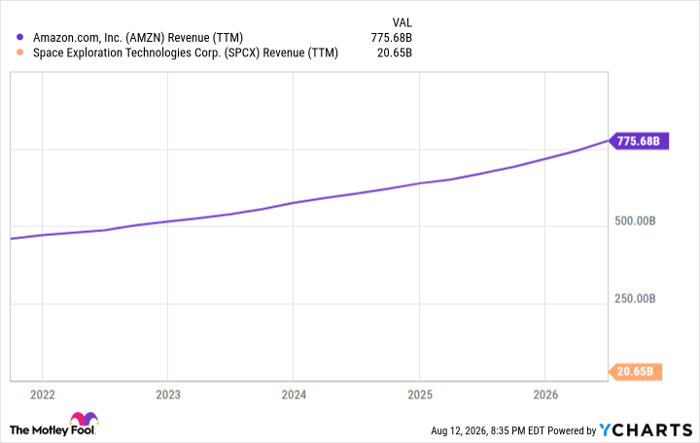
AMZN Revenue (TTM) data by YCharts
Is SpaceX stock a buy?
A more important question for investors is whether the inflection in AI revenue makes SpaceX stock a buy today.
Even if you are a believer that SpaceX will dominate the future of the AI market -- along with its bold plan for orbital data centers -- it will take many years, if not more than a decade, for it to reach $1 trillion in sales. On those sales, it is unclear what profit margins will be as a reseller of AI compute, much of which is sold to competitors today, like Alphabet and Anthropic. A 10% profit margin would equate to $100 billion in earnings on $1 trillion in revenue.
Today, SpaceX has a market cap of $1.93 trillion, meaning it trades at a price-to-earnings ratio (P/E) of 19 based on these estimates at some point over the next 10 to 20 years. This indicates a ton of future growth is already priced into SpaceX stock, meaning investors should avoid buying today.
Should you buy stock in Space Exploration Technologies right now?
Before you buy stock in Space Exploration Technologies, consider this:
The Motley Fool Stock Advisor analyst team just identified what they believe are the 10 best stocks for investors to buy now… and Space Exploration Technologies wasn’t one of them. The 10 stocks that made the cut could produce monster returns in the coming years.
Consider when Netflix made this list on December 17, 2004... if you invested $1,000 at the time of our recommendation, you’d have $421,943!* Or when Nvidia made this list on April 15, 2005... if you invested $1,000 at the time of our recommendation, you’d have $1,382,819!*
Now, it’s worth noting Stock Advisor’s total average return is 983% — a market-crushing outperformance compared to 216% for the S&P 500. Don't miss the latest top 10 list, available with Stock Advisor, and join an investing community built by individual investors for individual investors.
See the 10 stocks »
*Stock Advisor returns as of August 15, 2026.
Brett Schafer has no position in any of the stocks mentioned. The Motley Fool has positions in and recommends Amazon. The Motley Fool has a disclosure policy.
Recommended Articles


