


Social Security Is in Dire Straits, Thanks in Part to President Donald Trump, but Taxing the Rich Won't Fix the Problem
Key Points
Social Security's Old-Age and Survivors Insurance trust fund (OASI) -- the fund that pays retired workers and survivor beneficiaries -- is an estimated six years away from exhausting its asset reserves.
Although ongoing demographic shifts are primarily responsible for Social Security's deteriorating financial outlook, President Trump's policies are also playing a role.
While taxing the well-to-do can extend the solvency of Social Security's trust funds, it doesn't come close to offsetting the program's projected long-term funding shortfall.
- The $23,760 Social Security bonus most retirees completely overlook ›
For many of the nearly 55 million retired workers currently receiving a Social Security benefit, this income isn't a luxury. A quarter-century of annual surveys by Gallup shows that up to 90% of retired-worker beneficiaries rely on their monthly payout, in some capacity, to cover their expenses.
Given how important Social Security income is to aging workers, you'd think that strengthening this program would be a top priority for our elected officials, including President Donald Trump -- but this hasn't been the case.
Missed Nvidia in 2009? This Rare Signal Is Flashing Again. In 2009, a "Double Down" signal flashed for a little-known chipmaker called Nvidia. For the first time in years, that same "Total Conviction" signal is flashing for a company 1/100th the size of Nvidia. Continue »
Social Security's financial outlook has steadily worsened over the last four decades, thanks in part to President Trump's policies. Worst of all, the most popular fix, taxing the rich, won't solve Social Security's most glaring problem.

President Trump delivering remarks. Image source: Official White House Photo by Joyce N. Boghosian.
Sweeping Social Security benefit cuts are an estimated six years away
Before going any further, let's clarify an important point: Social Security is in no danger of going bankrupt or halting benefits.
The program collects more than 91% of its income from the 12.4% payroll tax on earned income (wages and salaries, but not investment income). As long as Americans keep working and pay their taxes, Social Security will always have income to disburse to eligible beneficiaries.
But just because there's no danger of insolvency, it doesn't mean Social Security isn't in dire straits. According to the latest Social Security Board of Trustees Report, the program is staring down a $29.3 trillion unfunded obligation over the next 75 years. The Trustees have been forecasting a long-term funding shortfall since 1985.
The more pressing issue is the projected depletion of the Old-Age and Survivors Insurance trust fund's (OASI) asset reserves by the fourth quarter of 2032. The OASI is the fund responsible for doling out monthly benefits to retired workers and survivors of deceased workers.
If this excess cash built up since inception is exhausted over the next six years, the Trustees estimate that sweeping OASI benefit cuts of up to 22% may be necessary to sustain payouts through 2100.
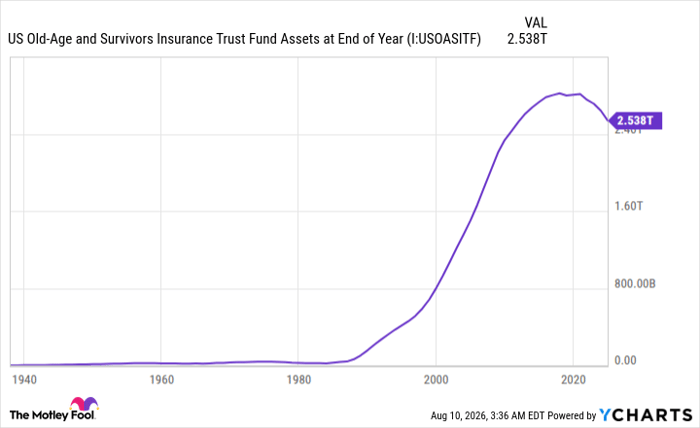
The OASI is expected to deplete its asset reserves by the fourth quarter of 2032. US Old-Age and Survivors Insurance Trust Fund Assets at End of Year data by YCharts.
Social Security is in dire straits -- but don't blame congressional theft or migrants
If you're wondering how the financial outlook for America's most important social program has deteriorated so badly, don't look to social media message boards for the answer. While claims of Congress stealing Social Security's trust funds and undocumented migrants receiving traditional benefits are common online scapegoats, neither claim has any evidence to back them up.
Rather, Social Security's shortcomings can primarily be traced to ongoing demographic shifts. This includes:
- The retirement of baby boomers, which is weighing on the worker-to-beneficiary ratio.
- Increased longevity for a program that was never designed to pay benefits for several decades.
- Historically low U.S. birth rates that threaten to further reduce the worker-to-beneficiary ratio.
- A meaningful drop in legal migration to the United States. Legal migrants are often young and spend decades in the labor force contributing via the payroll tax.
- Rising income inequality, which has allowed some earned income to "escape" the payroll tax.
Congress does deserve some of the blame for Social Security's deteriorating financial outlook, but it has nothing to do with the baseless claim of theft. Rather, lawmakers kicking the can down the road will make it costlier for workers and potentially retirees to eventually fix the program.
Even President Trump takes partial blame for Social Security's current financial situation. His tariff policy and the Iran war are driving up the U.S. inflation rate, which in turn should lead to an above-average cost-of-living adjustment (COLA) in 2027. An outsize Social Security raise for beneficiaries threatens to drain the OASI's asset reserves even faster.
Furthermore, Trump's flagship tax and spending law, the "Big, Beautiful Bill," provides an assortment of temporary tax breaks from 2025 through 2028 that'll reduce the income subject to the 12.4% payroll tax. According to the Social Security Administration's Office of the Actuary (OACT), the big, beautiful bill will increase the program's costs by an estimated $168.6 billion from 2025 to 2034.

Image source: Getty Images.
The popular fix isn't always the right (or only) option
These issues are well-known to lawmakers in Washington, D.C. The quandary is how best to strengthen Social Security?
Based on polling, the most popular solution to fix America's leading retirement program is to tax the rich. In 2026, all earned income between $0.01 and $184,500 is subject to the payroll tax, with any earnings above the $184,500 cap exempt. Since 94% of workers earn less than this cap and are taxed on every dollar they make, raising this cap, or removing it completely and subjecting all wages and salaries to the payroll tax, would only affect a small percentage of workers. This is one of the reasons why it's such a popular proposal.
On the one hand, raising or eliminating this cap and requiring the well-to-do to pay more into Social Security would generate immediate income for the program. But this isn't the complete story.
In December 2021, the Social Security Administration's OACT published a report ("Social Security: Raising or Eliminating the Taxable Earnings Base") that examined what would happen if all earnings were subject to the payroll tax. The result was an added 35 years of trust fund solvency.
Don't get me wrong, an extra 35 years for lawmakers to figure out how to resolve Social Security's shortcomings without any reduction to payouts would, in theory, be good news. But removing the earnings cap and taxing all wages and salaries doesn't come close to offsetting the aforementioned long-term unfunded obligation of $29.3 trillion (as of the 2026 Trustees Report).
In other words, taxing the rich can be part of the solution to strengthening Social Security, but requiring the well-to-do to pay more into the program can't, by itself, close the long-term funding gap. Other, less desirable solutions will need to be considered, including raising the full retirement age, means-testing benefits, or increasing the payroll tax on all workers.
The $23,760 Social Security bonus most retirees completely overlook
If you're like most Americans, you're a few years (or more) behind on your retirement savings. But a handful of little-known "Social Security secrets" could help ensure a boost in your retirement income.
One easy trick could pay you as much as $23,760 more... each year! Once you learn how to maximize your Social Security benefits, we think you could retire confidently with the peace of mind we're all after. Join Stock Advisor to learn more about these strategies.
View the "Social Security secrets" »
The Motley Fool has a disclosure policy.
Recommended Articles


