


Forget the Artificial Intelligence (AI) Capex Bubble: SpaceX CEO Elon Musk Says the Memory Shortage Will Drive Costs Even Higher
Key Points
Hyperscalers are increasing their capital expenditures (capex) budgets as demand for memory chips surges.
During SpaceX's recent earnings call, CEO Elon Musk specifically identified memory as the limiting factor for AI build-outs.
Musk explained that demand for memory is far outpacing available supply, implying that prices will continue rising.
- 10 stocks we like better than Micron Technology ›
Although some skeptics frame demand for memory chips and the acceleration in capital expenditures (capex) by artificial intelligence (AI) hyperscalers as a bubble, recent remarks from Elon Musk cut through this narrative with unusual clarity.
During the recent earnings call for Space Exploration Technologies, otherwise known as SpaceX, Musk said that "memory output is increasing by around 20% per year" while "demand is increasing by 200% a year, maybe higher."
Missed Nvidia in 2009? This Rare Signal Is Flashing Again. In 2009, a "Double Down" signal flashed for a little-known chipmaker called Nvidia. For the first time in years, that same "Total Conviction" signal is flashing for a company 1/100th the size of Nvidia. Continue »
This dynamic positions pure-play memory producers like Micron Technology (NASDAQ: MU) for outsize gains, making now a compelling entry point for investors who understand the forces of bringing next-generation AI applications into production amid the rising demand for the infrastructure that supports these developments.

Space Exploration Technologies CEO Elon Musk. Image source: The White House.
Memory specialists are in an advantageous position right now
In a mature industry, 20% annual growth in output would normally be celebrated. The explosion of AI workloads has, however, shifted adoption of specialized chips into an exponential regime. Training large language models and inference deployments consumes ever-larger volumes of high bandwidth memory (HBM) chips, with each new generation multiplying the requirement.
When demand grows by an order of magnitude faster than supply, scarcity becomes inevitable. Under these conditions, basic economics suggests that prices rise and profit margins expand for the businesses that can deliver the resource in question.
Micron focuses on advanced DRAM and HBM, placing it directly in the center of the bottleneck Musk cites. Smart investors have already recognized how rising capex is affecting Micron, as the company's pricing power is directly fueling improved profitability and helping fund aggressive manufacturing scale.
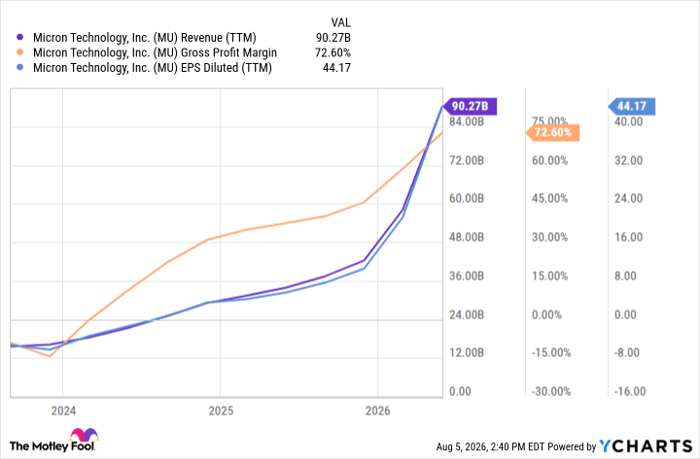
MU Revenue (TTM) data by YCharts
Why now is the time to buy Micron stock
The stock market often overreacts to short-term signals even when longer-term fundamentals remain intact. Micron stock reached an all-time high in late June, only to sell off considerably shortly after. Micron's decline reflects both a familiar pattern of profit-taking after a strong rally and ongoing skepticism surrounding AI infrastructure spending.
Musk's observation about memory prices reframes Micron's decline as noise rather than a signal that shares should continue to plummet. If memory remains the binding constraint for data center build-outs, this would imply Micron is in the early phase of capacity expansion rather than the late phase of excess supply. Against this backdrop, capital will continue to flow toward the memory bottleneck, benefiting the companies that produce it.
Buying Micron stock on the dip means investors gain exposure to rising memory prices at a steep discount to the valuation the market assigned just a handful of weeks earlier. In other words, Micron's sell-off does not erase the supply-demand gap in the memory market; rather, it temporarily lowers the valuation multiple while the physical shortage persists. For investors who agree with Musk's framing, Micron's current price point represents a much more attractive risk-reward profile than the levels that prevailed during the all-time high.
Why Micron stock can sustain upside in the years ahead
System designers should continue demanding denser, faster memory solutions -- reinforcing the need for the very products Micron supplies. At the same time, scarcity underscores the strategic value of reliable production capacity, giving manufacturers like Micron greater leverage in securing long-term contracts.
Investors who correctly interpret the imbalance Musk alluded to will treat Micron's recent sell-off as an opportunity to buy the dip rather than a reason to exit their position. The capex supercycle is not ending. Instead, it is being rewritten by a genuine shortage that only additional output can relieve.
Identifying memory as the limiting factor in data center expansion does not signal a peak in the AI build-out. It explains why demand for Micron's products should remain elevated, prices are more likely to continue rising, and the stock offers a rational place to invest right now.
Should you buy stock in Micron Technology right now?
Before you buy stock in Micron Technology, consider this:
The Motley Fool Stock Advisor analyst team just identified what they believe are the 10 best stocks for investors to buy now… and Micron Technology wasn’t one of them. The 10 stocks that made the cut could produce monster returns in the coming years.
Consider when Netflix made this list on December 17, 2004... if you invested $1,000 at the time of our recommendation, you’d have $397,405!* Or when Nvidia made this list on April 15, 2005... if you invested $1,000 at the time of our recommendation, you’d have $1,344,091!*
Now, it’s worth noting Stock Advisor’s total average return is 953% — a market-crushing outperformance compared to 214% for the S&P 500. Don't miss the latest top 10 list, available with Stock Advisor, and join an investing community built by individual investors for individual investors.
See the 10 stocks »
*Stock Advisor returns as of August 8, 2026.
Adam Spatacco has no position in any of the stocks mentioned. The Motley Fool has positions in and recommends Micron Technology. The Motley Fool has a disclosure policy.
Recommended Articles


