


Gold Price Forecast: Can Gold Still Rise Above $4,300 Ahead of July Non-Farm Payrolls?

 Trending Articles
- US President Donald Trump says Iran talks to begin Monday after canceling attack
- Gold rallies to two-week high as USD softens on Iran deal hopes, receding Fed hike bets
- Australian Dollar remains calm following Trade Balance data
- WTI trades with positive bias below mid-$79.00s on Iran uncertainty, supply concerns
- Bitcoin Falls Below $63,000; Can US-Iran Negotiations Reverse the Downtrend?
- WTI holds losses around $82.50 on renewed US-Iran diplomatic hopes

TradingKey - As of the European session on August 7, gold prices ( XAUUSD) extended their recent strong performance, rising over 1% intraday to briefly cross the $4,300 mark. With a cumulative gain of more than 6% this week, gold is poised to post its largest weekly gain since January this year. As the U.S. non-farm payrolls data for July is about to be released, the market is reassessing whether a Federal Reserve rate hike in September is still necessary, and gold has also entered a critical phase of deciding its near-term direction.
Fed Rate Hike Expectations Key for Gold Prices Ahead of July Non-Farm Payrolls
The U.S. will release the July non-farm payrolls report at 8:30 a.m. ET on August 7. Based on market expectations, non-farm payrolls in July are expected to increase by approximately 80,000, higher than the 57,000 in June, while the unemployment rate is projected to hold steady at 4.2% and year-on-year growth in average hourly earnings is expected to remain around 3.5%. Although employment figures may rebound, an increase of 80,000 is still relatively low by recent standards. Therefore, investors need to pay closer attention to whether the labor market is merely cooling gently or experiencing a more pronounced slowdown.
Recent leading employment indicators have been generally weak. ADP data showed that the U.S. private sector added only 44,000 jobs in July, falling short of market expectations of 75,000, while the ISM Services Employment Index fell from 51.2 to 47.4, returning to contraction territory. At the same time, job openings in June fell to 7.359 million. However, initial jobless claims in the U.S. remained at a low 199,000, and announced corporate layoffs fell to a two-year low, indicating that while hiring intentions have cooled, large-scale layoffs have not yet materialized.
The primary market impact of this payrolls report will focus on Federal Reserve policy expectations. Traders currently price in an approximate 55% probability of a Fed rate hike in September. If non-farm payrolls significantly exceed 100,000, while the unemployment rate falls and wage growth beats expectations, the market may ramp up the probability of a September rate hike. Treasury yields and the U.S. dollar would likely rise, thereby increasing the opportunity cost of holding gold and potentially causing gold prices to pull back from around $4,300.
Conversely, if job growth falls significantly below 80,000, particularly if it nears 50,000 or lower, while the unemployment rate rises to 4.3% or previous figures are significantly revised downward again, the market may conclude that the U.S. labor market is cooling further. Consequently, expectations for a September Fed rate hike would diminish. If the dollar and Treasury yields retreat in tandem, it would further bolster the trading environment for gold, potentially pushing gold prices up toward $4,380.
However, if non-farm payrolls are significantly weaker than expected or even contract, investors should be wary of escalating market concerns over a U.S. recession. While short-term safe-haven flows may continue to seek refuge in gold, market volatility could also intensify significantly.
Gold Price Technical Analysis
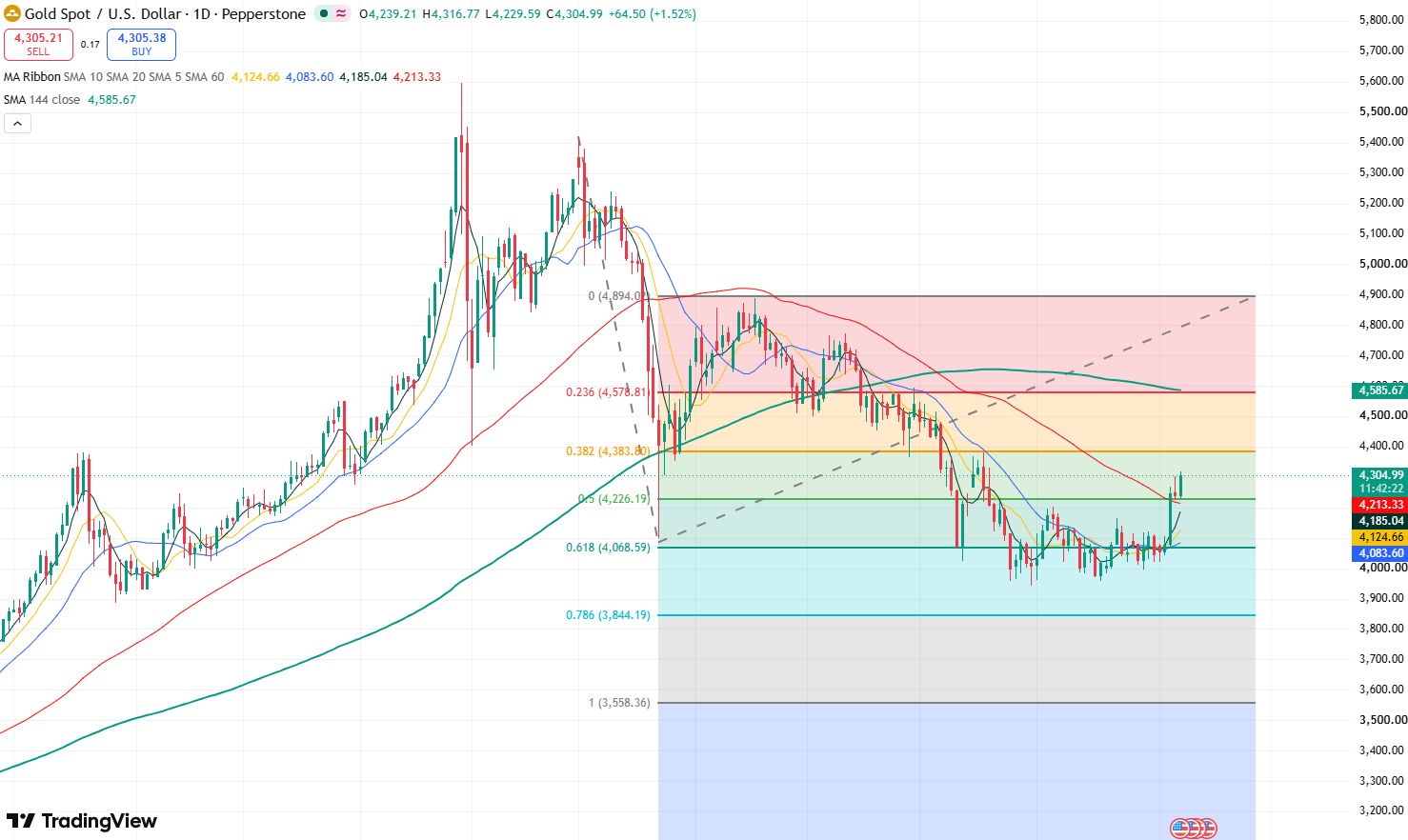
Gold Price Daily Chart, Source: TradingView
Looking at the daily chart of gold prices, gold has recently continued to rebound, rallying at one point from around $4,000 to above $4,300—a rebound of over $300. This indicates that bullish market sentiment has gained the upper hand, and the rebound may continue in the short term.
From a technical perspective, as gold prices broke through the $4,300 threshold, the upside toward the key resistance level of $4,380 has opened up. If the non-farm payrolls (NFP) data turns out to be bearish for gold and today's closing price ends up below $4,300, gold may test the $4,200 support level on the downside in the short term, with further support down in the $4,180–$4,130 range.
Currently, the key overhead resistance level to watch for gold is $4,380. If gold breaks through and consolidates above this level, it will open up upside toward $4,500; conversely, if gold remains under pressure below $4,380, it may test the $4,300 threshold on the downside in the short term, and further down to $4,200.
Read more
* The content presented above, whether from a third party or not, is considered as general advice only. This article should not be construed as containing investment advice, investment recommendations, an offer of or solicitation for any transactions in financial instruments.


