


If the Iran War Is Over, Is the Vanguard Energy ETF Still a Good Buy?
Key Points
The Vanguard Energy ETF has outperformed the S&P 500 year to date but has declined 11% since March 27.
A higher oil supply resulting from the end of the Iran war could be bad news for energy stock prices.
- 10 stocks we like better than Vanguard World Fund - Vanguard Energy ETF ›
As of this writing, on June 14, the U.S. and Iran have reached a deal to end the Iran war and reopen the Strait of Hormuz. Oil prices and global stocks have been highly volatile since the U.S. and Israel attacked Iran on Feb. 28, with widespread damage to Middle East oil infrastructure and a shutdown of oil shipments through the vital Strait of Hormuz.
Higher oil prices in 2026 have been good for energy stocks. The Vanguard Energy ETF (NYSEMKT: VDE) has delivered 25% returns year to date. But this energy ETF has lost about 11% of its value since reaching an all-time high on March 27.
Where to invest $1,000 right now? Our analyst team just revealed what they believe are the 10 best stocks to buy right now, when you join Stock Advisor. See the stocks »
If the Iran war is over, the world economy might be ready to find a new path forward. Stocks are rallying. The S&P 500 index is up 10.4% year to date, and has gained about 19% since hitting a 2026 low on March 30. But good news for the S&P 500 might be bad news for energy stocks. Ever since the end of March, the Vanguard Energy ETF and the S&P 500 have been going in opposite directions:
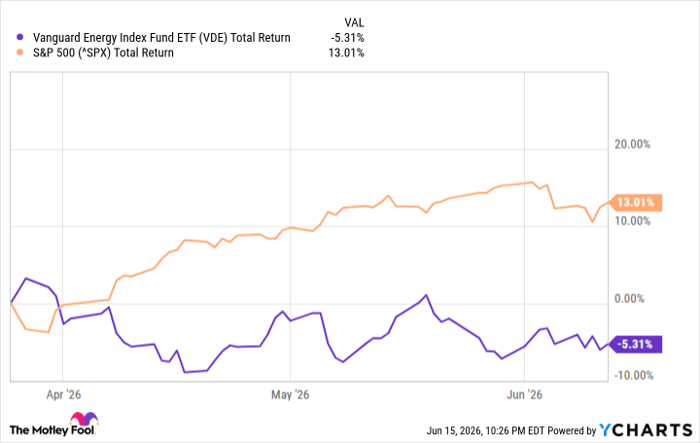
VDE Total Return Level data by YCharts
Even though the Vanguard Energy ETF has delivered impressive recent returns, now might not be a good time to buy. Let's look at a few reasons why this Vanguard ETF is facing an uncertain future.
Vanguard Energy ETF: 111 stocks; 5 years of 21% annualized returns
The Vanguard Energy ETF is a passively managed exchange-traded fund that holds stocks of oil companies, natural gas companies, coal companies, and other companies involved in energy exploration and production. The fund charges a low expense ratio of 0.09% and has delivered a trailing-12-month dividend yield of 2.47%.
For the past five years, this energy ETF has delivered average annual returns of 21.1%. It's outperformed the S&P 500 year to date, for the past year, and for the past five years.
Its portfolio includes 111 stocks. The fund's top five holdings are:
- ExxonMobil: 21.98%
- Chevron: 14.2%
- ConocoPhillips: 5.8%
- Williams Companies: 3.64%
- SLB: 3.5%
Since three major oil companies make up about 42% of the fund, it's not surprising that Vanguard Energy ETF performance tends to go up and down with the price of oil. The recent run-up in oil prices as tensions rose in the Middle East went along with an increase in the ETF's share price.
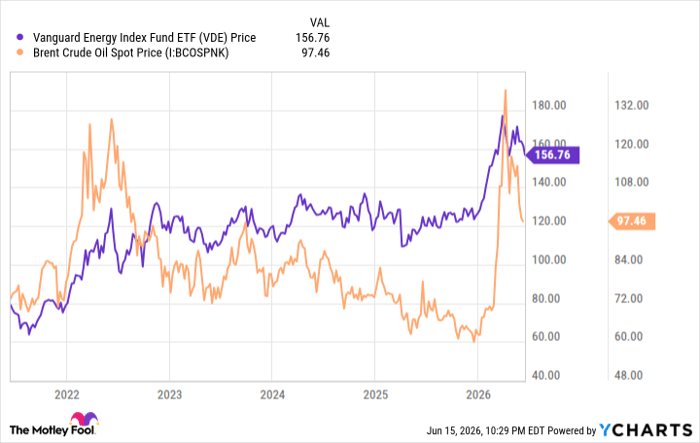
VDE data by YCharts
However, in the long run, it's hard for energy stocks to beat the market. Since the fund's inception in September 2004, the Vanguard Energy ETF has been outperformed nearly 2-to-1 by the S&P 500 index.
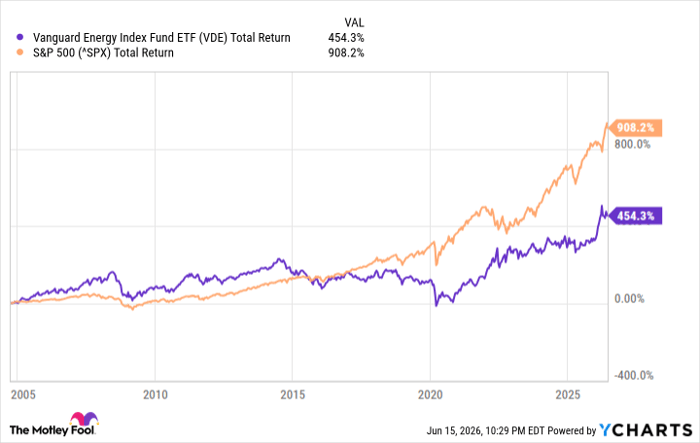
VDE Total Return Level data by YCharts
Why investors should avoid the Vanguard Energy ETF
The situation in the Middle East is complex and rapidly shifting. It's not clear if peace is around the corner, when the Strait of Hormuz will reopen, or how the global supply of oil and natural gas will be affected.
The price of oil could plummet after the war as more oil production comes online. In the long run, demand for oil could be reduced if drivers, companies, and utilities worldwide decide to shift to electric vehicles, renewable energy, and other alternatives to Middle East oil.
The biggest gains of 2026 in the Vanguard Energy ETF might have already happened. For most long-term investors, investing too heavily in oil stocks might not be a good choice. I wouldn't invest in the Vanguard Energy ETF now.
Should you buy stock in Vanguard World Fund - Vanguard Energy ETF right now?
Before you buy stock in Vanguard World Fund - Vanguard Energy ETF, consider this:
The Motley Fool Stock Advisor analyst team just identified what they believe are the 10 best stocks for investors to buy now… and Vanguard World Fund - Vanguard Energy ETF wasn’t one of them. The 10 stocks that made the cut could produce monster returns in the coming years.
Consider when Netflix made this list on December 17, 2004... if you invested $1,000 at the time of our recommendation, you’d have $415,040!* Or when Nvidia made this list on April 15, 2005... if you invested $1,000 at the time of our recommendation, you’d have $1,256,076!*
Now, it’s worth noting Stock Advisor’s total average return is 923% — a market-crushing outperformance compared to 207% for the S&P 500. Don't miss the latest top 10 list, available with Stock Advisor, and join an investing community built by individual investors for individual investors.
See the 10 stocks »
*Stock Advisor returns as of June 18, 2026.
Ben Gran has no position in any of the stocks mentioned. The Motley Fool has positions in and recommends Chevron. The Motley Fool recommends ConocoPhillips. The Motley Fool has a disclosure policy.
Recommended Articles


