


Three Major International Investment Banks Bearish on Oil Outlook, Citi Expects Brent to Fall to $70. Crude Oil Prices Fall for Four Straight Days to Levels at Start of US-Iraq War.

 Trending Articles
- Iranian military drones targeted US Fifth Fleet in Bahrain in response to southern US strikes
- Gold Price Trend Forecast: US-Iran Peace Talks Drive Gold Rebound, Is the Gold Slump Over?
- Gold plummets below $4,200 as US‑Iran tensions spur hawkish rate bets ahead of US CPI
- Gold rises to weekly high as US, Iran reach peace deal
- SpaceX Listing Imminent. Funds Flood Into SpaceX On-Chain Tokens, Bitcoin Rebound Momentum May Be Weakened
- Bitcoin Strongly Breaks $65,000, How This Week’s FOMC Decision Will Influence the Outlook?
TradingKey - On June 16, after US President Donald Trump sent consecutive signals of geopolitical easing, the two major crude oil benchmarks extended their recent declines and are poised to return to price levels seen prior to the US-Iran conflict.
Regarding the stances of both sides, Trump stated that the Strait of Hormuz will fully reopen this Friday. US-Iran relations have been "normalized", and the US will further push down oil prices, threatening to ramp up sanctions on Russia on the grounds of improved oil supply. He emphasized that the US and Iran have successfully signed a memorandum of understanding (MoU) online, and that negotiations for the US-Iran agreement have now entered the second phase, saying "this should be easier than the first phase."
Iran, however, showed some reservations. According to Iran's Fars News Agency, citing sources familiar with the matter, when the Supreme National Security Council reviewed the ceasefire memorandum of understanding, the resolution was passed based on a precise, step-by-step "interpretive theory". This mechanism, specifically designed in response to the US's history of breaching agreements, matches each US obligation with a corresponding step of Iranian implementation, progressing conditionally throughout.
Its core logic is reciprocal performance: Iran will only implement corresponding measures simultaneously when the US fully delivers on a commitment. If any term fails to materialize, Iran will immediately suspend its respective obligations, with the counter-mechanism taking effect instantly.
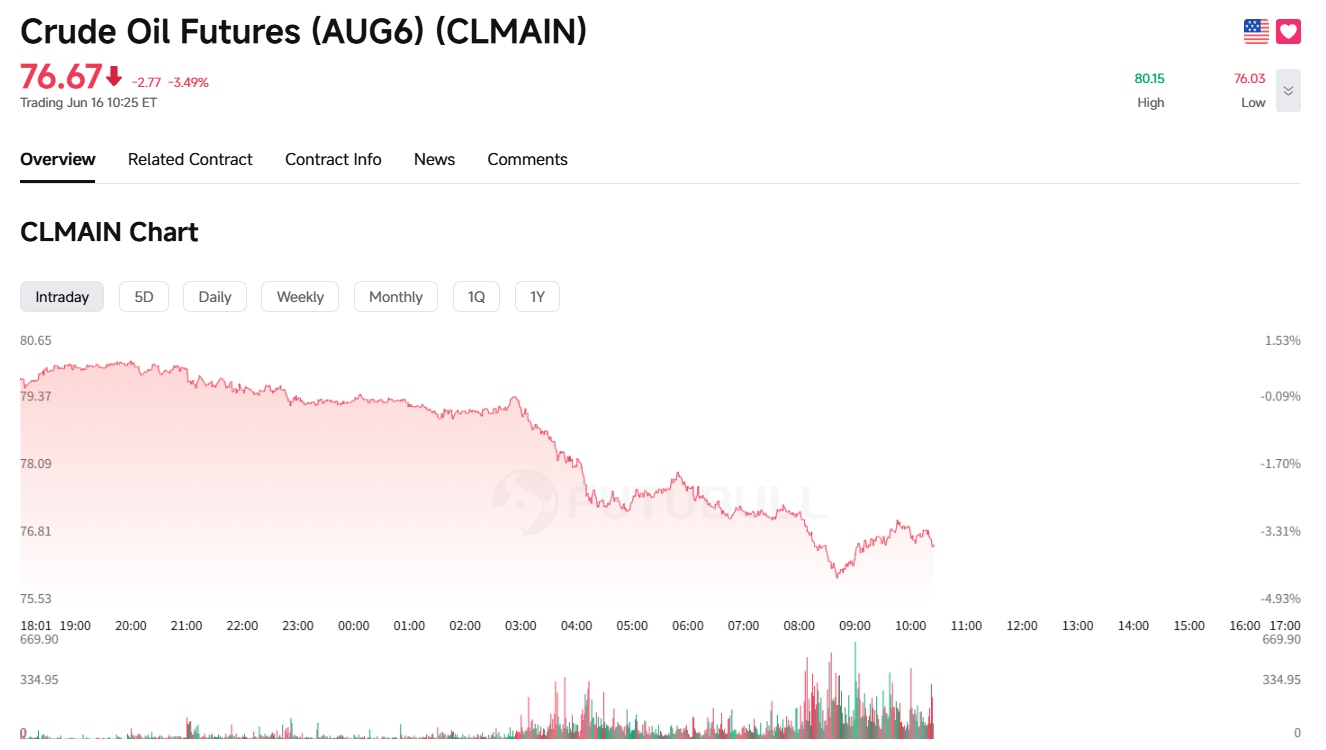
Crude oil prices fell for a fourth straight session after both sides further signaled deepening peace talks. As of press time, WTI crude futures fell 3.49% to $76.67 per barrel, while Brent crude fell 3.52% to $80.24 per barrel.
[Source: FutuBull]
As the US-Iran ceasefire agreement nears finalization, major international investment banks have followed up with their latest oil price forecasts.
Citi cut its international oil price forecasts, lowering its average Brent crude price predictions for the third and fourth quarters of this year to $75 and $70, respectively, while slashing its 2027 oil price forecast from $80 to $65. The bank stated that the US and Iran have finalized a ceasefire agreement and will formally sign it in Switzerland this Friday. Although the full terms have not been made public, the market widely expects shipping in the Strait of Hormuz to gradually normalize, with a sharp drop in geopolitical premiums directly pressuring oil prices. Citi estimates a roughly 60% probability that the Strait will resume regular navigation in mid-to-late July.
The bank further noted that at the current stage, oil prices have not fully priced in the positive impact of long-term uninterrupted shipping. If the market fully digests this expectation, Brent crude has another $10 to $15 per barrel of downside potential. Given that the US has no intention of restarting a war and Iran also seeks to stabilize the situation, Citi suggests selling summer crude contracts on rallies when oil prices spike.
In its latest research report, Goldman Sachs predicted that as oil exports from the Gulf region recover faster than previously expected, global crude supply tightness will ease. However, Middle East geopolitical risks have not entirely disappeared, and oil prices still face distinct two-way volatility in the future; from a risk-reward perspective, upside risks remain slightly higher than downside risks.
Goldman Sachs initially expected oil exports from Persian Gulf countries to return to pre-war levels by the end of August this year, but pulled this timeline forward to the end of July following Trump's announcement of the imminent agreement signing. The bank also cut its Q4 2026 Brent crude price forecast from $90 to $80 per barrel, and lowered its WTI price forecast to $75 for the same period.
Morgan Stanley also lowered its oil price forecasts, downgrading its Q3 average Brent crude price prediction from the previous $100/bbl to $90/bbl, and its Q4 average price expectation from $95 to $80/bbl—a $15 reduction from the prior forecast.
Meanwhile, the bank warned that geopolitical uncertainties persist, as many details of the agreement have yet to be finalized and potential risks have not been fully cleared. Nonetheless, the finalization of this agreement remains a key development in easing geopolitical conflicts and is expected to drive a recovery in oil export volumes through the Strait of Hormuz.
Read more
* The content presented above, whether from a third party or not, is considered as general advice only. This article should not be construed as containing investment advice, investment recommendations, an offer of or solicitation for any transactions in financial instruments.


