


Is the Departure of Fiserv's CEO a Major Red Flag?
Key Points
Mike Lyons is leaving Fiserv to become the CEO of Truist.
The move comes at a bad time for a company trying to engineer a turnaround.
When there is a major leadership shake-up, investors need to step back and re-examine their thesis, especially for a struggling company.
- 10 stocks we like better than Fiserv ›
The bank software and payments company Fiserv (NASDAQ: FISV) recently stunned investors by announcing that its chief executive officer, Michael Lyons, had resigned. The move is not due to a disagreement at the company, according to a Securities and Exchange Commission filing, but rather that Lyons is set to become the next CEO of Truist, a super-regional bank with roughly $549 billion in assets.
The move caught investors off guard not only because Lyons joined the company at the beginning of 2025, but also because Lyons and the rest of the team at Fiserv have been trying to engineer a major turnaround after the company reported surprisingly poor earnings last year, sending the stock plummeting.
Where to invest $1,000 right now? Our analyst team just revealed what they believe are the 10 best stocks to buy right now, when you join Stock Advisor. See the stocks »
Is Lyons' departure a major red flag?

Image source: Getty Images.
Why the change comes at a bad time
Any major leadership change needs careful evaluation, but Lyons' departure comes at a particularly unsettling time, given the challenges Fiserv has faced.
The company has been one of the dominant players in providing core banking processing technology that powers many banks' daily back-end operations. Fiserv also owns the Clover point-of-sale payments platform, which many small businesses use.
In its third-quarter earnings results reported last October, Fiserv missed earnings estimates by about 23% and then cut its full-year forecast by about 16% in an earnings surprise that BTIG analyst Andrew Harte called "shockingly bad" at the time.
The stock fell by more than 40% after the report and is down by more than 70% during the past year.
It turns out that past management had been over-inflating growth numbers at Clover and charging excessive fees. There were also issues in the core processing business, an area typically considered woefully outdated at a time when banks must embrace technology.
Revenue in Fiserv's banking segment declined 7% year over year.
Although things were bad after that dismal earnings report, the silver lining was that investors believed most of the mismanagement had occurred under former CEO Frank Bisignano, who is now commissioner of the U.S. Social Security Administration.
Bullish investors believed a new management team, with Lyons at the helm, recognized the mistakes made and could correct them. After all, Fiserv still holds significant market share and has long-term customer contracts, making the stock a potentially compelling turnaround story.
Lyons' departure is certainly not a good sign
Although Lyons' departure isn't necessarily a dealbreaker for the stock, it's certainly not a good sign.
I obviously don't know what is going through Lyons' head, but the biggest red flag I see is that Fiserv highly incentivized Lyons with a $70 million pay package that included some $56 million in equity awards spread out over several years.
However, based on Fiserv's proxy statement, a significant part of Lyons' total pay package is based on performance stock units (PSUs) tied to metrics such as total shareholder return, organic revenue growth, and adjusted earnings per share.
At Truist, Lyons will receive a base salary of $1.3 million per year, similar to the one he received at Fiserv. Lyons will also receive a long-term incentive award of $12 million for 2026, 40% of which is performance-based.
Lyons will also receive replacement awards to compensate for the money he is leaving on the table at Fiserv, so it seems as if the banking veteran will be made whole. But this raises the question of whether Lyons believed he would have an easier time getting his performance-based incentives at Truist than at Fiserv.
Truist has not exactly had an easy time either. Since the SunTrust and BB&T merger that created Truist in 2019, the stock has been deemed a disaster by most bank investors.
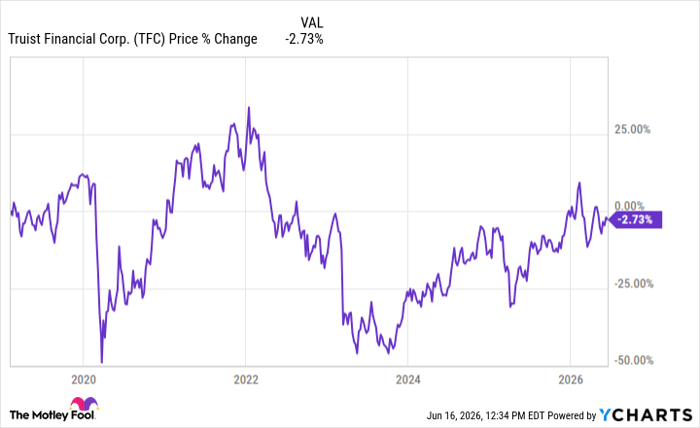
TFC data by YCharts
In fact, many investors believed Truist might be acquired by another bank before Lyons was hired.
The silver lining
Looking at the situation from an optimistic perspective, it's possible Lyons simply wanted to be the CEO of a super-regional bank, given that he's spent most of his career climbing the ranks at PNC Financial Services Group, a direct peer of Truist.
The other good news for Fiserv investors is that the company named Takis Georgakopoulos as its new CEO. Georgakopoulos had served in various senior roles since joining the company in 2024, notably as chief operating officer.
While investors liked Lyons, they might have been more excited about Georgakopoulos, who is somewhat of a legend in the world of payments.
Before to Fiserv, Georgakopoulos spent 17 years at JPMorgan Chase, where he played a pivotal role in building JPMorgan's global payments business, which now processes more than $10 trillion in daily volume. He also ran the unit for seven years.
Investors have a lot of confidence in Georgakopoulos's abilities and knowledge of payments. Ultimately, although the Fiserv story is not dead, I see Lyons' departure as a major red flag and recommend that investors reevaluate their thesis before doing anything else.
Should you buy stock in Fiserv right now?
Before you buy stock in Fiserv, consider this:
The Motley Fool Stock Advisor analyst team just identified what they believe are the 10 best stocks for investors to buy now… and Fiserv wasn’t one of them. The 10 stocks that made the cut could produce monster returns in the coming years.
Consider when Netflix made this list on December 17, 2004... if you invested $1,000 at the time of our recommendation, you’d have $424,531!* Or when Nvidia made this list on April 15, 2005... if you invested $1,000 at the time of our recommendation, you’d have $1,273,016!*
Now, it’s worth noting Stock Advisor’s total average return is 940% — a market-crushing outperformance compared to 209% for the S&P 500. Don't miss the latest top 10 list, available with Stock Advisor, and join an investing community built by individual investors for individual investors.
See the 10 stocks »
*Stock Advisor returns as of June 18, 2026.
JPMorgan Chase is an advertising partner of Motley Fool Money. Bram Berkowitz has no position in any of the stocks mentioned. The Motley Fool has positions in and recommends JPMorgan Chase and Truist Financial. The Motley Fool has a disclosure policy.
Recommended Articles


