


ExxonMobil Has Its Sights on Its Next Megamerger. Here's the Oil Stock It Should Buy.
Key Points
Exxon appears increasingly focused on expanding its LNG business.
Woodside offers scale, cash flow, and major growth projects.
Santos may deliver similar benefits at lower cost.
- 10 stocks we like better than Santos ›
Just two years after completing its $60 billion acquisition of Pioneer Natural Resources, ExxonMobil (NYSE: XOM) may already be looking for its next major deal.
And there's reason to believe it could be Woodside Energy (NYSE: WDS).
Where to invest $1,000 right now? Our analyst team just revealed what they believe are the 10 best stocks to buy right now, when you join Stock Advisor. See the stocks »
While discussions reportedly remain in the early stages, Exxon appears focused on expanding its position in liquefied natural gas (LNG), one of the fastest-growing segments of the global energy market.
So indeed, Woodside is a logical target.
$2 billion up for grabs
In 2025, Woodside produced a record 198.8 million barrels of oil equivalent and generated $12.98 billion in revenue. It also earned $2.65 billion in underlying net profit despite a weaker commodity-price environment.
Worth noting: Woodside controls some of the most attractive LNG growth projects currently under development. One of those projects is called Scarborough.
The development is more than 96% complete and remains on track to deliver its first LNG cargo in the fourth quarter of 2026. Once operational, Scarborough could become one of Australia's most important new sources of LNG supply and significantly expand Woodside's production capacity.
Also consider Louisiana LNG, a massive liquefied natural gas export project under construction along the U.S. Gulf Coast.
This project was acquired by Woodside in 2024 and will have an initial export capacity of 16.5 million metric tons of LNG per year, with the potential to expand to 27.6 million metric tons annually.
The company estimates this could generate roughly $2 billion in annual operating cash flow during the 2030s.
For Exxon, those assets would immediately strengthen its position in LNG at a time when global demand continues to rise.
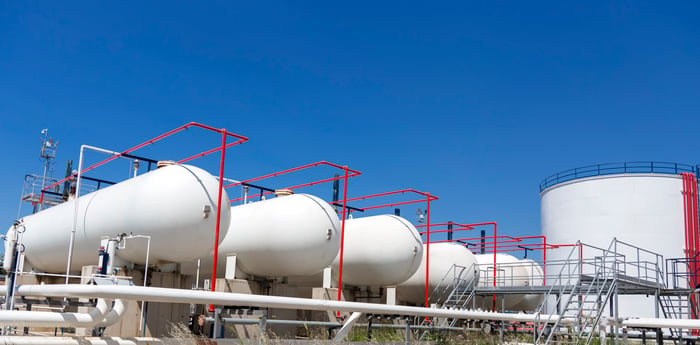
Image source: Getty Images.
Woodside itself expects LNG production from its operated facilities to reach roughly 40 million tons annually by 2032, nearly double current levels. The company also expects annual operating cash flow to increase from about $5 billion today to roughly $9 billion by the early 2030s.
Of course, this doesn't automatically make Woodside the best acquisition target, particularly when you consider cost.
Cost and execution still matter
Woodside's market value is roughly $40 billion, meaning a takeover would likely require a premium. That's a substantial commitment even for Exxon, particularly after the Pioneer acquisition, which cost the company more than $59 billion.
Any deal would also likely face political scrutiny in Australia. Western Australia Premier Roger Cook has already publicly expressed opposition to a takeover that would move Woodside's headquarters out of Perth.
There's also execution risk.
While Scarborough is nearing completion, Woodside's Louisiana LNG project appears to face some commercialization challenges. Reuters reported in April that the company was struggling to secure additional long-term LNG sales agreements, with industry sources citing liquefaction fees that were above prevailing U.S. market rates.
That's why another Australian producer could potentially be a contender, too.
The Santos angle
Santos (OTC: SSLZY), the Australian energy producer that operates throughout Asia and other global markets, doesn't offer the same scale as Woodside, but it owns valuable LNG assets in Australia and Papua New Guinea, and would likely be far less expensive to acquire while providing Exxon with many of the same strategic benefits.
A smaller acquisition generally means fewer assets to integrate, fewer overlapping operations to consolidate, and less execution risk. Santos would still give Exxon meaningful exposure to LNG markets in Asia, but without the complexity and price tag that would accompany a takeover of Woodside. That's not trivial.
Still, if Exxon is looking for a transformative deal rather than an incremental one, Woodside remains the most compelling candidate.
The company offers record production, billions in cash flow, major LNG projects nearing completion, and decades of exposure to growing Asian energy demand. Those are exactly the kinds of assets Exxon has been prioritizing.
Whether a deal actually happens remains uncertain. Woodside has stated that it is unaware of any proposal involving Exxon.
That said, after spending years building one of the strongest shale portfolios in North America, Exxon now appears heavily focused on LNG. And if management believes global natural gas demand will remain strong for decades, another megamerger is likely.
Should you buy stock in Santos right now?
Before you buy stock in Santos, consider this:
The Motley Fool Stock Advisor analyst team just identified what they believe are the 10 best stocks for investors to buy now… and Santos wasn’t one of them. The 10 stocks that made the cut could produce monster returns in the coming years.
Consider when Netflix made this list on December 17, 2004... if you invested $1,000 at the time of our recommendation, you’d have $424,531!* Or when Nvidia made this list on April 15, 2005... if you invested $1,000 at the time of our recommendation, you’d have $1,273,016!*
Now, it’s worth noting Stock Advisor’s total average return is 940% — a market-crushing outperformance compared to 209% for the S&P 500. Don't miss the latest top 10 list, available with Stock Advisor, and join an investing community built by individual investors for individual investors.
See the 10 stocks »
*Stock Advisor returns as of June 18, 2026.
Jeff Siegel has no position in any of the stocks mentioned. The Motley Fool has no position in any of the stocks mentioned. The Motley Fool has a disclosure policy.
Recommended Articles


