


Rocket Lab Has a $1.1 Billion Backlog, 50+ Successful Launches, and Neutron Due in 2026 — Is RKLB a Buy at $117?
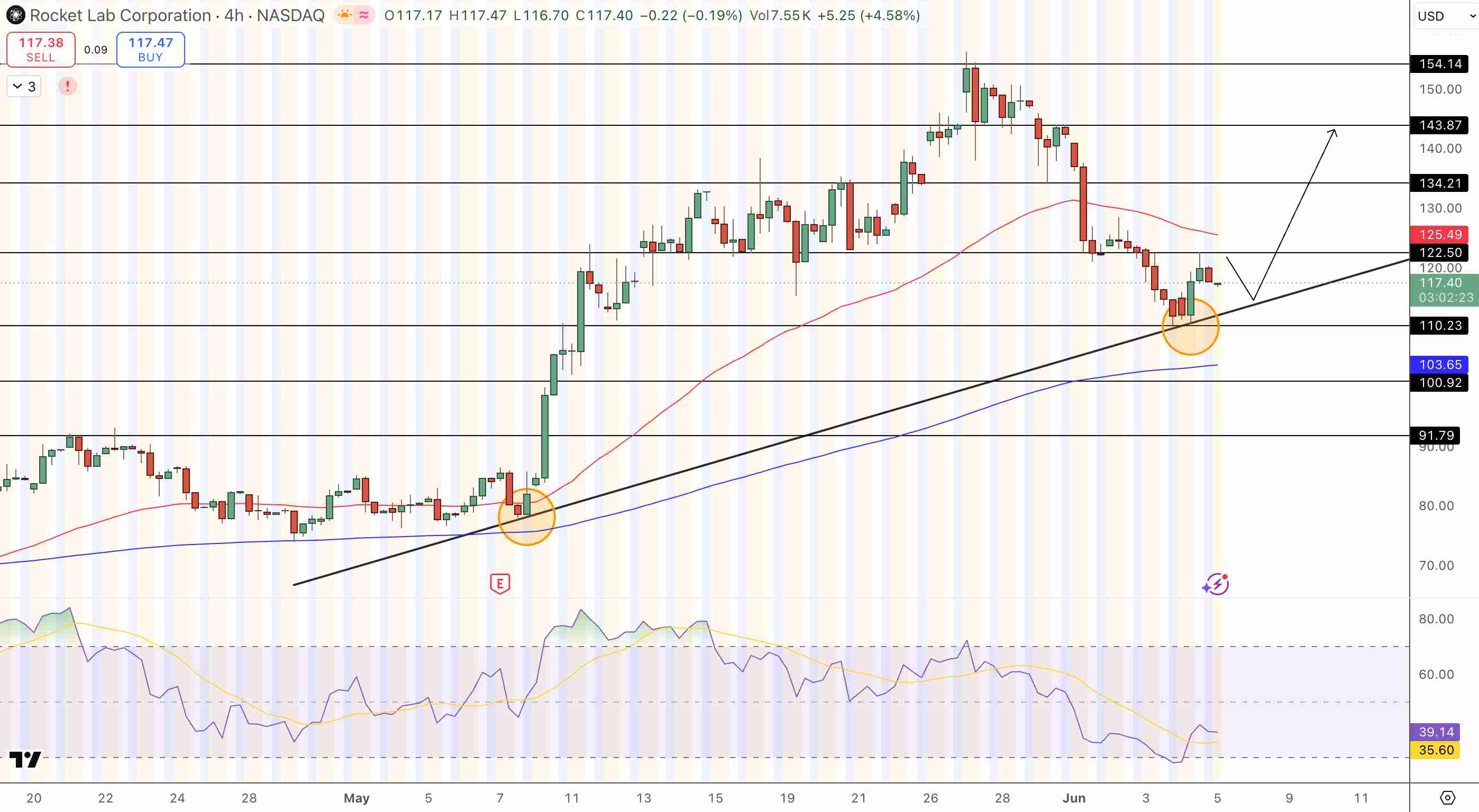
TradingKey - In its latest quarter, Rocket Lab USA (NASDAQ: RKLB) reported $110 million in revenue, has completed more than 50 orbital launches, boasts a $1.1 billion backlog, and is planning its first Neutron flights in 2026. From a technical perspective, the stock has retraced from $154.14 high into the ascending multi-touch trendline on the 4H chart at the $117.40 price. RSI stands at 39 to 50 and a minor bullish divergence is taking shape in the early stages. Rocket Lab is the most credible pure-play space infrastructure public investment today because its $1.1B backlog is valid, its flight history is real, and Neutron is the catalyst that alters the revenue ceiling.
Why Rocket Lab Is No Longer Just a Launch Company
The most significant fundamental change for Rocket Lab over the past couple of years is the evolution from a pure-launch vehicle operator to a vertically integrated space company. Electron launches into orbit remain the core of the business but, over the past 24 months, the Space Systems business has expanded beyond a niche operation to the point of being a meaningful revenue contributor with a significantly better margin profile.
The $1.1 billion backlog is a direct result of this diversification away from pure-launch-only contracts that are booked mission-by-mission. A purely-launch vehicle backlog that size for Electron alone would require dozens and dozens of missions and take years, potentially a decade or longer, to execute. But Rocket Lab has multiple-year space systems manufacturing contracts, satellite platform deployments, and supply contracts for spacecraft components all included in the backlog as well.
Rocket Lab’s recent wins with the Department of Defense in the field of responsive and resilient launches is just one example of a multi-year defense-funded program designed to create a more resilient space architecture for the U.S. Department of Defense. National security launch is an expansion market that will not materially contract, regardless of whether commercial demand for smallsat launches accelerates.
What Neutron Actually Means for Rocket Lab’s Revenue Ceiling
Electron can lift up to about 300 kg of payload into low Earth orbit, which means only certain types of satellites are viable customers for a launch contract. However, with its reusable first stage, Neutron will have the potential to put up to 13,000 kg in orbit on one flight, which is 43 times the payload lift capability of Electron. And, because a Neutron rocket is designed for reusability, the cost per launch and revenue per launch will be significantly higher than Electron launches today. A single Neutron mission could produce revenue equivalent to many Electron launches. It also opens the door to a whole new class of customers, including commercial customers for medium-sized satellites, cargo and large government payloads that today only have access to SpaceX’s Falcon 9 rocket.
Rocket Lab plans the first flight of Neutron in 2026 and, when it happens, that is not the start of Neutron revenue in size; it is a proof-of-concept milestone to get the vehicle into service, initiate qualification of customers, and then to start moving Letters of Intent into firm contracts. 2027 to 2028 is the year that Neutron revenue begins to really impact the financials but, as always, the market starts pricing in future cash flows long before the money starts rolling into the company and that is why the first flight milestone in 2026 should drive the stock higher far more than the first commercial customer launch in the subsequent year. Neutron is not perfect today, but the engine tests have passed and structural development milestones have been hit.
RKLB Technical Setup — Ascending Trendline at $117, RSI 39–50, Target $134
Rocket Lab’s stock is in the middle of the 4H ascending trend and at $117.40 is bouncing off the multi-touch ascending black trendline following a decline from the $154.14 high to the $110 region. RSI sits at 39 to 50, a neutral setting where we’re starting to see an incipient bullish price divergence as each successive low is higher. The red volume bars are rising on the green candles indicating accumulation at the support level.
The overhead red trendline sets the immediate resistance area at $122.10 to $124.95. Should the $122.50 handle clear, the path is open to extend to the $134.21 and $143.87 level. The horizontal support to the downside is at $110.23 to $103.65.
Trade Idea
- Entry: above $122.50 after $122.10 handle clears.
- T1: $134.21
- T2: $143.87
- Stop: below $110.23
What Does Rocket Lab Do and What Is Its Revenue?
Rocket Lab delivers small satellite launches using its Electron rocket, manufactures spacecraft and components through its Space Systems division, and operates the Photon satellite platform to serve both government and commercial space customers. The company reports that it has successfully completed 50+ orbital launches and has achieved a record Electron launch cadence in 2025.
Quarterly revenue was recently ~$110m with $1.1b+ backlog for multi-year revenue visibility across launches and space systems.
What Does Rocket Lab Do and What Is Its Revenue?
Neutron, Rocket Lab’s medium-lift reusable rocket, is targeting a 13,000kg payload to low earth orbit, a 43x payload capacity increase from Electron. The first stage on Neutron is designed to be reusable, reducing cost per flight. Management continues to maintain a 2026 launch date for the first Neutron launch, with engine tests and structure development milestones already achieved.
The launch of Neutron introduces a different customer tier, medium size constellations, commercial cargo, and government payloads that are served currently by SpaceX’s Falcon 9, and the Neutron is the primary long term inflection point for revenue.
Is RKLB a Buy at $117 After Pulling Back From $154?
The bull case for RKLB is strong. $1.1b+ backlog, 50+ successful launches, a growing Space Systems business with government and space security customers, and the potential for the Neutron to be first launched before revenue arrives, which is enough to re-rate the stock. The 4H ascending trendline with RSI positive divergence with the reading between 39 to 50 supports the technical setup.
Above $122.50, the targets are $134.21 and $143.87 with a stop below $110.23. Key risks include Neutron’s first launch schedule, competition from SpaceX and Firefly, and cash burn in a higher for longer interest rate environment, requiring position sizing to be consistent with stage of development risk.
Bottom Line
Rocket Lab is no longer an early-stage company. It has 50+ successful launches, a backlog in the $1.1 billion range, a growing space systems business with government and national security customers, and Neutron targeting a first launch in 2026 that would introduce a different customer segment, medium constellations, commercial cargo, and government payloads that are served currently by SpaceX Falcon 9. The drop from $154 to $117 is not an underlying fundamental shift in the story, but simply the operation of an ascending trendline within a larger timeframe uptrend.
Above $122.50, the targets are $134.21 and $143.87 with a stop below $110.23. The next event that will re-rate the stock is a 2026 first launch on Neutron. Until that occurs, Electron’s launch cadence, the $1.1b+ backlog, and Space Systems’ growth will be the fundamental drivers.
Recommended Articles


