


AAOI Stock Forecast: Applied Optoelectronics Revenue Grew 42%, but Is the AI Opportunity Just Starting?
TradingKey - Applied Optoelectronics (NASDAQ: AAOI) posted Q1 2026 revenue of $68.4 million, a 42% year-over-year increase, as it ramped up shipments of 800G transceivers for artificial intelligence and cloud applications. The move helped non-GAAP gross margin jump from 19.4% to 28.7%. Net loss contracted from $0.42 per share to $0.18 per share and operating cash flow was positive.
There isn’t anything here suggesting a struggling business: this is the kind of performance one would expect to see out of a smaller optical component manufacturer at the beginning of a structural uptrend in AI data centre network build-outs.
Shares are at $195.75, giving back from $221.57 peaks to reach the rising trendline on the 2-hour chart. Setup looks good. The real question, of course, is whether we have a growth story here or a cyclical play where 800G adoption tapers off eventually.
Why Every Large AI Cluster Has an AAOI-Sized Opportunity Built Into It
One of the less-widely recognized facts regarding large-scale AI data centres is the amount of optical transceivers used. A 100,000-GPU training cluster (which is the size we’re talking about with Microsoft, Meta, and Google right now) needs a lot of optical connections, one for each GPU, one for every switch, one for every rack, one for every building in a data centre campus. Rough industry numbers suggest that a 100,000-GPU cluster would require hundreds of thousands to low millions of individual transceivers, depending on cluster configuration. At 800G speeds, the transceiver is a decently priced component. So a single hyperscaler’s budget for transceivers over its AI deployment phase could easily reach into the hundreds of millions before one model ever sees the first training epoch.
Applied Optoelectronics is a part of this by virtue of having a vertically integrated product design and manufacturing: rather than just sourcing parts and assembling units, it actually makes the lasers, chips, and transceiver assemblies itself. That gives AAOI both cost and time-to-market advantages in bringing the next speed-gen to market relative to assembly-only manufacturers. The current 800G line of products (the one driving Q1 2026’s 42% increase) is in peak adoption. The next gen, 1.6T, is in the works at Applied Optoelectronics to follow along with the 800G adoption ramp when hyperscaler infrastructure starts the 1.6T migration sometime around 2027 to 2028. And design wins with Tier 1 hyperscalers is the leading indicator: each design win today translates to volume shipments 12 to 18 months in the future, once the new cluster goes into production.
The Q1 2026 Numbers — What the Margin Expansion Tells You
The margin expansion from 19.4% to 28.7% in a single year is probably the most important number in Q1’s release and it isn’t being talked up nearly enough. A gross margin increase of 930 basis points over a year for a hardware manufacturing business is generally a sign of at least one of these three factors: shift in product mix to higher-value items; operational efficiency from volume; or pricing power from a supply-demand gap. I expect AAOI has all three going. The shift towards 800G from slower products is a mix upgrade. Revenue growth of 42% means fixed cost absorption via operating leverage. And the 800G transceiver demand out there from hyperscalers is running hotter than the current supply from the 3 to 4 legitimate suppliers in this space (AAOI, Coherent, InnoLight, and a few others), meaning AAOI has pricing leeway that it simply didn’t in the last 400G wave.
Where to next from here depends on continued volume growth and keeping margins in check. Quarterly revenue at $68.4 million and gross margin at 28.7% means that the company is grossing about $19.6 million per quarter. The net loss of $0.18 per share is simply operating expenses still topping gross profit. But at this growth rate and margin trajectory, there’s a solid chance of seeing AAOI GAAP profitable within the next two to three quarters, so long as the 800G demand cycle continues to hold. That inflection point when a business like this finally goes from high-risk growth stock to a fundamentally re-ratable business will be the real game-changer.
AAOI Technical Setup — Ascending Trendline at $195, Entry Above $202, Target $221
On the 2-hour chart, AAOI is at $195.75 defending the rising black trendline off $221.57 highs. A green set of candles are now forming on the trendline with volume on the defensive. So, support levels with volume confirmed. RSI sits at 49 to 57; neutral-bullish with room to run before overbought and no bearish divergence. The descending red trendline from $221.57 is the ceiling on the upside, with $202.89 to $209.41 as targets in the near term. Break above $202.90 and it will open a shot at $221.57. Stop loss below $184.30, which represents a break in the rising trendline and larger channel pattern.
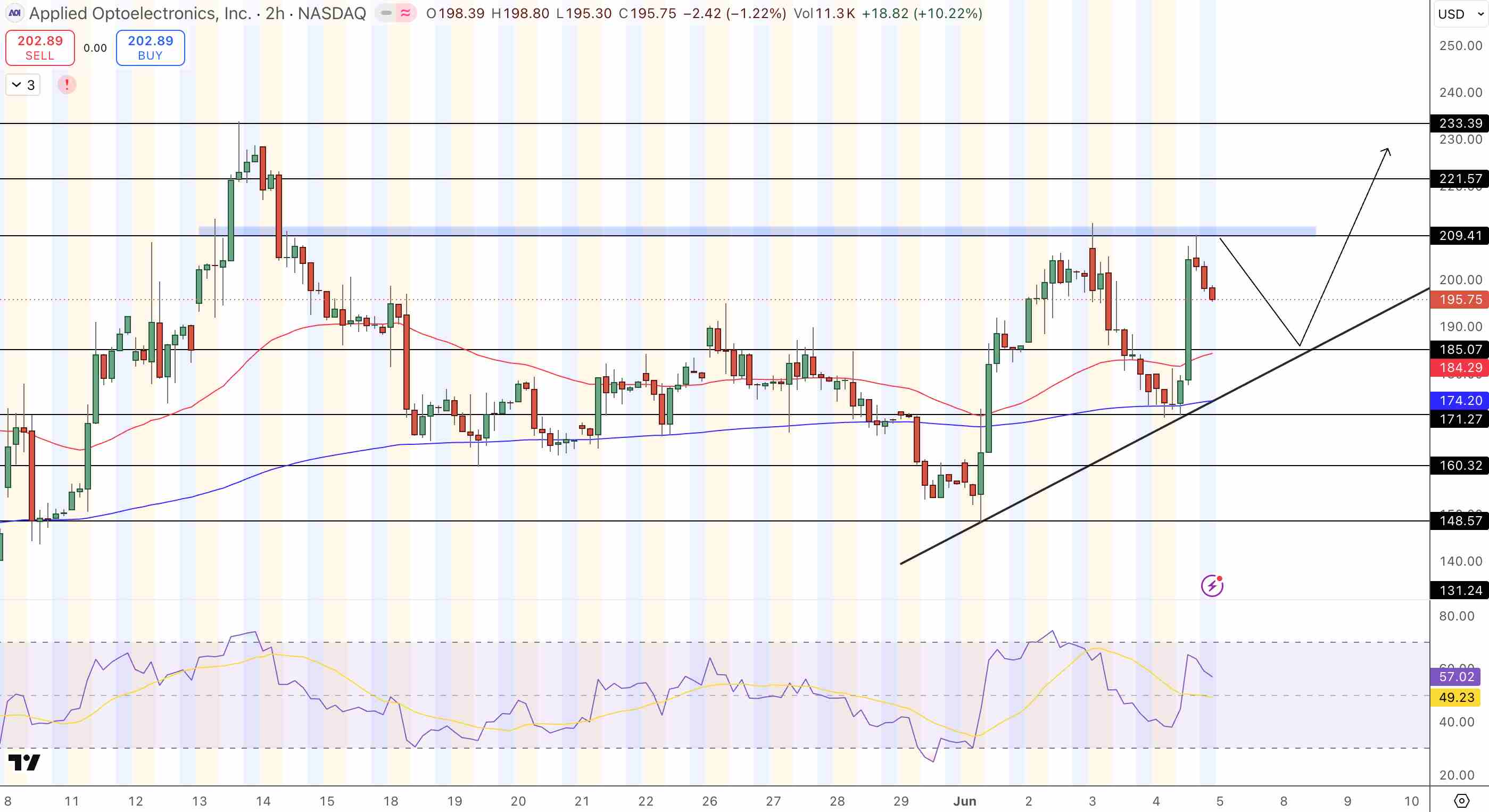
TRADE SETUP
- Entry: Long above $202.90, Descending resistance cleared
- Target 1: $209.41, Resistance cluster at support
- Target 2: $221.57, prior high
- Stop Loss: Daily close below $184.30, Breaking rising trendline
Q1 2026 Earnings Review:
AAOI's revenue totaled $68.4 million for Q1 2026, representing a 42% increase year over year. 800G transceiver shipment increases from AI and cloud computing demand helped propel revenue higher. Non-GAAP gross margin expanded from 19.4% to 28.7%. Net loss per diluted share narrowed from $0.42 to $0.18. Cash flow from operations was positive. As we enter Q2, AAOI's order book is robust and the company sees revenue continuing to grow during 2026, however no full-year financial guidance was released.
What Products Does Applied Optoelectronics Offer:
AAOI produces high-speed optical transceivers, lasers, and sub-assemblies for use in data centers and hyperscale deployments. A hyperscale data center containing 100,000 GPUs for AI training purposes could include hundreds of thousands of optical transceivers for connecting GPUs, optical switches, and network racks, at the data rates and bandwidth necessary to train an AI model. AAOI produces transceivers at 800G speeds. Being fully integrated, making their own lasers and optoelectronic integrated circuits, allows the company to be competitive with regards to time-to-market and manufacturing costs. Design wins at hyperscale customers are usually 12 to 18 months out prior to the transceiver being in volume production.
Is $195 a Buy With Strong Competition From Coherent, Inc. And InnoLight?
It's certainly a valid concern that there are much larger companies with more capital to invest in the optical market, including competitors like Coherent, Inc. (COHR), InnoLight, and Cisco Systems, Inc. (CSCO). However, the 42% Q1 revenue increase, combined with the 930 bps gross margin improvement, points to AAOI running a competitive operation and being a participant in the 800G transceiver demand wave. AAOOI is trading at $195.75 and defending an ascending trendline, while the RSI sits in neutral territory. Longs above $202.90 target $221.57 and should be stopped out if the stock slips below $184.30. AAOI is a high-risk, small-cap name and investors should consider position sizing before taking a position in this name. The profitability inflection in the next two to three quarters is the catalyst that would most significantly re-rate the stock.
Bottom Line
AAOI revenue growth accelerated to 42% in Q1 while gross margin growth nearly doubled during the quarter. The 800G transceiver cycle exists, vertical integration helps the company keep margins higher and design wins at hyperscale customers are a lead indicator of volume. There are risks from competition from larger companies and AAOI still has a way to go before GAAP profitability. The stock is currently trading at $195.75 and is defending an ascending trendline, the RSI is neutral to bullish, and volume has been healthy. Trade longs above $202.90 targeting $209.41 and $221.57 with a stop loss at $184.30. If AAOI shows profitability in the next two to three quarters, the stock could shift into a re-rate situation as well as being an equity momentum trade.
Recommended Articles


