


Where Will Tesla Stock Be in 3 Years?
Key Points
Tesla's first-quarter gross margin recovered to its best level in over a year.
The stock trades at about 380 times earnings as of this writing.
The company plans to spend more than $25 billion this year on AI, autonomy, robotics, chips, and other capital projects.
- These 10 stocks could mint the next wave of millionaires ›
Shares of Tesla (NASDAQ: TSLA) have staged a powerful comeback. After sliding for much of 2026, the stock has rallied over the past several weeks to about $420 as of this writing, leaving it well ahead of where it traded a year ago. The rebound has tracked recovering profit margins and a pickup in Chinese sales, with the market also warming to the company's autonomous-driving ambitions.
But a strong stretch for the stock doesn't automatically signal an attractive long-term outlook for shares. When thinking about the stock's potential, there's a lot to be concerned about. Tesla's core car business shrank last year, and the stock's price already assumes that self-driving software and robotics will become enormous profit engines for the overall company.
Will AI create the world's first trillionaire? Our team just released a report on the one little-known company, called an "Indispensable Monopoly" providing the critical technology Nvidia and Intel both need. Continue »
So, where could Tesla stock realistically be in three years?
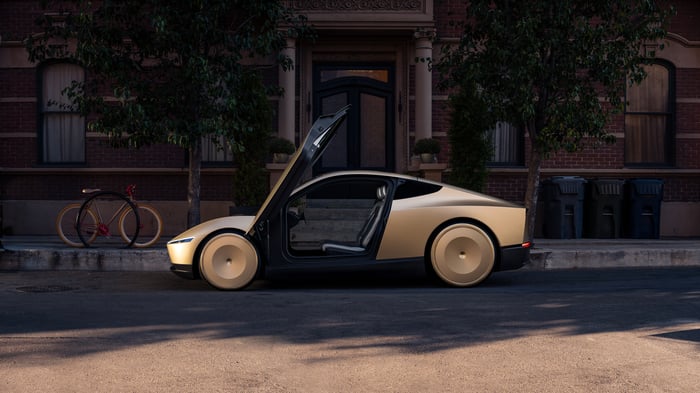
Image source: Tesla.
A business finding its footing
Tesla's first quarter showed a company on firmer ground than it was a year ago. Revenue rose 16% year over year to $22.4 billion, and the company's gross margin recovered to 21.1% -- up from 16.3% a year earlier and its best level in more than a year.
China, long a sore spot for the company, is reviving. Sales of Tesla's China-made vehicles reportedly jumped about 40% in May from a year earlier, the strongest monthly total of 2026.
And the autonomy story keeps inching forward. Tesla expanded its driverless Robotaxi service to Dallas and Houston in April, and the paid miles its robotaxis logged nearly doubled from the prior quarter. Additionally, Reuters reported in early June that Tesla had also launched unsupervised robotaxi service across the entire Austin metro area. The company also recently said active Full Self-Driving (Supervised) subscriptions reached 1.28 million, up 51% year over year.
Still, management is pacing the expansion deliberately.
"Initially, we're taking a very cautious approach to the rollout here," said Tesla CEO Elon Musk in the company's first-quarter earnings call.
Musk is targeting roughly a dozen states for the Robotaxi service by the end of 2026.
The three-year question
For all that progress, the heart of the business contracted last year.
Tesla delivered about 1.6 million vehicles in 2025, down roughly 9% from 2024, and last year brought the company's first annual revenue decline. In the first quarter, production again outran deliveries by roughly 50,000 vehicles, pushing more cars into inventory.
That backdrop makes the valuation the central issue. At about 390 times earnings as of this writing, Tesla carries a price-to-earnings ratio that no ordinary automaker (and few companies of any kind) could justify on current profits. This is because its roughly $1.6 trillion market capitalization rests on the belief that Robotaxi and the Optimus humanoid robot will one day dwarf the car business.
Tesla is spending heavily to get there. Management raised its 2026 capital expenditures plan to more than $25 billion -- about triple last year's, and the company's chief financial officer told investors to expect negative free cash flow through the rest of the year as that capital flows into AI infrastructure and Tesla's newest products.
And the payoff from these investments is probably years away. Tesla doesn't expect Robotaxi to bring in meaningful revenue this year, Optimus is still in the production-line installation stage, and the autonomy timeline still hinges on safety records and regulators -- including in China, where approval for the company's driver-assistance software remains pending.
So, where could the stock land in three years?
The honest answer is that the range is unusually wide. At about 390 times earnings, the price arguably already builds in autonomy success. Even if Tesla were to triple its earnings over the next three years, the stock would still trade at well over 100 times earnings at today's price. To compound at even a market-like rate from here, the company likely needs both a real earnings inflection from autonomy and investors still willing to pay a steep premium for the promise.
All of this to say, my best guess is that three years from now, the stock will still be trading somewhere between $300 and $600 per share.
That's probably not a satisfying prediction to hear. But that's the reality of the significant uncertainty that underscores the stock, given its extraordinarily high valuation and the speculative nature of its growth initiatives.
Sure, few companies have a better record of turning bold bets into shipping products. But from this price, the car business is almost beside the point.
Overall, I'd treat Tesla as a high-risk holding whose three-year path has a wide range of outcomes.
Don’t miss this second chance at a potentially lucrative opportunity
Ever feel like you missed the boat in buying the most successful stocks? Then you’ll want to hear this.
On rare occasions, our expert team of analysts issues a “Double Down” stock recommendation for companies that they think are about to pop. If you’re worried you’ve already missed your chance to invest, now is the best time to buy before it’s too late. And the numbers speak for themselves:
- Nvidia: if you invested $1,000 when we doubled down in 2009, you’d have $557,033!*
- Apple: if you invested $1,000 when we doubled down in 2008, you’d have $59,133!*
- Netflix: if you invested $1,000 when we doubled down in 2004, you’d have $439,632!*
Right now, we’re issuing “Double Down” alerts for three incredible companies, available when you join Stock Advisor, and there may not be another chance like this anytime soon.
See the 3 stocks »
*Stock Advisor returns as of June 4, 2026.
Daniel Sparks and his clients have positions in Tesla. The Motley Fool has positions in and recommends Tesla. The Motley Fool has a disclosure policy.
Recommended Articles


