


Indian Rupee ticks lower as RBI leaves Repo Rate unchanged at 5.25%, as expected
- The Indian Rupee edges down against the US Dollar after the RBI keeps key interest rates steady.
- RBI Governor Malhotra warns that energy supply crisis has prompted risks both to inflation and growth.
- Investors await the US NFP data for fresh cues regarding the Fed’s monetary policy outlook.
The Indian Rupee faces marginally selling pressure against the US Dollar (USD) after Reserve Bank of India’s (RBI) monetary policy decision; however, the USD/INR pair is still marginally lower at around 95.70.
As expected, the RBI has left its Repo Rate steady at 5.25%, with warning that adverse implications of the extended disruption in global supply chains and higher energy prices have prompted risks both to inflation and growth. However, RBI Governor Sanjay Malhotra has stated that the headline inflation is still below the central bank’s target and the core inflation is much lower, excluding precious metals.
Regarding the monetary policy outlook, RBI Governor Malhotra has guided that it is “prudent to wait for greater clarity to emerge” and the central bank will remain “data-dependent”.
Meanwhile, the RBI has raised retail inflation forecast for the Financial Year (FY) 2026-27 to 5.1% from 4.6% previously anticipated.
Geopolitical tensions to remain a key drag on Indian Rupee
Continues hostilities between Israel and Lebanon despite the United States (US)-brokered ceasefire continue to escalate US-Iran deal uncertainty.
Hezbollah chief Naim Qassem has rejected the ceasefire deal as a “farce”, warning that northern Israel will remain a target for fighters as long as Israel continues to bomb Lebanon, AlJazeera reported.
Ongoing Israel-Lebanon attacks could result in a resumption in oil prices’ rally, a scenario that will be unfavorable for currencies from economies, such as India, which rely heavily on oil imports to meet their energy needs.
Investors await US NFP data
Later in the day, investors will pay close attention to the US Nonfarm Payrolls (NFP) data for May, which will be published at 12:30 GMT. The US official employment data will influence market expectations for the Federal Reserve’s (Fed) monetary policy outlook.
The US NFP report is expected to show that employers hired 85K fresh workers, lower than 115K in April. The Unemployment Rate is seen steady at 4.3%.
Year-on-Year (YoY) Average Hourly Earnings, a key measure of wage growth, is estimated to arrive lower at 3.4% from the previous reading of 3.6%. On a monthly basis, the wage growth measure is expected to have grown 0.3% faster than 0.2% in April.
Technical Analysis: USD/INR holds above 20-day EMA
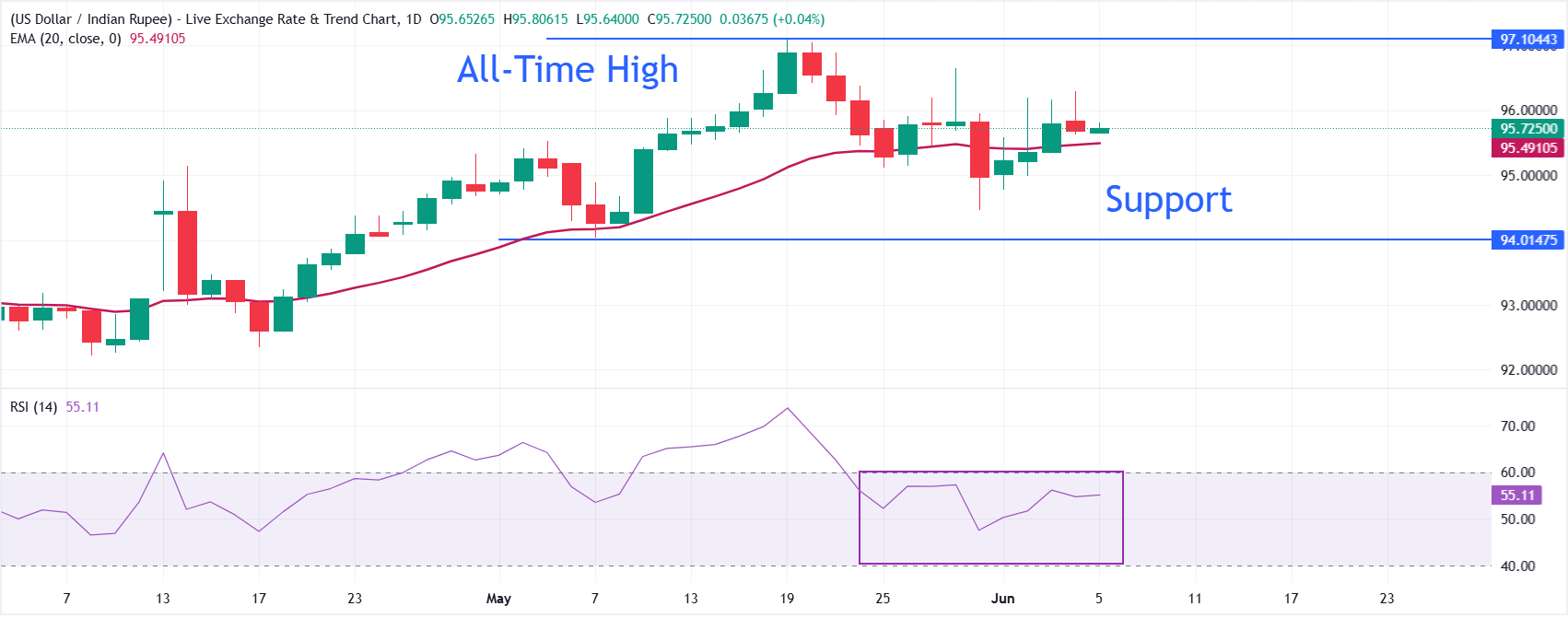
USD/INR trades marginally lower at around 95.70 at press time. The pair maintains a constructive bullish bias as spot remains above the 20-period Exponential Moving Average (EMA) at 95.4910.
The bounce from last week’s lows has kept the pair supported by this short-term trend indicator, while the 14-period Relative Strength Index (RSI) near 55 points to mildly positive, but not overstretched, momentum.
On the downside, immediate support is located at the 20-period EMA around 95.49, where buyers are likely to defend the short-term uptrend; a daily close below this area would suggest a deeper corrective move towards 95.00, while the May 7 low around 94.00 will remain key support zone. Looking up, the pair could aimd to revisit the all time high slightly above 97.00 if it manages to rise above the June 4 high at 96.30
(The technical analysis of this story was written with the help of an AI tool.)
Indian Rupee FAQs
The Indian Rupee (INR) is one of the most sensitive currencies to external factors. The price of Crude Oil (the country is highly dependent on imported Oil), the value of the US Dollar – most trade is conducted in USD – and the level of foreign investment, are all influential. Direct intervention by the Reserve Bank of India (RBI) in FX markets to keep the exchange rate stable, as well as the level of interest rates set by the RBI, are further major influencing factors on the Rupee.
The Reserve Bank of India (RBI) actively intervenes in forex markets to maintain a stable exchange rate, to help facilitate trade. In addition, the RBI tries to maintain the inflation rate at its 4% target by adjusting interest rates. Higher interest rates usually strengthen the Rupee. This is due to the role of the ‘carry trade’ in which investors borrow in countries with lower interest rates so as to place their money in countries’ offering relatively higher interest rates and profit from the difference.
Macroeconomic factors that influence the value of the Rupee include inflation, interest rates, the economic growth rate (GDP), the balance of trade, and inflows from foreign investment. A higher growth rate can lead to more overseas investment, pushing up demand for the Rupee. A less negative balance of trade will eventually lead to a stronger Rupee. Higher interest rates, especially real rates (interest rates less inflation) are also positive for the Rupee. A risk-on environment can lead to greater inflows of Foreign Direct and Indirect Investment (FDI and FII), which also benefit the Rupee.
Higher inflation, particularly, if it is comparatively higher than India’s peers, is generally negative for the currency as it reflects devaluation through oversupply. Inflation also increases the cost of exports, leading to more Rupees being sold to purchase foreign imports, which is Rupee-negative. At the same time, higher inflation usually leads to the Reserve Bank of India (RBI) raising interest rates and this can be positive for the Rupee, due to increased demand from international investors. The opposite effect is true of lower inflation.
Recommended Articles


