


Kospi Index Slumps Over 6% at One Point, Samsung Electronics Falls Over 7%, SK Hynix Drops More Than 9%, AI Bubble Fears Partially Erupt
TradingKey - During the Asian trading session on June 5, the Korea Composite Stock Price Index (KOSPI) saw its losses rapidly widen to over 6%. The Korea Exchange triggered the KOSPI circuit breaker mechanism after KOSPI 200 futures fell 5%, suspending program trading for five minutes.
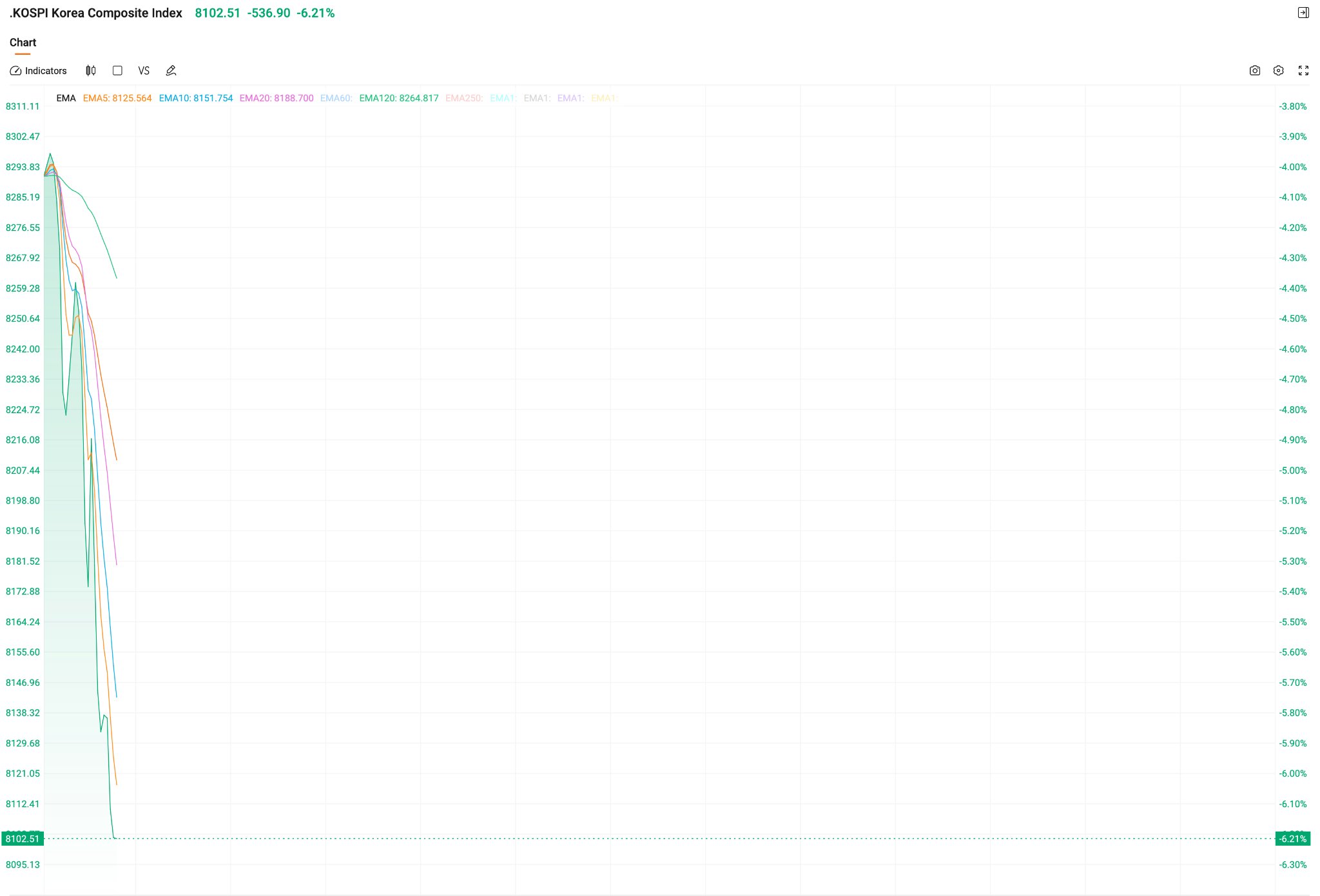
Samsung Electronics tumbled over 7%, while SK Hynix plummeted more than 9%. On the previous day, the KOSPI had already experienced a partial correction, falling 1.84%.
The core trigger for this sharp decline stems from the June 3 post-market Broadcom ( AVGO) earnings report and performance guidance.
Broadcom expects AI chip sales for the third fiscal quarter of 2026 to be $16 billion. Although this represents a year-on-year increase of over 200%, it is approximately 7% lower than the market estimate of $17.2 billion. The full-year AI chip revenue guidance of $56 billion was also below the expected $57.6 billion.
Broadcom shares at one point plummeted over 15% in after-hours trading, triggering a 5.45% plunge in the Philadelphia Semiconductor Index, with Nasdaq 100 futures following suit.
Panic quickly spread across markets. Due to the high weighting of semiconductor stocks, the KOSPI became one of the first indices to come under pressure. Additionally, the South Korean Finance Minister expressed concern that day about the increase in leveraged stock investments, stating that actions would be taken to address "herd mentality" in financial markets while closely monitoring risks in the equity, bond, and currency markets.
So far this year, the KOSPI's cumulative gain at one point exceeded 100%, with its total market capitalization more than tripling year-on-year. The massive valuation bubble accumulated in AI chip stocks is being unwound as the AI narrative in U.S. stocks softens at the margin. Since May, foreign investors have net sold approximately $22 billion in South Korean stocks, with SK Hynix recording a monthly net sell-off of about $12 billion.
This decline is a concentrated liquidation resulting from a combination of a gap in fundamental expectations and highly crowded positioning; in the short term, the market is still waiting for signals of sentiment stabilizing.
Recommended Articles


