


Dell Stock Price Prediction: Stock Soars on 45% AI Server Growth: Is DELL a Buy Now?
TradingKey - Dell Technologies (NYSE: DELL) released Q1 fiscal 2027 earnings toward the end of May, and the numbers were better than analysts predicted on both sales and profit fronts: $23.8 billion in sales, a 12% year-over-year increase; $11.2 billion from the Infrastructure Solutions Group, 28% growth year-over-year; 45% year-over-year growth in server and networking sales; and adjusted EPS of $2.41, better than Wall Street expects. Dell said its backlog for artificial intelligence servers runs through late 2026, and delivery times have not yet improved. The company returned over $1.5 billion to shareholders in the quarter.
At $420.52, DELL has risen above the 1.272 Fibonacci extension on the four-hour chart with its relative strength index near 78. At this level, DELL is finding support at $410.45. The setup is bullish. The issue is the rate of growth. Is the 45% annual gain for server and networking products an indication the demand for AI is peaking? Or does this number just signal an early period in an AI investment wave that will last several years?
Dell Q1 FY2027 AI Server Surge: Is DELL a Buy at $421?
The 45% year-over-year sales growth that Dell reported for its server and networking businesses is the key statistic when trying to re-examine the reasons Dell is worth buying today. For most of the last ten years, Dell has been viewed as a company with little growth potential, selling PCs and enterprise hardware, with single-digit growth in revenue and razor-thin profit margins. With Dell pivoting to AI-optimized servers, including PowerEdge systems equipped with Nvidia's (NASDAQ: NVDA) H100 and Blackwell graphics processing units, the IT hardware company is transitioning to a company that provides important AI infrastructure services.
An Infrastructure Solutions Group quarter of $11.2 billion, with 28% growth year-over-year, and individual servers growing 45%, does not suggest that the numbers were pushed up by a single, large transaction. The reason the numbers are higher is because enterprise customers are deploying their own artificial intelligence systems and want a company they can trust to provide the full range of equipment, the supply chain connections to obtain GPUs from Nvidia, and the expertise needed to deploy them at scale.
Dell's AI Server Backlog Extends Into Late 2026
The fact that the company has a backlog that has stretched into 2026 is a measure of the revenue growth that lies in front of it. Because Dell's delivery times for AI servers will extend until 2026, the company has demand commitments in the pipeline that will not convert into sales until 2027 and beyond. That's exactly what was driving SanDisk higher, as a backlog at a product with higher margins created more revenue certainty and reduced the risk of the cyclical demand that affects hardware sales.
Gross profit of 23.8% has been expanded because the sale of the higher-margin AI systems has replaced lower-margin devices. The Client Solutions Group grew 3% in Q1 to a total of $11.1 billion. Sales are not growing here, but the segment has not dragged on Dell's financials, as well, either. Demand has stabilized as businesses are buying new laptops and the economic outlook has improved, as the AI hardware group has picked up the bulk of the year-over-year increase.
Why Dell Is Different From Nvidia and Marvell
Nvidia manufactures the chips that artificial intelligence uses to run. Marvell Technology (NASDAQ: MRVL) manufactures the components that connect chips together. Dell builds the chips into a system that can be deployed into an enterprise setting, and provides the storage capacity, service contracts and support that companies need to run AI in production. The two segments do not compete with each other. They are largely complimentary.
Dell has a business model that is not focused on technology innovation. Instead, Dell's edge is systems engineering, scale, and relationships with enterprises. Dell's 150,000 or more customers worldwide give Dell the distribution channels that would take start-up AI server builders a long time to achieve and give hyperscalers a long time to replicate. When a member of the Fortune 500 decides to build their own in-house private cloud, Dell can walk into the room with a validated AI server, an active service contract, and an active Nvidia GPU supply relationship.
The longer-term path to higher margins is Dell's APEX portfolio of products and services sold on a monthly rental basis. As AI infrastructure transitions from a capital expenditure purchase to an operating expense, the recurring nature of Dell's AI revenue will increase its stability. Dell Technologies returned over $1.5 billion in cash to shareholders in the first quarter. With the growth Dell is seeing in its backlog, the shift in the types of hardware Dell is selling, and the strength of Dell's cash flow generation, Dell should re-rate from a low-multiple computer hardware company to a mid-to-high multiple AI infrastructure provider.
DELL Technical Analysis: Breakout Above $421 Targets $445 and $466
DELL has broken above the 1.272 Fibonacci projection on a 4H price chart, rising higher off of a $200 base. The stock has been respecting a rising black trendline as it continues to form its higher low price pattern. The small red price bar today was testing $410.45 and finding support, with its lower wick touching the breakout level. The relative strength index has been rising and near 78 but there has been no divergence between the price and momentum.
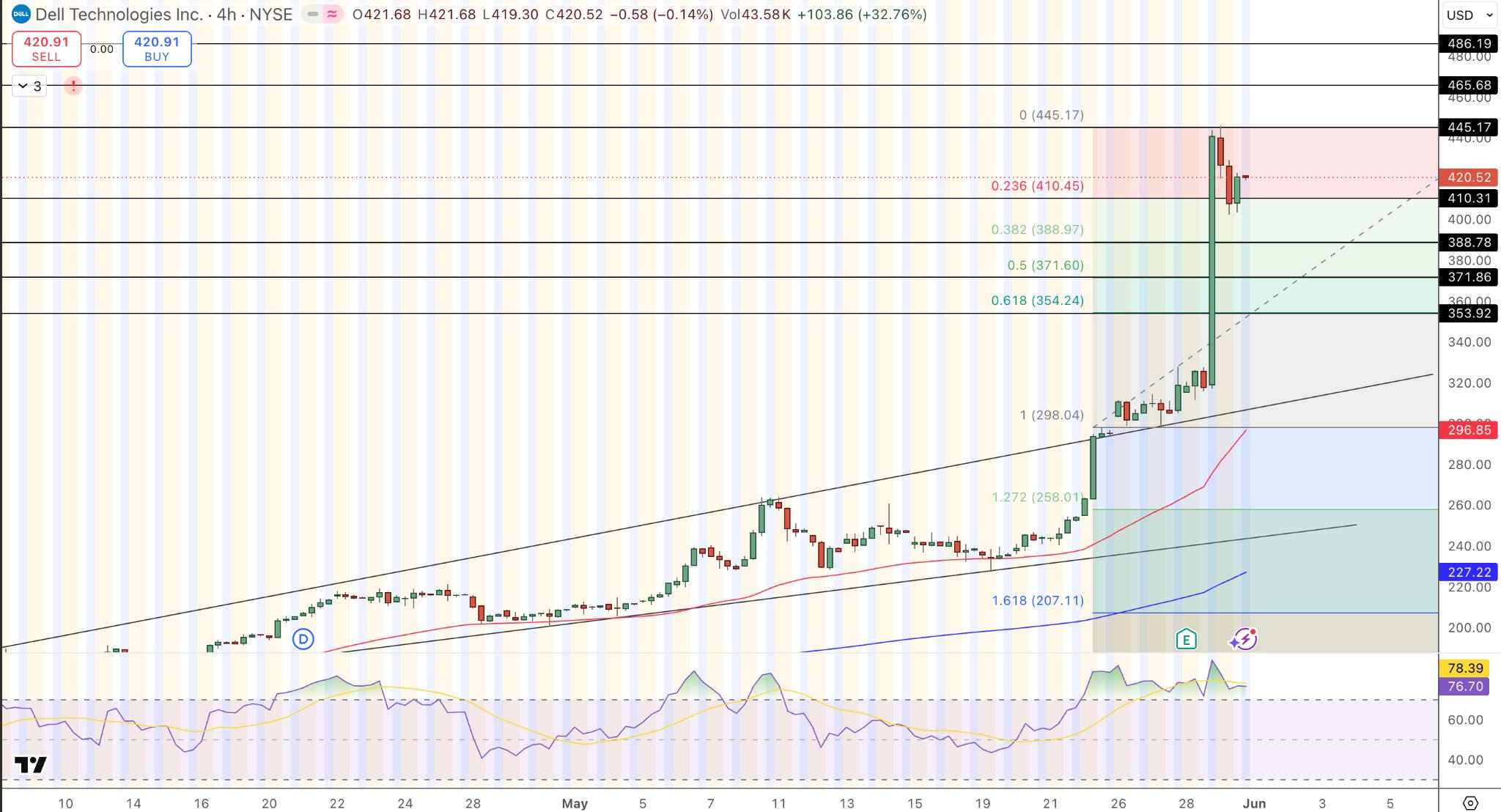
DELL Price Chart - Source: Tradingview
There is plenty of momentum on the upside, but no sign it has been spent. The next Fibonacci level to aim for on a continuation in the channel, should occur at $445.17. The upper end of a channel extension is $465.68. The stop should be placed below $410.31, where the 0.236 Fibonacci support breaks and the most recent breakout price occurs.
Investment Outlook for Dell Technologies
- Entry: Buy above $421. This is an upside breakout of the 1.272 Fib level that has been tested and found solid.
- Target 1: Sell near $445.17, which is the next Fibonacci extension level to aim for on a price chart.
- Target 2: Sell near $465.68, which is the top edge of a potential channel extension.
- Stop loss: Sell if the price closes the next daily candle below $410.31, the 0.236 Fibonacci level, and the breakout level for the most recent price rally.
What Were Dell's Q1 FY2027 Results?
Dell's Q1 FY2027 revenue came in at $23.8 billion, representing a 12% year-over-year increase. Revenue from its Infrastructure Solutions Group reached $11.2 billion, a 28% increase, with server and networking revenue up 45%, thanks in part to strong demand for AI servers in the form of PowerEdge systems packed with Nvidia graphics processing units (GPUs). Revenue from the Client Solutions Group rose 3% to $11.1 billion.
Adjusted earnings per share of $2.41 beat expectations. The company's gross margin increased to 23.8%. Dell paid more than $1.5 billion to shareholders in buybacks and dividends. Orders for AI servers run into late 2026. Dell's Q2 FY2027 results are scheduled to come out at the end of August.
Why Is Dell an AI Infrastructure Company?
Dell offers end-to-end infrastructure solutions, installing Nvidia GPUs and AI accelerators into its PowerEdge server systems and then selling them to businesses building out private AI clouds. It provides end-to-end infrastructure with servers, storage, networking, and services.
The way in which Dell has value in the AI stack is not in making chips, but instead in integrating hardware into solutions. This gives it an inherent advantage over its competitors because it can deploy to existing enterprise customer relationships. Dell's base of more than 150,000 enterprise clients provides it with a distribution advantage that startups don't have. The AI server backlog through late 2026 and the 45% increase in server revenue tell us that this is more than just talk on Wall Street; the AI server pipeline is being converted into sales.
Is DELL a Buy at $421?
Dell's stock has an attractive technical set up. DELL has topped the 1.272 Fib extension with the RSI (Relative Strength Index) near 78 and showing no sign of divergence. The chart also has a long bullish trend line that was established back in 2023. It was based off of $200 and continues to act as a strong support level. The buy is in above $421. Targets are $445.17 and $465.68. The stop loss is below $410.31.
Fundamentally, the bull case is supported by the 45% year-over-year growth in server revenue; the AI server backlog extending through late 2026; an increase in gross margin to 23.8%; and $1.5 billion in buybacks and dividends paid by the company over the quarter. The biggest risk to a bullish thesis is if Nvidia's GPU production is limited and Dell can't convert the backlog to sales, or if enterprise IT spending gets hammered.
Bottom Line
Dell's core re-rating catalyst is its 45% year-over-year growth in server revenue and the fact that the AI server backlog extends through late 2026. Dell does not make chips and is not innovating in chip design. It's more a supplier of systems to companies that are integrating Nvidia GPUs into their servers. It's a key component of Dell's business model and gives it a competitive advantage over startup companies. It can deploy to its large base of existing enterprise customers; a distribution channel startups can't duplicate.
The 23.8% gross margin is up significantly from last year. There are $1.5 billion in buybacks and dividends in Q1 FY2027 and Dell's subscription business (APEX) is becoming more dominant as the mix of its revenue moves toward subscriptions. At $421, DELL has broken above the 1.272 Fib on the 4-hour (4H) timeframe with an RSI of 78 and no divergence. There is an ascending long-term trendline that has stood the test of time since March 2023. The trade is above $421.
Take target profits at $445 and $466. Q2 earnings at the end of August will be the next fundamental catalyst to watch. In addition, keep an eye out for comments on Nvidia's ability to supply GPUs to Dell at the current rate that they are ordering them.
Recommended Articles


