


45.7% of Berkshire Hathaway's Portfolio Is Parked in 3 Stocks That Could Pay the Conglomerate $1.6 Billion in Dividends This Year
Key Points
Warren Buffett turned Berkshire Hathaway into a $1 trillion conglomerate during his 60-year tenure as CEO.
Buffett handed the reins to his chosen successor, Greg Abel, at the start of 2026, who is likely to follow a very similar investment strategy.
Buffett always liked dividend-paying stocks because they helped compound his returns at a faster rate.
- 10 stocks we like better than Apple ›
Berkshire Hathaway (NYSE: BRKA)(NYSE: BRKB) was a struggling textile manufacturer when Warren Buffett acquired a controlling stake in 1965. He converted it into a holding company for his various investments, and by the time he stepped down as chief executive officer at the end of 2025, it had grown into a $1 trillion conglomerate with numerous subsidiaries and a $330 billion portfolio of stocks and securities.
Buffett targeted companies with steady growth, reliable profits, and strong management teams. But he was particularly fond of companies with shareholder-friendly initiatives, such as stock buyback and dividend payments, because they helped compound Berkshire's returns much faster. The conglomerate's new CEO, Greg Abel, previously worked alongside Buffett for more than two decades, so he is likely to use a very similar investment strategy.
Will AI create the world's first trillionaire? Our team just released a report on the one little-known company, called an "Indispensable Monopoly" providing the critical technology Nvidia and Intel both need. Continue »
Three long-standing positions in Berkshire's stock portfolio, which account for almost half of its value, are on track to pay the conglomerate a combined $1.6 billion in dividends this year alone.
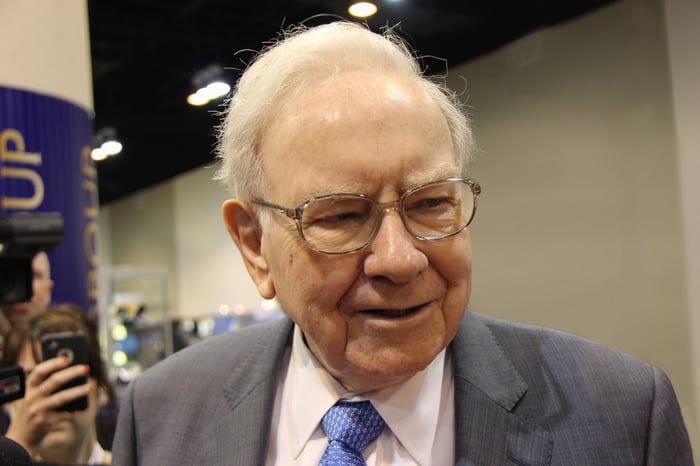
Image source: The Motley Fool.
1. Apple: $243.9 million in potential dividends in 2026
Apple (NASDAQ: AAPL) is the consumer electronics giant behind the iPhone, iPad, Mac computers, and more. The company continues to introduce artificial intelligence (AI)-powered features through its Apple Intelligence software suite, which could help attract new customers and expand its installed base of 2.5 billion devices worldwide.
Berkshire invested about $38 billion in Apple stock between 2016 and 2023. By the start of 2024, that position was worth more than $170 billion and accounted for about half of the conglomerate's entire portfolio. Buffett and his team have since sold 75% of the Apple stake to lock in some gains and reduce concentration risk, but it remains Berkshire's largest position at 21.5% of its portfolio.
Berkshire owns 227.9 million Apple shares as I write this. The iPhone maker paid a quarterly dividend of $0.26 per share in January and another of $0.27 per share in April. Two more quarterly payments of $0.27 are likely this year, bringing the annualized total to $1.07 per share.
Therefore, while capital growth is the main story here, Berkshire is on track to earn $243.9 million in dividends from its Apple stake during 2026, which is certainly nothing to sneeze at. Of course, that could change if Abel decides to further trim the conglomerate's position.
2. American Express: $556.4 million in potential dividends
American Express (NYSE: AXP) is a global payments giant. It offers credit cards to consumers and businesses, funds the underlying debt, and operates the payment network underpinning every transaction. Therefore, it has multiple revenue streams, whereas competitors like Visa and Mastercard focus on operating their respective payment networks and rely on banks to issue their cards and finance credit.
American Express is one of Berkshire's oldest positions. Buffett accumulated $1.3 billion in shares between 1991 and 1995, and that position is currently worth a whopping $47.7 billion, representing 14.4% of Berkshire's entire portfolio. That's right: The conglomerate has earned an eye-popping 3,569% return on this stock before dividends.
Amex paid a quarterly dividend of $0.82 per share in January, followed by another quarterly payment of $0.95 in April. The company is likely to make two more payments of $0.95 in 2026, taking its annualized total to $3.67 per share. Berkshire currently holds 151.6 million shares, so it's on track to earn $556.4 million in dividends this year.
3. Coca-Cola: $848 million in potential dividends
Coca-Cola (NYSE: KO) is the world's largest beverage company. Classic Coca-Cola remains its flagship soda, but the company now sells products across more than 200 brands in over 200 countries. The company's revenue typically increases at a modest pace but generates a ton of cash, which it uses to fund further product development and acquisitions. However, it also returns a ton of money to shareholders every year.
Coca-Cola is another one of Berkshire's oldest positions. Buffett spent $1.3 billion to acquire 400 million shares between 1988 and 1994, and he has never sold a single one. That position is now worth $32.1 billion, representing a staggering 2,370% return on investment -- not including dividends. This stock now accounts for 9.7% of Berkshire's portfolio.
Coca-Cola has paid two quarterly dividends of $0.53 per share in 2026 so far, and it will likely pay two more, bringing the annual total to $2.12 per share. Therefore, Berkshire is poised to earn a whopping $848 million in dividend payments on its 400 million shares this year. That means the conglomerate now recovers its entire original outlay of $1.3 billion in dividends alone every 18 months or so.
It's a practical lesson in the magic of compounding, which only works when investors focus on the long term.
Should you buy stock in Apple right now?
Before you buy stock in Apple, consider this:
The Motley Fool Stock Advisor analyst team just identified what they believe are the 10 best stocks for investors to buy now… and Apple wasn’t one of them. The 10 stocks that made the cut could produce monster returns in the coming years.
Consider when Netflix made this list on December 17, 2004... if you invested $1,000 at the time of our recommendation, you’d have $463,900!* Or when Nvidia made this list on April 15, 2005... if you invested $1,000 at the time of our recommendation, you’d have $1,294,401!*
Now, it’s worth noting Stock Advisor’s total average return is 978% — a market-crushing outperformance compared to 211% for the S&P 500. Don't miss the latest top 10 list, available with Stock Advisor, and join an investing community built by individual investors for individual investors.
See the 10 stocks »
*Stock Advisor returns as of May 31, 2026.
American Express is an advertising partner of Motley Fool Money. Anthony Di Pizio has no position in any of the stocks mentioned. The Motley Fool has positions in and recommends American Express, Apple, Berkshire Hathaway, Mastercard, and Visa. The Motley Fool has a disclosure policy.
Recommended Articles


