

Micron Just Entered the Trillion-Dollar Club. Is It Too Late to Buy the Stock?

Source The Motley Fool

Key Points

  • Micron is one of the big winners of the AI growth story as companies rush to its memory products.

  • Agentic AI could supercharge Micron’s growth in the quarters to come.

  • 10 stocks we like better than Micron Technology ›

Micron Technology (NASDAQ: MU) has been around for nearly 50 years, but these days, this tech giant is experiencing growth you might generally expect from an exciting start-up. This is thanks to the artificial intelligence (AI) boom, which has supercharged demand for the company's memory and storage offerings and translated into significant revenue growth.

As a result, investors have rushed to get in on the stock, pushing the company's market value to new highs. In fact, Micron just recently entered the trillion-dollar club, meaning its market value reached $1 trillion. It joins a handful of other tech giants, including well-known names like Amazon, Microsoft, and Nvidia -- the world's biggest company with a market value of more than $5 trillion.

Will AI create the world's first trillionaire? Our team just released a report on the one little-known company, called an "Indispensable Monopoly" providing the critical technology Nvidia and Intel both need. Continue »

Now you may be wondering: After Micron's latest gain, is it too late to buy the stock? Let's find out.

An investor holds a laptop near the window in an office.

Image source: Getty Images.

What market cap tells us

So, first, a quick note about market cap. It's exciting when a company sees its market value rise and reach high levels -- it shows that investors are interested in the stock, and that often is due to the company's performance. That's positive, of course. But, on its own, an increase in market value shouldn't be seen as a buy or sell signal. Just because a company has seen its stock rise doesn't mean the momentum will continue; and the gains don't mean it's ripe for a decline either.

Now, let's consider the specific case of Micron, starting with its role in the AI story. When we think of the training of large language models and putting them to work, we may first think of graphics processing units (GPUs) and other AI chips that power those processes. But there's another key ingredient that must be present, and that's memory. This is where Micron comes in, offering DRAM, NAND, and HBM that are needed at various moments of the training and inference processes -- training involves the feeding of information into the AI model, while inference is the actual thinking process the AI model goes through to do its job.

Micron's soaring revenue

This demand for memory has helped revenue soar quarter after quarter in recent times. In the latest period, it surged nearly 200% to more than $23 billion. And the company set records in revenue, gross margin, earnings per share, and free cash flow. Micron predicted it would set records in these metrics again in the current quarter, to be reported next month.

Moving forward, memory is positioned to become even more crucial for AI. This is because, as AI agents scale up, they will need more memory to power the processes. For example, memory allows for deeper reasoning chains and supports the collaboration of various AI agents.

Agentic AI, seen as the next big wave of AI growth, is the actual application of AI to problems -- these agents use inference to process information, then take steps to complete tasks.

So, though demand for memory has climbed, the need for it may be even greater as the agentic AI era develops -- that's fantastic news for Micron.

Micron's biggest challenge

Of course, Micron isn't alone in the space. The company faces competition from Seagate and other memory giants. But it's important to keep in mind that Micron's biggest problem these days isn't pressure from competitors but instead meeting demand. Due to supply constraints, the company said it's able to fill half to two-thirds of some of its key customers' needs in the medium term. So the challenge Micron faces is managing supply in order to keep growth progressing. As for competition, if the AI story unfolds as expected, there is room for more than one memory player to generate significant growth.

So, Micron could have plenty of bright days ahead. But is the stock a buy now? Its valuation has climbed in recent months, but it's still well below levels of a couple of years ago.
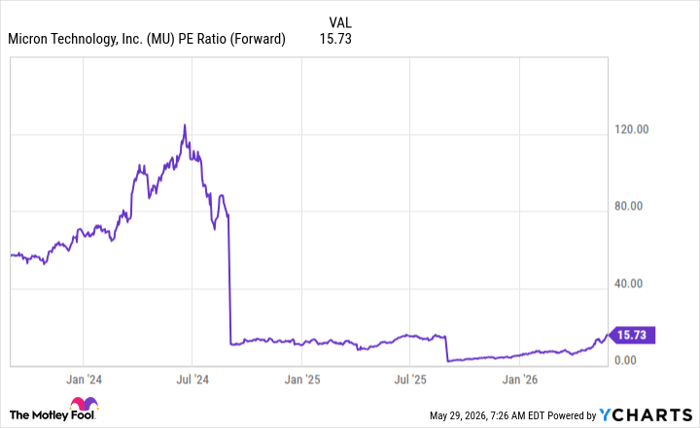
MU PE Ratio (Forward) Chart

MU PE Ratio (Forward) data by YCharts

While Micron may not look dirt cheap, it remains at a reasonable valuation considering its recent earnings performance and the long-term growth outlook. All of this means that, even after Micron's market cap roared past $1 trillion, the stock still represents a compelling AI buy right now.

Should you buy stock in Micron Technology right now?

Before you buy stock in Micron Technology, consider this:

The Motley Fool Stock Advisor analyst team just identified what they believe are the 10 best stocks for investors to buy now… and Micron Technology wasn’t one of them. The 10 stocks that made the cut could produce monster returns in the coming years.

Consider when Netflix made this list on December 17, 2004... if you invested $1,000 at the time of our recommendation, you’d have $463,900!* Or when Nvidia made this list on April 15, 2005... if you invested $1,000 at the time of our recommendation, you’d have $1,294,401!*

Now, it’s worth noting Stock Advisor’s total average return is 978% — a market-crushing outperformance compared to 211% for the S&P 500. Don't miss the latest top 10 list, available with Stock Advisor, and join an investing community built by individual investors for individual investors.

See the 10 stocks »

*Stock Advisor returns as of May 31, 2026.

Adria Cimino has positions in Amazon. The Motley Fool has positions in and recommends Amazon, Micron Technology, Microsoft, and Nvidia. The Motley Fool has a disclosure policy.

Disclaimer: For information purposes only. Past performance is not indicative of future results.
placeholder
Bitcoin CME gaps at $35,000, $27,000 and $21,000, which one gets filled first?Prioritize filling the $27,000 gap and even try higher.
Author  FXStreet
Aug 22, 2023
Prioritize filling the $27,000 gap and even try higher.
placeholder
Pinduoduo Earnings Incoming: Morgan Stanley Sees Long-Term Profit Potential​Insights – On November 21, Chinese e-commerce giant Pinduoduo (PDD) will release its Q3 2024 earnings.
Author  Mitrade
Nov 20, 2024
​Insights – On November 21, Chinese e-commerce giant Pinduoduo (PDD) will release its Q3 2024 earnings.
placeholder
Bitcoin briefly loses 2025 gains as crypto plunges over the weekend.Bitcoin experienced a sharp decline this weekend, briefly erasing its 2025 gains and dipping below its year-opening value of $93,507. The cryptocurrency fell to a low of $93,029 on Sunday, representing a 25% drop from its all-time high in October. Although it has rebounded slightly to around $94,209, the pressures on the market remain significant. The downturn occurred despite the reopening of the U.S. government on Thursday, which many had hoped would provide essential support for crypto markets. This year initially appeared promising for cryptocurrencies, particularly after the inauguration of President Donald Trump, who has established the most pro-crypto administration thus far. However, ongoing political tensions—including Trump's tariff strategies and the recent government shutdown, lasting a historic 43 days—have contributed to several rapid price pullbacks for Bitcoin throughout the year. Market dynamics are also being influenced by Bitcoin whales—investors holding large amounts of Bitcoin—who have been offloading portions of their assets, consequently stalling price rallies even as positive regulatory developments emerge. Despite these sell-offs, analysts from Glassnode argue that this behavior aligns with typical patterns seen among long-term investors during the concluding stages of bull markets, suggesting it is not indicative of a mass exodus. Notably, Bitcoin is not alone in its struggles, as Ethereum and Solana have also recorded declines of 7.95% and 28.3%, respectively, since the start of the year, while numerous altcoins have faced even steeper losses. Looking ahead, questions linger regarding the viability of the four-year cycle thesis, particularly given the increasing institutional support and regulatory frameworks now in place in the crypto landscape. Matt Hougan, chief investment officer at Bitwise, remains optimistic, suggesting a potential Bitcoin resurgence in 2026 driven by the “debasement trade” thesis and a broader trend toward increased adoption of stablecoins, tokenization, and decentralized finance. Hougan emphasized the soundness of the underlying fundamentals, pointing to a positive outlook for the sector in the longer term.
Author  Mitrade
Nov 17, 2025
Bitcoin experienced a sharp decline this weekend, briefly erasing its 2025 gains and dipping below its year-opening value of $93,507. The cryptocurrency fell to a low of $93,029 on Sunday, representing a 25% drop from its all-time high in October. Although it has rebounded slightly to around $94,209, the pressures on the market remain significant. The downturn occurred despite the reopening of the U.S. government on Thursday, which many had hoped would provide essential support for crypto markets. This year initially appeared promising for cryptocurrencies, particularly after the inauguration of President Donald Trump, who has established the most pro-crypto administration thus far. However, ongoing political tensions—including Trump's tariff strategies and the recent government shutdown, lasting a historic 43 days—have contributed to several rapid price pullbacks for Bitcoin throughout the year. Market dynamics are also being influenced by Bitcoin whales—investors holding large amounts of Bitcoin—who have been offloading portions of their assets, consequently stalling price rallies even as positive regulatory developments emerge. Despite these sell-offs, analysts from Glassnode argue that this behavior aligns with typical patterns seen among long-term investors during the concluding stages of bull markets, suggesting it is not indicative of a mass exodus. Notably, Bitcoin is not alone in its struggles, as Ethereum and Solana have also recorded declines of 7.95% and 28.3%, respectively, since the start of the year, while numerous altcoins have faced even steeper losses. Looking ahead, questions linger regarding the viability of the four-year cycle thesis, particularly given the increasing institutional support and regulatory frameworks now in place in the crypto landscape. Matt Hougan, chief investment officer at Bitwise, remains optimistic, suggesting a potential Bitcoin resurgence in 2026 driven by the “debasement trade” thesis and a broader trend toward increased adoption of stablecoins, tokenization, and decentralized finance. Hougan emphasized the soundness of the underlying fundamentals, pointing to a positive outlook for the sector in the longer term.
placeholder
Markets in 2026: Will gold, Bitcoin, and the U.S. dollar make history again? — These are how leading institutions thinkAfter a turbulent 2025, what lies ahead for commodities, forex, and cryptocurrency markets in 2026?
Author  Insights
Dec 25, 2025
After a turbulent 2025, what lies ahead for commodities, forex, and cryptocurrency markets in 2026?
placeholder
Gold flatlines near $4,450 on US-Iran uncertainties, US PCE inflation data loomsGold price (XAU/USD) trades on a flat note around $4,455 during the early Asian session on Thursday. The precious metal steadies as US-Iran peace negotiations face uncertainties.
Author  FXStreet
May 28, Thu
Gold price (XAU/USD) trades on a flat note around $4,455 during the early Asian session on Thursday. The precious metal steadies as US-Iran peace negotiations face uncertainties.
goTop
quote