


Micron’s HBM Is Sold Out Through 2026 and Data Centre Revenue Grew 150% — Is MU a Buy at $914?
TradingKey - Micron Technology (NASDAQ: MU) is trading at $914.43, having broken above the 1.272 Fibonacci extension at $862.46 and is now inching toward the 1.618 level at $919.75.
This move on the 4-hour chart is backed by robust bullish candles and a clear expansion in volume that signals aggressive buyer participation. These technicals are supported by an equally compelling fundamentals picture: Q2 FY2026 revenue surged 62% year-over-year to $8.71 billion, Data Center revenue more than doubled (+150%), the company announced HBM3E is sold out for much of 2026, and management lifted its full-year outlook to $31.5 to $33.5 billion.
Micron remains one of just three firms globally able to source the high-bandwidth memory essential for next-gen AI accelerators, and this scarcity is only just beginning to be reflected in the stock’s valuation.
Q2 FY2026 Results: The HBM Supercycle Is Here and Micron Is Sold Out
Micron delivered its Q2 FY2026 earnings report March 26, topping the board in virtually every respect. Revenue rose 62% YoY to $8.71B. The firm reported non-GAAP EPS of $1.85, well above the Street’s expectation. Non-GAAP gross margin expanded to 45.8%, from significantly lower levels a year earlier, due to a mix-shift to higher-value HBM and data centre DRAM at the expense of lower-margin consumer memory. Data Center revenue, which includes HBM and enterprise DRAM, grew >150% YoY, the fastest rate the company has recorded. The company also raised full-year FY2026 revenue guidance to $31.5 to $33.5B, implying sequential revenue growth for the balance of 2026.
Of the many things the Q2 FY2026 earnings call told us, the most important for understanding the near-term fundamental thesis is the discussion about being sold out on HBM allocations for most of 2026. This means that Micron is unable to meet all of its demand for this memory. HBM3E, Micron’s current-gen high bandwidth memory stack, is the memory stack sitting directly atop the interposer of Nvidia’s H100, H200, and Blackwell GPUs. In other words, the memory stack is what powers the GPU. There are only 3 vendors on the planet, Micron, Samsung, and SK Hynix, that can produce HBM at commercial scale. Micron’s HBM3E being sold out through much of 2026 isn’t a bad thing in that Micron is leaving money on the table. Rather, it means Micron has locked up multiyear supply contracts with major hyperscalers for contracted HBM3E pricing, which transitions the memory business away from commodity cycles, to something closer to a more visibility driven model. This would constitute a significant re-rating opportunity in the shares.
Hbm Is Different from Dram, And Why Margin Expansion Should Be Sustainable
Standard DRAM is, by its nature, a commodity. The per-GB price is determined by the intersection of supply and demand around the world. When there is too much supply in relation to demand (such as in CY2023/2024) then the per-GB margin shrinks to near zero. HBM, by contrast, is not a commodity. HBM is a custom-manufactured product that requires many months for qualification. The reason why the per-GB cost for the same capacity of DRAM is much greater for HBM products is because it is very hard to switch suppliers once a hyperscaler is in the deployment phase of an AI data centre. HBM manufacturing involves a unique stack-based approach that only a very few companies around the globe have mastered at commercial scales. It takes many months to qualify, and there are high switching costs if a customer wants to switch from one HBM supplier to another once they have moved to mass deployment in the field.
According to Micron CEO Sanjay Mehrotra, HBM is being driven by AI, which is driving a massive shift from traditional DRAM workloads to massively parallel AI workloads. HBM can be thought of as 10-20x more memory intensive than standard DRAM. It is these structural forces that make the Q2 FY2026 45.8% non-GAAP gross margin expansion a likely trend, and not something that will soon revert back to the historical norm. Micron is making significant investments into HBM and will continue to invest. Micron currently produces its 1beta, and 1gamma DRAM process nodes with improved power and density that support higher-end HBM products. Additionally, the U.S. and Japan manufacturing expansion, supported by CHIPS Act funding, reduces geopolitical supply chain risk and gives hyperscalers the domestic sourcing assurance they increasingly require. Micron also continues to enjoy strong business from legacy DRAM markets such as PCs, smartphones, automotive, which are also recovering after the 2024 to 2025 downturn. Together, Micron has an improving margin profile, with a legacy DRAM business that is beginning to improve, in addition to its leading edge HBM that is currently sold out. That’s usually a combination that doesn’t stick at a discount forever.
MU Chart Analysis: Fib 1.618 at $919.75 as Next Target Following 1.272 Clearance
MU is trading for $914.43 on the 4H chart. MU has cleared the 1.272 Fib at $862.46 with strong bullish candles along with a clear increase in volume. The dynamic support has risen cleanly from the recent low at $651.84, and MU continues to generate clean higher highs and higher lows. RSI is trading from 61 to 78, indicating strong momentum, but not yet exhausted conditions.
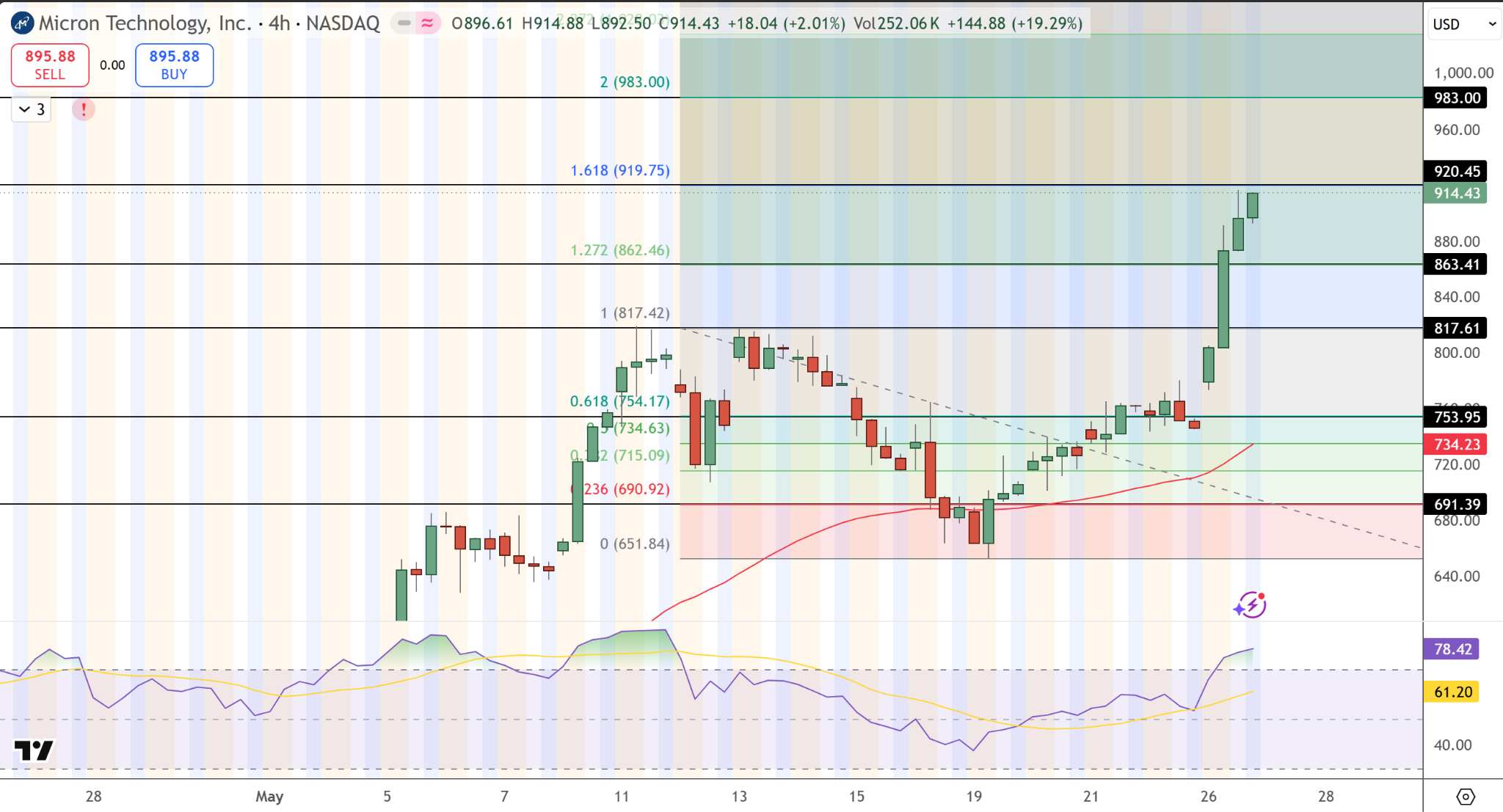
The 1.618 Fib extension at $919.75 stands out as the next potential target. That is a mere $5.32 away from the current price level. A close back above $920 would open the door to the 2.0 Fib extension at $983. Key support resides at $863 to $862, the previously broken-out 1.272 Fib level, and $734.23 on a deeper pullback.
TRADE SETUP
- Entry: Long if the daily closes above $920, fib 1.618 re-test
- Target: $983, Fib 2.0 extension
- Support: $863, prior 1.272 Fib level
- Stop loss: Daily close below $863, structure invalidation
What Did Micron Report in Q2 FY2026 Earnings?
In Q2 FY2026, Micron posted revenues of $8.71B, up +62% YoY, while earnings per share came in at non-GAAP $1.85, beating expectations. Micron reported +150%+ growth in Data Centre (DC) revenue on HBM3E supplying AI accelerator manufacturers. Non-GAAP gross margin expanded to 45.8%. Micron raised full-year fiscal 2026 revenue guidance to $31.5 to $33.5B. HBM3E reportedly is sold out through much of 2026 from multi-year hyperscaler supply agreements. Q3 FY2026 earnings due late August.
What Is HBM and Why Does Micron Have an Advantage in It?
High bandwidth memory (HBM) is a special purpose memory chip stacked directly onto AI accelerator chips like Nvidia’s H100 or Blackwell GPUs to deliver the massive bandwidth needed for AI training and inference. Only three suppliers exist: Micron, Samsung, and SK Hynix. Unlike regular DRAM, it takes months before a customer can move to a different supplier for HBM, resulting in significant switching costs for customers and multi-year revenue visibility into the business for HBM suppliers. HBM3E is reportedly sold out through much of 2026 from contracted hyperscaler agreements at Micron. In other words, the HBM business is no longer a commodity play.
Is MU a buy at $914 in May 2026?
The MU price is now clearing 1.272 Fib level at $862.46 with volume, and is approaching 1.618 level at $919.75. Price breaking above $920 would target the 2.0 Fib level at $983, with a stop below the prior high at $863. The strong bull case is built on +62% revenue growth, Data Centre up +150% YoY, 45.8% non-GAAP gross margins, HBM sold out through 2026, and the full year forecast range of $31.5 to $33.5B. Key risk factors include Samsung and SK Hynix competing heavily for HBM market share and hyperscaler AI capital expenditures moderating which would slow down near-term HBM growth demand.
Bottom Line
Micron HBM is sold out at contracted price through 2026, Data Centre is up +150% YoY, and 45.8% non-GAAP gross margins have expanded to a structural margin level, not cyclical. The three-supplier status of HBM, switching costs between suppliers, and multi-year hyperscaler supply agreements make for a revenue visibility picture and margin outlook that bears no resemblance to the commodity DRAM business MU traded on two years ago.
Micron is currently trading at 1.618 Fib level ($919.75) with the RSI at 61 to 78 and confirming volume is present with an uptrend in place. MU needs to clear the $920 level to target $983, while the next hard catalyst is Q3 FY2026 earnings due late August. Until then, keep a close eye on HBM supply and AI memory demand comments from the hyperscalers.
Recommended Articles


