

Gold declines as inflation worries weight despite Oil sell-off

Source Fxstreet
  • Gold price declines to near $4,475 even as oil prices plunge to near $89.00.
  • Oil prices face a sharp sell-off despite growing concerns over the US-Iran deal.
  • Fed’s Kashkari stated that the rising inflation has become a greater concern than job market worries.

Gold price (XAU/USD) is down 0.7% to near $4,475 during the European trading session on Wednesday. The precious metal faces selling pressure even as oil prices have tumbled.

As of writing, the WTI Oil price is down 3.8% to near $89.00.

Bullions have been underperforming in the past few months, as elevated oil prices due to the Middle East war prompted the United States (US) inflation and forced traders to pare dovish Federal Reserve (Fed) bets for the year.

Oil prices have declined despite increased concerns regarding the United States (US) and Iran reaching a permanent deal.

The US-Iran deal uncertainty has escalated as Iran has condemned so-called US “defensive strikes” and the Islamic Revolutionary Guard Corps (IRGC) has threatened retaliation. On Monday, the US Central Command launched strikes on Iran, which were described as "self-defense", aiming to “protect troops from threats posed by Iranian forces", BBC reported.

The downside move in the Gold price appears to be a shift in Fed policymakers’ concerns towards high inflation rather than weak job market conditions. Earlier in the day, Minneapolis Federal Reserve (Fed) Bank President Neel Kashkari said that the major concern for the central bank now is higher US inflation than deteriorating labor market conditions; however, the central bank needs to pay attention to both.

According to the CME FedWatch tool, the odds of the Fed holding interest rates at their current levels this year are 52.3%, while the rest favor at least one interest rate hike this year. This is a sharp turnaround from two interest rate cuts anticipated before the onset of the war.

Technically, the scenario of hawkish Fed bets or persistent hold on interest rates bodes poorly for non-yielding assets, such as Silver.

Gold technical analysis
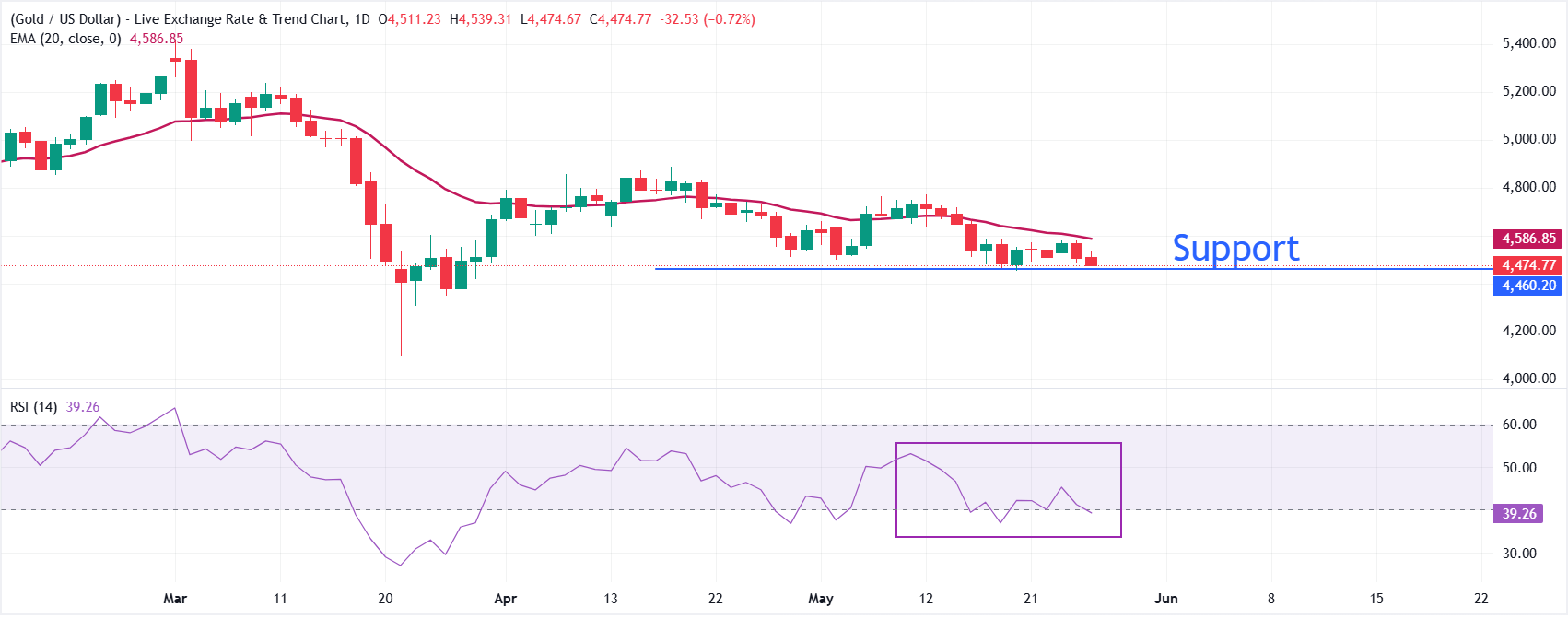
XAU/USD trades significantly lower at around $4,475 at press time. The near-term tone of the yellow metal is bearish as it holds below the 20-day Exponential Moving Average (EMA), which is at $4,586.85.

The downside tone is also reinforced by a subdued Relative Strength Index (RSI) at 39, which sits in bearish territory without yet signaling outright oversold conditions, hinting that sellers still retain control while immediate recovery attempts are likely to be capped beneath the nearby EMA barrier.

On the topside, initial resistance is defined by the 20-day EMA at $4,586.85, and a daily close above this dynamic hurdle would be needed to ease downside pressure and open the way for a more sustained bounce towards the May 14 high at $4,718.82. Looking down, the Gold price could slide towards the March 26 low at $4,351.23 if it slides below the May 20 low at $4,453.72.

(The technical analysis of this story was written with the help of an AI tool.)

Gold FAQs

Gold has played a key role in human’s history as it has been widely used as a store of value and medium of exchange. Currently, apart from its shine and usage for jewelry, the precious metal is widely seen as a safe-haven asset, meaning that it is considered a good investment during turbulent times. Gold is also widely seen as a hedge against inflation and against depreciating currencies as it doesn’t rely on any specific issuer or government.

Central banks are the biggest Gold holders. In their aim to support their currencies in turbulent times, central banks tend to diversify their reserves and buy Gold to improve the perceived strength of the economy and the currency. High Gold reserves can be a source of trust for a country’s solvency. Central banks added 1,136 tonnes of Gold worth around $70 billion to their reserves in 2022, according to data from the World Gold Council. This is the highest yearly purchase since records began. Central banks from emerging economies such as China, India and Turkey are quickly increasing their Gold reserves.

Gold has an inverse correlation with the US Dollar and US Treasuries, which are both major reserve and safe-haven assets. When the Dollar depreciates, Gold tends to rise, enabling investors and central banks to diversify their assets in turbulent times. Gold is also inversely correlated with risk assets. A rally in the stock market tends to weaken Gold price, while sell-offs in riskier markets tend to favor the precious metal.

The price can move due to a wide range of factors. Geopolitical instability or fears of a deep recession can quickly make Gold price escalate due to its safe-haven status. As a yield-less asset, Gold tends to rise with lower interest rates, while higher cost of money usually weighs down on the yellow metal. Still, most moves depend on how the US Dollar (USD) behaves as the asset is priced in dollars (XAU/USD). A strong Dollar tends to keep the price of Gold controlled, whereas a weaker Dollar is likely to push Gold prices up.

Disclaimer: For information purposes only. Past performance is not indicative of future results.
placeholder
Bitcoin CME gaps at $35,000, $27,000 and $21,000, which one gets filled first?Prioritize filling the $27,000 gap and even try higher.
Author  FXStreet
Aug 22, 2023
Prioritize filling the $27,000 gap and even try higher.
placeholder
Pinduoduo Earnings Incoming: Morgan Stanley Sees Long-Term Profit Potential​Insights – On November 21, Chinese e-commerce giant Pinduoduo (PDD) will release its Q3 2024 earnings.
Author  Mitrade
Nov 20, 2024
​Insights – On November 21, Chinese e-commerce giant Pinduoduo (PDD) will release its Q3 2024 earnings.
placeholder
Elon Musk’s xAI and Neuralink Launch New Funding Rounds​Billionaire Elon Musk recently raised funds for his two high-profile tech companies, xAI and Neuralink.
Author  Insights
Jun 03, 2025
​Billionaire Elon Musk recently raised funds for his two high-profile tech companies, xAI and Neuralink.
placeholder
Bitcoin briefly loses 2025 gains as crypto plunges over the weekend.Bitcoin experienced a sharp decline this weekend, briefly erasing its 2025 gains and dipping below its year-opening value of $93,507. The cryptocurrency fell to a low of $93,029 on Sunday, representing a 25% drop from its all-time high in October. Although it has rebounded slightly to around $94,209, the pressures on the market remain significant. The downturn occurred despite the reopening of the U.S. government on Thursday, which many had hoped would provide essential support for crypto markets. This year initially appeared promising for cryptocurrencies, particularly after the inauguration of President Donald Trump, who has established the most pro-crypto administration thus far. However, ongoing political tensions—including Trump's tariff strategies and the recent government shutdown, lasting a historic 43 days—have contributed to several rapid price pullbacks for Bitcoin throughout the year. Market dynamics are also being influenced by Bitcoin whales—investors holding large amounts of Bitcoin—who have been offloading portions of their assets, consequently stalling price rallies even as positive regulatory developments emerge. Despite these sell-offs, analysts from Glassnode argue that this behavior aligns with typical patterns seen among long-term investors during the concluding stages of bull markets, suggesting it is not indicative of a mass exodus. Notably, Bitcoin is not alone in its struggles, as Ethereum and Solana have also recorded declines of 7.95% and 28.3%, respectively, since the start of the year, while numerous altcoins have faced even steeper losses. Looking ahead, questions linger regarding the viability of the four-year cycle thesis, particularly given the increasing institutional support and regulatory frameworks now in place in the crypto landscape. Matt Hougan, chief investment officer at Bitwise, remains optimistic, suggesting a potential Bitcoin resurgence in 2026 driven by the “debasement trade” thesis and a broader trend toward increased adoption of stablecoins, tokenization, and decentralized finance. Hougan emphasized the soundness of the underlying fundamentals, pointing to a positive outlook for the sector in the longer term.
Author  Mitrade
Nov 17, 2025
Bitcoin experienced a sharp decline this weekend, briefly erasing its 2025 gains and dipping below its year-opening value of $93,507. The cryptocurrency fell to a low of $93,029 on Sunday, representing a 25% drop from its all-time high in October. Although it has rebounded slightly to around $94,209, the pressures on the market remain significant. The downturn occurred despite the reopening of the U.S. government on Thursday, which many had hoped would provide essential support for crypto markets. This year initially appeared promising for cryptocurrencies, particularly after the inauguration of President Donald Trump, who has established the most pro-crypto administration thus far. However, ongoing political tensions—including Trump's tariff strategies and the recent government shutdown, lasting a historic 43 days—have contributed to several rapid price pullbacks for Bitcoin throughout the year. Market dynamics are also being influenced by Bitcoin whales—investors holding large amounts of Bitcoin—who have been offloading portions of their assets, consequently stalling price rallies even as positive regulatory developments emerge. Despite these sell-offs, analysts from Glassnode argue that this behavior aligns with typical patterns seen among long-term investors during the concluding stages of bull markets, suggesting it is not indicative of a mass exodus. Notably, Bitcoin is not alone in its struggles, as Ethereum and Solana have also recorded declines of 7.95% and 28.3%, respectively, since the start of the year, while numerous altcoins have faced even steeper losses. Looking ahead, questions linger regarding the viability of the four-year cycle thesis, particularly given the increasing institutional support and regulatory frameworks now in place in the crypto landscape. Matt Hougan, chief investment officer at Bitwise, remains optimistic, suggesting a potential Bitcoin resurgence in 2026 driven by the “debasement trade” thesis and a broader trend toward increased adoption of stablecoins, tokenization, and decentralized finance. Hougan emphasized the soundness of the underlying fundamentals, pointing to a positive outlook for the sector in the longer term.
placeholder
Gold edges higher above $4,550 on US-Iran peace optimism Gold price (XAU/USD) gains ground to near $4,575 during the early Asian session on Tuesday. The precious metal edges higher as hopes for US-Iran peace negotiations weakened the US Dollar (USD). 
Author  FXStreet
Yesterday 01: 21
Gold price (XAU/USD) gains ground to near $4,575 during the early Asian session on Tuesday. The precious metal edges higher as hopes for US-Iran peace negotiations weakened the US Dollar (USD). 
Related Instrument
goTop
quote