


Macquarie Cuts AI Stocks and Bitcoin ETFs, Significantly Increases Circle, Will It Spawn a New Market Direction?
TradingKey - 13F filings submitted by Macquarie Group in mid-May show that the Australian financial services giant made a systematic directional shift in its crypto asset holdings in the first quarter of 2026.
Specifically, it reduced exposure to Bitcoin and Ethereum ETFs and significantly increased its stake in stablecoin issuer Circle ( CRCL ), while establishing a new Bitcoin mining company BitMine ( BMNR) position.
As of March 31, 2026, Macquarie's iShares Bitcoin Trust ( IBIT) holdings fell from 5.13 million shares to 4.14 million shares, a 19.3% reduction, with the value of the holdings dropping from approximately $255 million to $159 million; Ethereum ETF ( ETHA) holdings fell from 3.63 million shares to 3.29 million shares, a 9.5% decline, with the corresponding value dropping from approximately $81.5 million to $52.1 million.
In terms of crypto-related stocks, Macquarie cut its Coinbase position by about 19%, but its Circle stake surged 188%, valued at approximately $2.326 million at the end of the first quarter, and established a new BitMine position valued at roughly $4.153 million.
Meanwhile, its overall stance on the AI sector was cautious, with significant reductions in positions such as Nvidia, Palantir, and AMD, while only a few semiconductor names like Micron Technology saw modest increases.
Capital Divergence Intensifies, Crypto Logic Shifts
Macquarie's portfolio rebalancing is not an isolated incident.
BlackRock's IBIT recorded net outflows of approximately $970 million in the first quarter, with JPMorgan analysts noting that total digital asset inflows for Q1 reached about $11 billion—merely a third of the level seen in the same period last year.
Jane Street slashed its IBIT holdings by a staggering 71% and FBTC by 60%; as one of Wall Street's most active proprietary trading firms, this reflects a systemic reassessment of the sector rather than a temporary adjustment. Conversely, JPMorgan increased its holdings in related ETFs by 174%, highlighting a profound divergence within Wall Street over the direction of the crypto space.
A shift in strategy among some top-tier funds from "passively tracking Bitcoin prices" to "actively investing in crypto infrastructure" may be creating a new primary narrative in the crypto space; Macquarie’s selection of Circle and BitMine is a direct reflection of this strategic pivot.
Circle’s Appeal Differs Fundamentally from Bitcoin
Comparing Circle alongside Bitcoin ETFs is essentially comparing two completely different profit models.
The value of a Bitcoin ETF relies entirely on Bitcoin price fluctuations, characterized by high volatility and speculation; Circle's value is derived from USDC's circulation scale, transaction fee revenue, and the ecosystem expansion potential of its Arc public chain.
In the first quarter of 2026, Circle's revenue grew 20% year-over-year to $694 million, with USDC circulation reaching $770 billion (up 28% YoY) and on-chain transaction volume surging 263% to $21.5 trillion, accounting for 63% of the stablecoin market's transaction volume and reflecting the ongoing penetration of real-world payment scenarios.
The Arc public chain, unveiled concurrently with the Q1 results, is even more noteworthy: its native token, ARC, completed a $222 million pre-sale led by a16z crypto, with participation from over a dozen financial heavyweights including BlackRock, Apollo, Intercontinental Exchange (ICE), SC Ventures, and ARK Invest, reaching a fully diluted valuation of $3 billion.
Circle is striving to provide the underlying settlement layer for micro-transactions between AI agents, evolving stablecoins from "internal crypto market settlement tools" into "payment infrastructure for the AI era."
Macquarie's 188% increase in its Circle holdings during the first quarter likely underscores this: it is not a bet on crypto market volatility, but a bet on the foundational status of digital payment infrastructure in the age of AI.
Bitcoin’s growth logic decelerates, yet the crypto industry has not entered a winter.
The macro backdrop for the approximately $970 million in net outflows from spot Bitcoin ETFs in the first quarter is that Bitcoin prices hovered between $76,000 and $80,000, down about 40% from the peak of approximately $124,000 at the end of 2025.
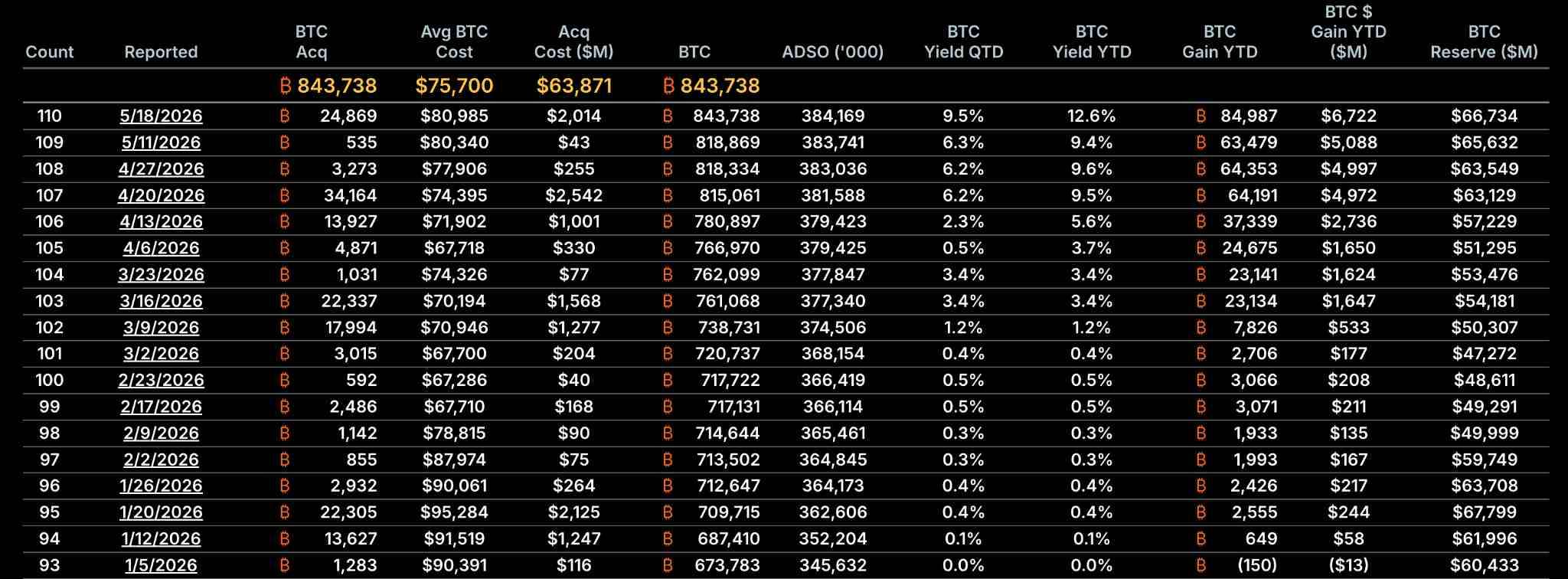
[MSTR Bitcoin Holdings, Source: Strategy]
In mid-May, Strategy (formerly MicroStrategy) spent an additional $2 billion to acquire 24,869 BTC, bringing its total holdings to 843,738 BTC. Its cumulative purchase cost is approximately $63.87 billion, with an average cost of roughly $75,700 per coin—a level the current price is now very close to.
Strategy now appears to be one of the few "stable buyers" in the Bitcoin market, and this singular buying structure itself poses a structural risk to the market.
It should be noted that the slowing growth momentum of Bitcoin ETFs does not mean the end of the crypto industry's capital market narrative.
At the same time, portfolio adjustments by Macquarie and Goldman Sachs in the first quarter—liquidating XRP and Solana ETFs while increasing positions in Circle and Coinbase—may be catalyzing a new trend: institutional capital is migrating from a "price narrative" to an "infrastructure narrative." The focus for institutions is no longer whether Bitcoin can continue to rise, but which companies and services will hold a competitive advantage in the next phase of the industry's evolution.
Recommended Articles


