


Walt Disney vs. Netflix: What Recent Revenue Trends Reveal
Key Points
Walt Disney consistently generates higher overall revenue than Netflix, although Netflix currently shows a more reliable upward growth trajectory.
Netflix has achieved steady quarter-over-quarter revenue growth across the examined timeframe, whereas Walt Disney has experienced a much more volatile revenue pattern.
Investors should closely watch whether the total revenue gap between the two companies continues to gradually narrow in the coming quarters.
- 10 stocks we like better than Netflix ›
Netflix: Steady Revenue Trajectory
Netflix (NASDAQ:NFLX) primarily generates revenue by providing subscription-based entertainment services, which include offering streaming television series, documentaries, feature films, and mobile games to paid members globally.
It officially expanded its live sports broadcasting agreement with the NFL and recorded an EBIT margin of approximately 32% for the quarter ended March 31, 2026.
Walt Disney: Managing Volatile Revenue
Walt Disney (NYSE:DIS) operates as a diversified global entertainment company that creates episodic television content and motion pictures while also managing extensive theme parks and direct-to-consumer streaming services.
It finalized the appointment of Josh D'Amaro as its new Chief Executive Officer and reported an EBIT margin of approximately 20% for the quarter ended March 28, 2026.
Why Revenue Matters for Retail Investors
Revenue serves as a critical baseline metric that shows investors the total gross cash a business captures from its customers before any operating costs or taxes are deducted. This helps investors gauge raw business scale and growth.
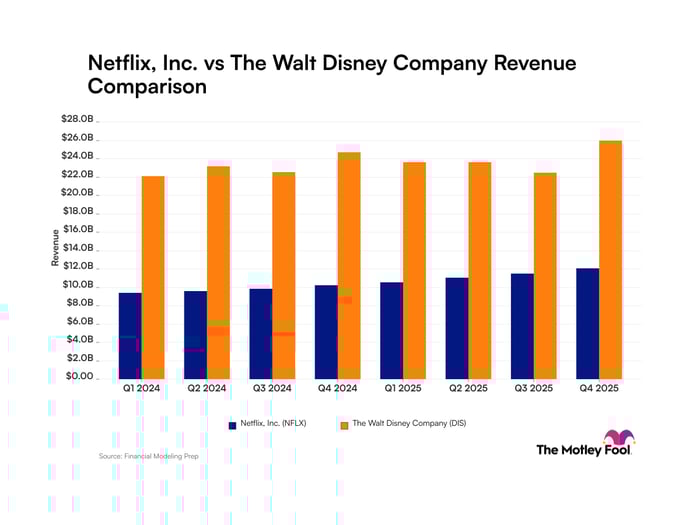
Image source: The Motley Fool.
Quarterly Revenue for Netflix and Walt Disney
| Quarter (Period End) | Netflix Revenue | Walt Disney Revenue |
|---|---|---|
| Q2 2024 | $9.6 billion (period ended June 2024) | $23.2 billion (period ended June 2024) |
| Q3 2024 | $9.8 billion (period ended Sept. 2024) | $22.6 billion (period ended Sept. 2024) |
| Q4 2024 | $10.2 billion (period ended Dec. 2024) | $24.7 billion (period ended Dec. 2024) |
| Q1 2025 | $10.5 billion (period ended March 2025) | $23.6 billion (period ended March 2025) |
| Q2 2025 | $11.1 billion (period ended June 2025) | $23.6 billion (period ended June 2025) |
| Q3 2025 | $11.5 billion (period ended Sept. 2025) | $22.5 billion (period ended Sept. 2025) |
| Q4 2025 | $12.1 billion (period ended Dec. 2025) | $26.0 billion (period ended Dec. 2025) |
| Q1 2026 | $12.2 billion (period ended March 2026) | $25.2 billion (period ended March 2026) |
Data source: Company filings.
Foolish Take
Contrasting Disney’s revenue against Netflix tells an insightful story. Although both are in the entertainment industry, Disney’s lumpy sales growth is indicative of the type of business it’s operating in contrast to its rival.
At the start of the streaming wars, I thought Disney had a great shot at the streaming leadership crown. It held impressive brands, such as Star Wars and Marvel, as well as an iconic position in family entertainment.
Now, it’s clear Netflix is the streaming winner, as its consistent sales growth illustrates. Moreover, the company is well run from a financial perspective. Not only did first quarter revenue rise 16% year over year to $12.2 billion, its diluted earnings per share (EPS) soared to $1.23 from $0.66 in the prior year, and free cash flow (FCF) nearly doubled to $5.1 billion compared to $2.7 billion in 2025.
Disney’s sales growth is slower. Revenue in its fiscal Q2, ended March 28, increased 7% to $25.2 billion. Its financials are also not as rock-solid. Its Q2 EPS dropped 30% year over year to $1.27 while FCF fell 1% to $4.9 billion.
That said, contrasting Disney to Netflix isn’t quite a fair comparison. Disney owns theme parks and cruise ships. It is a more diversified business, and that brings with it differences from the pure streaming champion. With a new CEO, Disney is also undergoing a transition. So investors should view Disney as a different kind of company from Netflix.
Should you buy stock in Netflix right now?
Before you buy stock in Netflix, consider this:
The Motley Fool Stock Advisor analyst team just identified what they believe are the 10 best stocks for investors to buy now… and Netflix wasn’t one of them. The 10 stocks that made the cut could produce monster returns in the coming years.
Consider when Netflix made this list on December 17, 2004... if you invested $1,000 at the time of our recommendation, you’d have $475,063!* Or when Nvidia made this list on April 15, 2005... if you invested $1,000 at the time of our recommendation, you’d have $1,369,991!*
Now, it’s worth noting Stock Advisor’s total average return is 996% — a market-crushing outperformance compared to 208% for the S&P 500. Don't miss the latest top 10 list, available with Stock Advisor, and join an investing community built by individual investors for individual investors.
See the 10 stocks »
*Stock Advisor returns as of May 21, 2026.
Robert Izquierdo has positions in Netflix and Walt Disney. The Motley Fool has positions in and recommends Netflix and Walt Disney. The Motley Fool has a disclosure policy.
Recommended Articles


