


Tesla Stock Is Soaring. Is the $10 Trillion Robotaxi Story Finally a Buy?
Key Points
Robotaxi continues to expand, but Tesla itself doesn't expect significant revenue from it in 2026.
Management now expects 2026 capital expenditures of more than $25 billion -- roughly three times what the company spent last year.
Even after the recent surge, the stock's valuation already prices in success from initiatives that haven't yet shown up in earnings.
- These 10 stocks could mint the next wave of millionaires ›
Shares of electric vehicle and energy specialist Tesla (NASDAQ: TSLA) have come roaring back. After spending most of the year in the red, the stock has climbed about 26% over the past month, with shares trading at about $445 as of this writing.
One catalyst for the stock recently has been Tesla's Robotaxi story. Bulls argue that Tesla's autonomous ride-sharing network -- which Ark Invest's Cathie Wood has speculated could eventually represent a $10 trillion global opportunity -- is finally gaining some significant traction. With unsupervised rides now happening in Texas and more cities on the way, there's good reason to be excited about the stock. But has it run up too much?
Will AI create the world's first trillionaire? Our team just released a report on the one little-known company, called an "Indispensable Monopoly" providing the critical technology Nvidia and Intel both need. Continue »
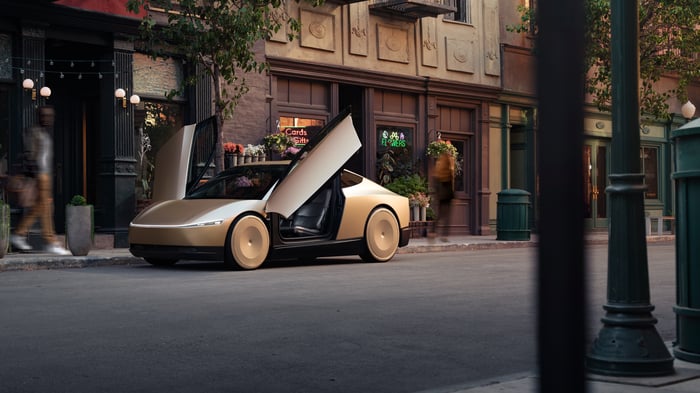
Tesla Robotaxi car. Image source: Tesla.
What's actually happening with Robotaxi
Tesla's autonomous ride-sharing service has been steadily widening its footprint. The service, which primarily uses Model Y vehicles today, originally launched in Austin in mid-2025 and has since expanded to Dallas and Houston, with preparations underway in Phoenix, Miami, Orlando, Tampa, and Las Vegas in the first half of 2026. In its first-quarter 2026 update, Tesla said its paid Robotaxi miles nearly doubled sequentially -- a sign that activity is picking up even as the service remains a small piece of the business.
Still, even the most measured forecasts of the long-term opportunity describe a sizable prize. Goldman Sachs Research recently estimated that the global Robotaxi market could reach roughly $415 billion by 2035, with cumulative gross profits across the industry potentially totaling about $440 billion over the next decade. That is a meaningful pool of capital, though one that may be carved up among Tesla, Alphabet's Waymo, Amazon's Zoox, and a growing list of Chinese competitors.
But it could be a while before any of this shows up in Tesla's financials in a serious way. When asked on the first-quarter earnings call about the path beyond Austin, CEO Elon Musk was unusually measured. "I don't think probably unsupervised [Full Self-Driving] or Robotaxi revenue will be super material this year, but I do think it will be material," he said. "It'll be material probably in a significant way next year."
In other words, the most exciting part of the bull case is still mostly a 2027 story.
A market cap well ahead of underlying earnings
As exciting as the Robotaxi narrative is for Tesla, the valuation looks strained.
At about $1.7 trillion, Tesla's market capitalization sits on top of trailing 12-month revenue of roughly $98 billion and trailing net income of about $3.9 billion. That works out to a price-to-earnings ratio of more than 400 and a price-to-sales ratio of close to 16 -- multiples that are difficult to reconcile with a business that posted a first-quarter operating margin of just 4.2%.
The underlying results also show a business in transition. Sure, first-quarter revenue rose 16% year over year to $22.4 billion, but operating margin actually came in below the 5.7% reported in the fourth quarter of 2025.
And Tesla's spending ramp may turn out to be the bigger near-term issue. Chief financial officer Vaibhav Taneja said on the first-quarter earnings call that 2026 capital expenditures are now expected to top $25 billion -- about $5 billion above prior plans and roughly three times the $8.6 billion Tesla spent in 2025. Taneja also said free cash flow would be negative for the remaining three quarters of the year as Tesla funds various projects, including AI (artificial intelligence) compute, its in-house AI5 inference chip, the Cybercab and Megapack 3 production ramps, and Optimus (a humanoid robot).
What's less clear is how profitable any of this will be, or how long it will take to get there. And while Tesla's Cybercab volume production is just ramping, Robotaxi still requires substantial operational infrastructure -- and Optimus remains months from start of production. In short, none of these initiatives has a track record at scale, while the auto business paying for them is operating at single-digit margins.
Ultimately, the recent run-up has only raised the bar.
With the rally adding hundreds of billions in market cap on the same early stage initiatives, even modest setbacks could trigger a sharp reversal in the stock price. For now, the $10 trillion Robotaxi vision remains just that -- a vision -- and I'd rather wait for a price that doesn't demand near-perfect execution.
Don’t miss this second chance at a potentially lucrative opportunity
Ever feel like you missed the boat in buying the most successful stocks? Then you’ll want to hear this.
On rare occasions, our expert team of analysts issues a “Double Down” stock recommendation for companies that they think are about to pop. If you’re worried you’ve already missed your chance to invest, now is the best time to buy before it’s too late. And the numbers speak for themselves:
- Nvidia: if you invested $1,000 when we doubled down in 2009, you’d have $572,674!*
- Apple: if you invested $1,000 when we doubled down in 2008, you’d have $56,187!*
- Netflix: if you invested $1,000 when we doubled down in 2004, you’d have $472,744!*
Right now, we’re issuing “Double Down” alerts for three incredible companies, available when you join Stock Advisor, and there may not be another chance like this anytime soon.
See the 3 stocks »
*Stock Advisor returns as of May 13, 2026.
Daniel Sparks has clients with positions in Tesla. The Motley Fool has positions in and recommends Alphabet, Amazon, Goldman Sachs Group, and Tesla. The Motley Fool has a disclosure policy.
Recommended Articles


