


My Top 3 AI Infrastructure Stocks to Buy for May 2026
Key Points
Nvidia is the dominant supplier of artificial intelligence chips for data centers.
Foundry leader TSMC expects demand for AI accelerators to grow at a compound annual rate in the mid-to-high-50% range over the coming years.
Amazon plans to spend $200 billion this year to build data centers and other AI infrastructure.
- 10 stocks we like better than Taiwan Semiconductor Manufacturing ›
Most people care about artificial intelligence (AI) only as much as they interact with it. Whether it's using ChatGPT to put together a workout plan, having Claude walk you through coding your newest app idea, or asking Alphabet's Google Gemini to turn your Google Sheets into charts, that's where it starts and ends for them.
However, behind the scenes, a complex ecosystem of hardware and cloud infrastructure ensures the AI tools you interact with run as planned. And as companies continue to invest in AI development, those working on AI infrastructure are seeing increased demand and making sound investments.
Will AI create the world's first trillionaire? Our team just released a report on the one little-known company, called an "Indispensable Monopoly" providing the critical technology Nvidia and Intel both need. Continue »
Nvidia (NASDAQ: NVDA), Taiwan Semiconductor Manufacturing (NYSE: TSM) (TSMC), and Amazon (NASDAQ: AMZN) are great examples. These three cover the full AI stack, including chip design, chip manufacturing, and cloud infrastructure. If you're looking to invest in AI infrastructure stocks, they are great go-to options.

Image source: Getty Images.
1. Nvidia
Nvidia deserves a lot of credit for the explosion in AI tools over the past few years. It doesn't have a generative AI app or a large language model, but its hardware provides the "brains" that power much of the training and deployment of popular AI models. Its GPUs were originally used to enhance video game graphics, but the same parallel-processing capacities that worked so well for that niche use also turn out to be just what is required to rapidly process complex AI workloads.
Nvidia has had a something of a stranglehold on the data center AI chip market over the past few years, and its dominance has been reflected in its financials. Because it holds a near-monopoly in general-purpose AI processors, Nvidia has been able to charge a premium, boosting its margins and profitability. In its most recently reported quarter (which ended Jan. 25), Nvidia's net income increased 94% year over year to $43 billion. That metric also rose by 594% over the past three years.
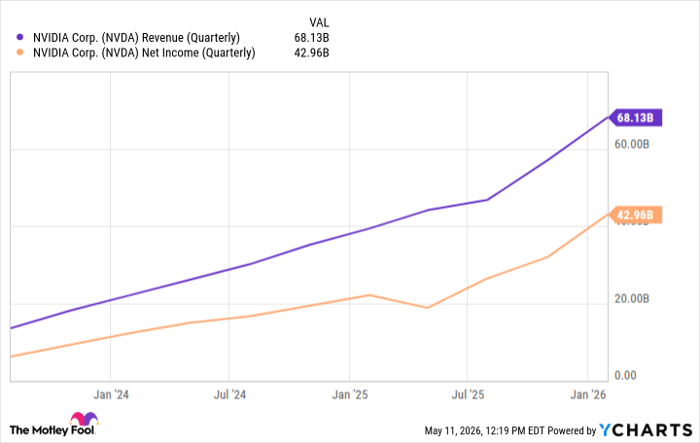
NVDA Revenue (Quarterly) data by YCharts.
With tech companies like Amazon and Alphabet developing their own AI chips, Nvidia won't be able to maintain its previous degree of dominance in the long term, but it still has a significant competitive advantage. Even beyond its hardware, its CUDA software ecosystem is the industry standard that millions of developers use to build AI applications.
2. TSMC
Although companies like Nvidia design the AI chips found throughout data centers, TSMC is the company that physically produces most of them. It's the world's leading chip manufacturer and plays a key role in the AI ecosystem.
Manufacturing chips is an expensive, highly specialized task that few companies can do well. Moreover, no rival's abilities compare to TSMC's, which is why so many big-name tech companies rely on it to manufacture their high-end chip designs.
With hundreds of billions of dollars expected to be spent on building out data centers and other AI infrastructure (such as cooling systems) in the next year alone, TSMC will be a major beneficiary. In its recent earnings call, TSMC noted that it expects long-term demand for its AI accelerators to grow at a compound annual rate in the mid-to-high-50% range.
Without TSMC's manufacturing prowess, the quality of AI chips would suffer, which means the reliability of the AI tools we use would also decline. It's hard to overstate the company's importance.
3. Amazon
Amazon's AI role is built on its cloud platform, Amazon Web Services (AWS), which is the largest cloud infrastructure provider in the world. Platforms like AWS are important to the AI ecosystem because they provide the necessary computing power to develop and deploy the software. Without them, only a handful of large tech companies would have the resources to work in the AI space.
Amazon's Bedrock is becoming an all-in-one AI development platform. It allows users to access different AI models, customize their own models, and deploy their own applications. And now that OpenAI isn't in an exclusive partnership with Microsoft, AWS can add one of the most used models on the market -- ChatGPT -- to its offerings.
Demand for AWS services is exceeding the company's cloud capacity right now, which is why its backlog continues to grow. As of March 31, Amazon's backlog was $364 billion, with most of it tied to AWS. That says a lot about AWS's positioning as a go-to cloud provider and the value it provides.
Amazon is planning to spend $200 billion this year on building out data centers and improving its AI infrastructure. As these developments unfold and allow it to bring on more customers and reduce its backlog, Amazon should begin seeing a much higher return on its AI investments.
Should you buy stock in Taiwan Semiconductor Manufacturing right now?
Before you buy stock in Taiwan Semiconductor Manufacturing, consider this:
The Motley Fool Stock Advisor analyst team just identified what they believe are the 10 best stocks for investors to buy now… and Taiwan Semiconductor Manufacturing wasn’t one of them. The 10 stocks that made the cut could produce monster returns in the coming years.
Consider when Netflix made this list on December 17, 2004... if you invested $1,000 at the time of our recommendation, you’d have $472,744!* Or when Nvidia made this list on April 15, 2005... if you invested $1,000 at the time of our recommendation, you’d have $1,353,500!*
Now, it’s worth noting Stock Advisor’s total average return is 991% — a market-crushing outperformance compared to 207% for the S&P 500. Don't miss the latest top 10 list, available with Stock Advisor, and join an investing community built by individual investors for individual investors.
See the 10 stocks »
*Stock Advisor returns as of May 13, 2026.
Stefon Walters has positions in Microsoft and Taiwan Semiconductor Manufacturing. The Motley Fool has positions in and recommends Alphabet, Amazon, Microsoft, Nvidia, and Taiwan Semiconductor Manufacturing. The Motley Fool has a disclosure policy.
Recommended Articles


