

Bitcoin is not a safe haven against geopolitical tensions, says Standard Chartered

Source Cryptopolitan

Bitcoin isn’t going to save us from geopolitical uncertainties. That’s what Geoff Kendrick, Standard Chartered’s global head of digital assets research, believes.

With tensions in the Middle East rising, he expects Bitcoin to fall way below $60,000 before the weekend. But he also believes this could be a prime buying opportunity.

Kendrick points out the connection between geopolitical issues and self-proclaimed pro-crypto Donald Trump’s chances.

This week, his odds of winning the November elections have increased by about 1%, while Kamala Harris’s chances dropped by the same. Trump now sits at 50%, slightly ahead of Harris, who has 49%.

According to Kendrick, there’s a “circularity” in how these tensions affect Bitcoin. When geopolitical risks like the Middle East flare up, Bitcoin drops.

But, oddly enough, these same risks seem to favor Trump’s chances. A Trump victory is considered bullish for Bitcoin, while a Harris win will have the opposite effect.

Trump’s crypto play could change Bitcoin’s fate

Trump’s reappearance on the political stage comes with a twist for the crypto community as he did a complete 180 on the matter.

Analysts expect that a Trump administration would speed up pro-crypto policies, which could send prices flying in the months following the election.

Regulatory advancements could slow down under a Harris administration, ruining market sentiment. But Kendrick believes investors will eventually “buy the dip” when they realize that progress on regulation is inevitable, just delayed.

Despite it all, the market has been seeing a surge in Bitcoin call option positions. Open interest for call options expiring on December 27 with a strike price of $80,000 surged by 1,300 Bitcoin in just two days.

Bitcoin is no gold

While Bitcoin has long been pitched as “digital gold,” Kendrick believes it’s not the safe haven some make it out to be. He said:

“Gold is a geopolitical hedge. Bitcoin is a hedge against traditional finance issues like bank collapses or U.S. Treasury problems.”

When looking at Bitcoin’s price performance from past market cycles, Kendrick says there’s a weird consistency. Despite drastically different conditions, Bitcoin’s behavior is oddly similar across these cycles. 

Analysts debate why this happens, but the fact remains that BTC tends to follow similar patterns, making its dynamics predictable to some extent.
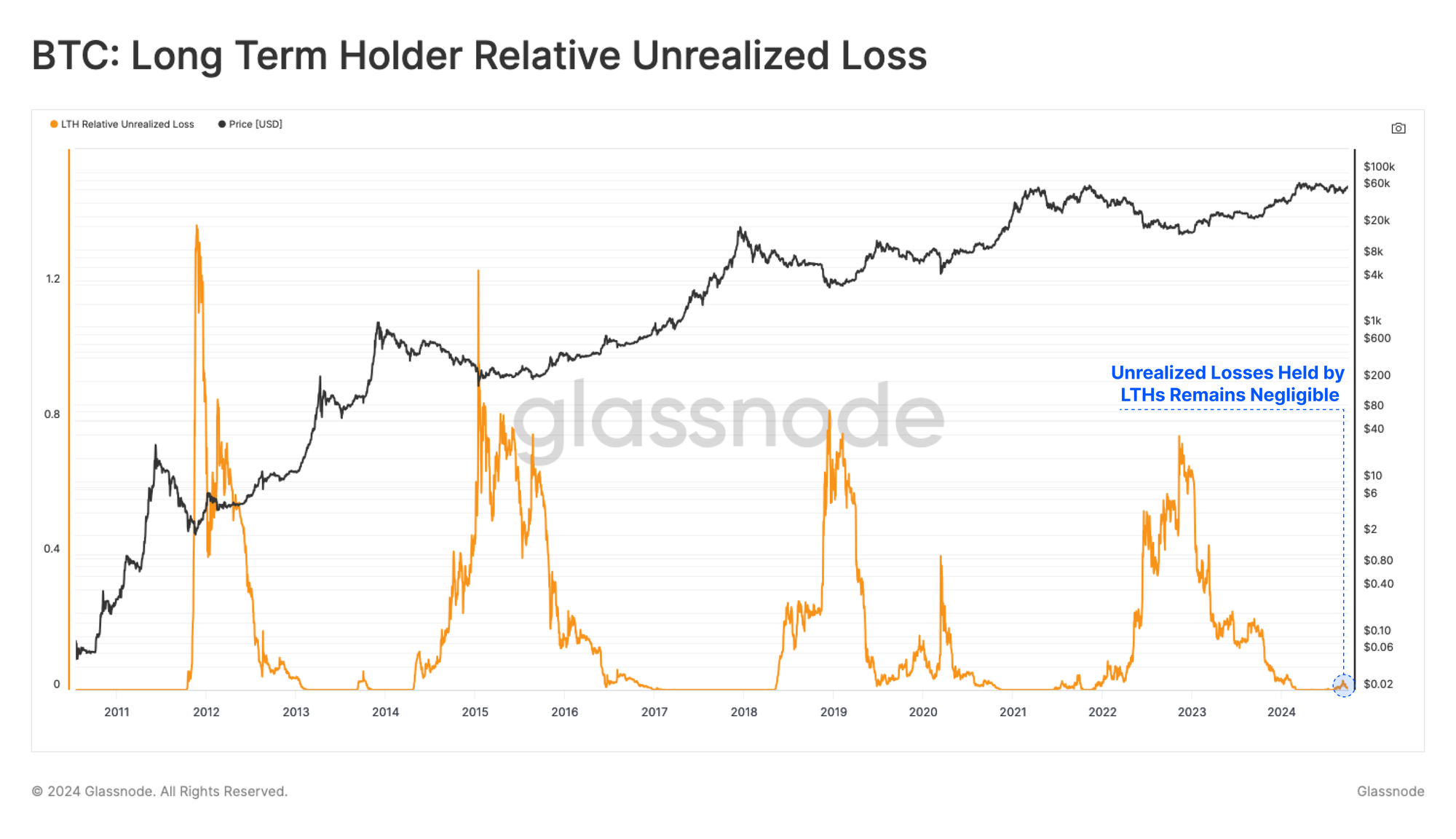
Meanwhile, the percentage of Bitcoin supply held by long-term investors has hit its highest level since mid-2021.

But many of these holders are sitting on unrealized losses. Coins bought near Bitcoin’s all-time high of $73,000 have now crossed the 155-day threshold and are being held at a loss.

Around 47.4% of all Bitcoin in loss right now is held by long-term holders. But the losses aren’t severe enough to cause panic.

Short-term holders, on the other hand, are doing a bit better. Over the past few weeks, short-term holders have seen a slight improvement in profitability.
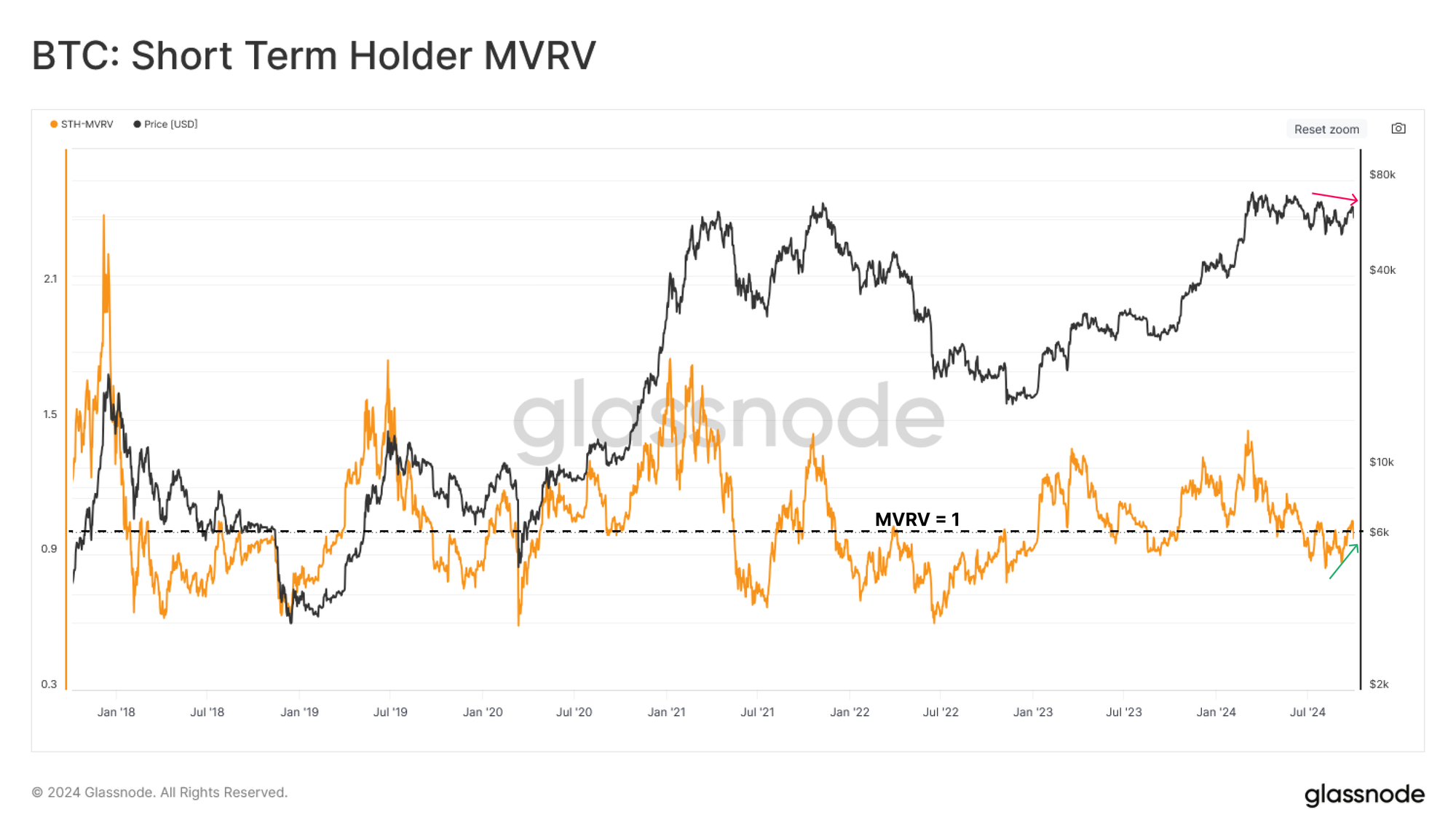
The percentage of short-term supply in profit has risen to over 62%. Also, profit-taking volumes are 14.17 times higher than loss-taking, showing that investors are cashing out when they can.

This aligns with the idea that while short-term holders are quick to react to market conditions, they’re starting to see better days ahead.

Disclaimer: For information purposes only. Past performance is not indicative of future results.
placeholder
Bitcoin CME gaps at $35,000, $27,000 and $21,000, which one gets filled first?Prioritize filling the $27,000 gap and even try higher.
Author  FXStreet
Aug 22, 2023
Prioritize filling the $27,000 gap and even try higher.
placeholder
Bitcoin briefly loses 2025 gains as crypto plunges over the weekend.Bitcoin experienced a sharp decline this weekend, briefly erasing its 2025 gains and dipping below its year-opening value of $93,507. The cryptocurrency fell to a low of $93,029 on Sunday, representing a 25% drop from its all-time high in October. Although it has rebounded slightly to around $94,209, the pressures on the market remain significant. The downturn occurred despite the reopening of the U.S. government on Thursday, which many had hoped would provide essential support for crypto markets. This year initially appeared promising for cryptocurrencies, particularly after the inauguration of President Donald Trump, who has established the most pro-crypto administration thus far. However, ongoing political tensions—including Trump's tariff strategies and the recent government shutdown, lasting a historic 43 days—have contributed to several rapid price pullbacks for Bitcoin throughout the year. Market dynamics are also being influenced by Bitcoin whales—investors holding large amounts of Bitcoin—who have been offloading portions of their assets, consequently stalling price rallies even as positive regulatory developments emerge. Despite these sell-offs, analysts from Glassnode argue that this behavior aligns with typical patterns seen among long-term investors during the concluding stages of bull markets, suggesting it is not indicative of a mass exodus. Notably, Bitcoin is not alone in its struggles, as Ethereum and Solana have also recorded declines of 7.95% and 28.3%, respectively, since the start of the year, while numerous altcoins have faced even steeper losses. Looking ahead, questions linger regarding the viability of the four-year cycle thesis, particularly given the increasing institutional support and regulatory frameworks now in place in the crypto landscape. Matt Hougan, chief investment officer at Bitwise, remains optimistic, suggesting a potential Bitcoin resurgence in 2026 driven by the “debasement trade” thesis and a broader trend toward increased adoption of stablecoins, tokenization, and decentralized finance. Hougan emphasized the soundness of the underlying fundamentals, pointing to a positive outlook for the sector in the longer term.
Author  Mitrade
Nov 17, 2025
Bitcoin experienced a sharp decline this weekend, briefly erasing its 2025 gains and dipping below its year-opening value of $93,507. The cryptocurrency fell to a low of $93,029 on Sunday, representing a 25% drop from its all-time high in October. Although it has rebounded slightly to around $94,209, the pressures on the market remain significant. The downturn occurred despite the reopening of the U.S. government on Thursday, which many had hoped would provide essential support for crypto markets. This year initially appeared promising for cryptocurrencies, particularly after the inauguration of President Donald Trump, who has established the most pro-crypto administration thus far. However, ongoing political tensions—including Trump's tariff strategies and the recent government shutdown, lasting a historic 43 days—have contributed to several rapid price pullbacks for Bitcoin throughout the year. Market dynamics are also being influenced by Bitcoin whales—investors holding large amounts of Bitcoin—who have been offloading portions of their assets, consequently stalling price rallies even as positive regulatory developments emerge. Despite these sell-offs, analysts from Glassnode argue that this behavior aligns with typical patterns seen among long-term investors during the concluding stages of bull markets, suggesting it is not indicative of a mass exodus. Notably, Bitcoin is not alone in its struggles, as Ethereum and Solana have also recorded declines of 7.95% and 28.3%, respectively, since the start of the year, while numerous altcoins have faced even steeper losses. Looking ahead, questions linger regarding the viability of the four-year cycle thesis, particularly given the increasing institutional support and regulatory frameworks now in place in the crypto landscape. Matt Hougan, chief investment officer at Bitwise, remains optimistic, suggesting a potential Bitcoin resurgence in 2026 driven by the “debasement trade” thesis and a broader trend toward increased adoption of stablecoins, tokenization, and decentralized finance. Hougan emphasized the soundness of the underlying fundamentals, pointing to a positive outlook for the sector in the longer term.
placeholder
ECB Policy Outlook for 2026: What It Could Mean for the Euro’s Next MoveWith the ECB likely holding rates steady at 2.15% and the Fed potentially extending cuts into 2026, EUR/USD may test 1.20 if Eurozone growth proves resilient, but weaker growth and an ECB pivot could pull the pair back toward 1.13 and potentially 1.10.
Author  Mitrade
Dec 26, 2025
With the ECB likely holding rates steady at 2.15% and the Fed potentially extending cuts into 2026, EUR/USD may test 1.20 if Eurozone growth proves resilient, but weaker growth and an ECB pivot could pull the pair back toward 1.13 and potentially 1.10.
placeholder
Gold Price Forecast: XAU/USD opens lower around $4,450 on fears of widening Iran conflictsGold price (XAU/USD) opens over 1% lower to near $4,445.00 on Monday, as oil prices have rallied further on fears of further widening of conflicts in the Middle East. WTI Oil price is up almost 3% above $102.50 in the opening trade, increasing fears of higher inflation expectations globally.
Author  FXStreet
Mar 30, Mon
Gold price (XAU/USD) opens over 1% lower to near $4,445.00 on Monday, as oil prices have rallied further on fears of further widening of conflicts in the Middle East. WTI Oil price is up almost 3% above $102.50 in the opening trade, increasing fears of higher inflation expectations globally.
placeholder
Silver Price Forecast: XAG/USD falls to near $72.00 amid fading safe-haven demandSilver price (XAG/USD) continues to lose ground after registering tiny losses in the previous day, trading around $72.90 during the Asian hours on Thursday. The safe-haven demand for the precious metal fades amid rising optimism over Middle East peace.
Author  FXStreet
Apr 02, Thu
Silver price (XAG/USD) continues to lose ground after registering tiny losses in the previous day, trading around $72.90 during the Asian hours on Thursday. The safe-haven demand for the precious metal fades amid rising optimism over Middle East peace.
goTop
quote