

NatWest, Bank of America and four peers want AI shopping agents to disclose themselves

Source Cryptopolitan

On Sept. 22, six banks put out joint principles proposing that all parties to an agentic commerce purchase know when an AI agent is involved in the transaction and who it is acting for.

The paper, titled “Building Trust in Agentic Commerce,” was co-authored by NatWest Group, Bank of America, Capital One, ING Group, Commonwealth Bank of Australia, and New Zealand’s ASB Bank.

Principles are voluntary, not binding. Banks plan to consult policymakers on the proposals and bring out a second paper on how to implement them.

Transparency heads the list of five principles

The disclosure proposal falls under transparency, the first of five principles. The other four are safety, privacy and data, choice, and interoperability.

Transparency also stretches to how agents rank options and make decisions, including sponsored options. The paper warns that agents may promote products or payment methods that give their providers a larger cut, such as higher commissions, even if they are not the best value for the consumer.

On safety, the banks want consumers to be able to control the authority they give to agents, including the ability to view and manage delegations. Agents should enter payment credentials in a secure, auditable manner.

Every party should be involved in the dispute process, and the liability should be where the risk or error was introduced.

The data principle asks providers to keep auditable records of consumer instructions and intent, touch only the data they need, and allow consumer and merchant consent to determine any further use.

Consumers and merchants should be free to make a choice on agentic commerce services without unreasonable constraints.

“But for that potential to be realised, customers need to trust that they remain in control of how payments are made and that their money is safe,” NatWest Chief Payments Officer Mark Brant said.
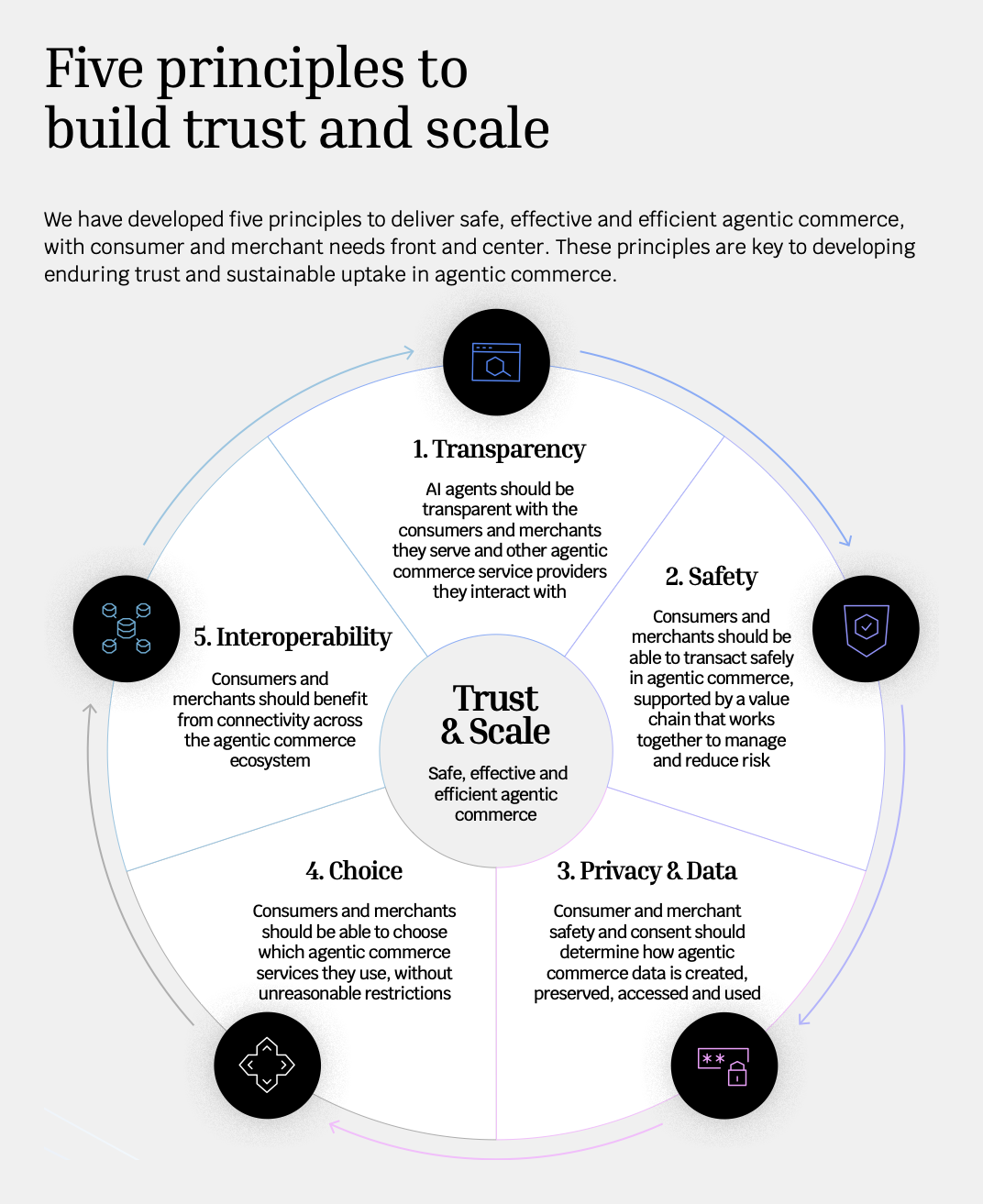
AI shopping agents should declare themselves whenever they pay, six banks propose.
The five principles in Building Trust in Agentic Commerce, the joint paper six banks published Sept. 22, 2026.

Card details keyed straight into websites top the unsafe list

“Consumers are unclear if AI agents will act in their interests,” the paper said.

Consumers are troubled that agents may buy the wrong thing, spend too much, or lose money to scams and fraud, and they don’t know who to turn to when things go wrong.

The paper finds unsafe practices by some providers, such as requesting consumer card details and then keying them into websites, and prioritizing payment methods that offer less protection.

It also flags attackers that compromise or impersonate AI agents and merchants. Merchants fear disputes and chargebacks may rise for reasons outside their control.

Agentic commerce has already progressed from closed trials to live pilots and early scaling, and those developments are outpacing formal governance, the banks said.

According to Cryptopolitan, Robinhood rolled out credit card spending for AI agents in May while most finance companies were still stuck in pilot mode.

Six banks invited other banks and payments firms to apply the principles and help build a blueprint for implementing them.

If you're reading this, you’re already ahead. Stay there with our newsletter.

Disclaimer: For information purposes only. Past performance is not indicative of future results.
placeholder
Bitcoin falls below $75,000 as the CLARITY Act fails in the Senate — what the vote means for cryptoThe US Senate blocked the Digital Asset Market CLARITY Act in a 49-50 procedural vote, sending Bitcoin briefly below $75,000 — its biggest one-day drop since June. Ethereum fell more than 8%, Coinbase slid 10% and $75 billion of crypto market value evaporated. Here is what the vote was, why it failed, and the levels that matter now.
Author  Suzie
Sep 16, Wed
The US Senate blocked the Digital Asset Market CLARITY Act in a 49-50 procedural vote, sending Bitcoin briefly below $75,000 — its biggest one-day drop since June. Ethereum fell more than 8%, Coinbase slid 10% and $75 billion of crypto market value evaporated. Here is what the vote was, why it failed, and the levels that matter now.
placeholder
Dollar index tops 100 for the first time since July as the Fed's hawkish dot plot sinks inThe U.S. dollar index broke back above 100 for the first time since 31 July after the Fed delivered its first rate hike since 2023, with the dot plot showing 16 of 18 officials expect at least one more increase this year. Here are the levels that matter for DXY, the currencies feeling it most, and what to watch next.
Author  Irene Q.
Sep 17, Thu
The U.S. dollar index broke back above 100 for the first time since 31 July after the Fed delivered its first rate hike since 2023, with the dot plot showing 16 of 18 officials expect at least one more increase this year. Here are the levels that matter for DXY, the currencies feeling it most, and what to watch next.
placeholder
Gold ends three-week slide at the $4,400 line — eight straight days of ETF inflows vs a 5% 10-year and a 100 dollarSpot gold closed Friday at $4,378.39, up 0.84% on the day and about 0.8% for the week — its first weekly gain in four weeks — with the intraday high of $4,399.67 leaving it 33 cents shy of the $4,400 line. Gold ETFs have now logged eight straight sessions of inflows, but with the 10-year back above 5% and the dollar index near 100, here is what decides whether this is a reversal or a bounce.
Author  Suzie
Sep 20, Sun
Spot gold closed Friday at $4,378.39, up 0.84% on the day and about 0.8% for the week — its first weekly gain in four weeks — with the intraday high of $4,399.67 leaving it 33 cents shy of the $4,400 line. Gold ETFs have now logged eight straight sessions of inflows, but with the 10-year back above 5% and the dollar index near 100, here is what decides whether this is a reversal or a bounce.
placeholder
Bitcoin rallies near $86K on improving markets ahead of quarterly options expiryBitcoin (BTC) market conditions improved over the past week as spot buying pressure strengthened and derivatives positioning increased, pushing the top crypto near $86,000.
Author  FXStreet
Yesterday 01: 16
Bitcoin (BTC) market conditions improved over the past week as spot buying pressure strengthened and derivatives positioning increased, pushing the top crypto near $86,000.
placeholder
Dollar holds above 100 near a 3-month high — three Fed speakers and a $69 billion auction land tonightThe dollar index closed at 100.43 on Monday, its highest close since late July, after a weekly gain of about 1% — the best in more than three months — and is holding above the 100.00 handle in Asia. Three Fed officials speak tonight alongside a $69 billion two-year note auction, the first leg of $183 billion of Treasury supply this week.
Author  Suzie
23 hours ago
The dollar index closed at 100.43 on Monday, its highest close since late July, after a weekly gain of about 1% — the best in more than three months — and is holding above the 100.00 handle in Asia. Three Fed officials speak tonight alongside a $69 billion two-year note auction, the first leg of $183 billion of Treasury supply this week.
goTop
quote