


Indian Rupee comes under pressure amid hawkish Fed expectations
- The Indian Rupee drops against the US Dollar after rising significantly in the last two trading days.
- The Fed is almost certain to deliver at least one more interest rate hike this year.
- US President Trump sees deal with Iran after midterm elections.
The Indian Rupee (INR) trades slightly lower against the US Dollar (USD) in the opening session on Wednesday after rising in the past few trading days. The USD/INR pair is marginally up to near 95.62 as the US Dollar outperforms amid firm expectations that the Federal Reserve (Fed) will extend its monetary tightening cycle for the remainder of the year.
As of writing, the US Dollar Index (DXY), which gauges the Greenback’s value against six major currencies, trades 0.17% higher to near 100.73, the highest level seen in over seven weeks.
The CME FedWatch tool shows traders see an almost 90% chance that the Fed will deliver at least one more interest rate hike this year.
What’s driving hawkish Fed expectations
Analysts at MUFG note that these rate expectations “were supported by hawkish comments from regional Fed presidents although neither are voting members this year.” In particular, Chicago Fed President Austan Goolsbee, who “will become a voting member again from next year,” cautioned that “supply shocks have come more frequently, hit harder and lasted longer and once supply shocks to inflation become persistent, some of the logic behind ‘looking through’ no longer holds,” reinforcing the case for an extended period of tighter Fed policy.
On Tuesday, Richmond Fed Bank President Thomas Barkin, who is also currently a non-voting member, said that more interest rate hikes will be required to tame inflation. However, he didn’t provide any specific guidance regarding how much higher interest rates could go. "Will additional hikes be required, and how many? We'll see," Barkin said, Reuters reported.
Oil prices extend the decline
Oil prices continue to remain under pressure on hopes of diplomacy between the United States (US) and Iran, a scenario that will ease energy supply disruption through the Middle East. The optimism over US-Iran diplomacy boosted after a report from Kyodo News showed that a senior Iranian official confirmed Tehran sending proposal to the US via mediators, which states that Iran would reopen the Hormuz Strait within seven days in return of Washington’s military de-escalation near their seaports.
In the opening session, the MCX Crude Oil contract expiring on October 19 is down 1.43% to near Rs. 8,520, the lowest level seen in two weeks.
Lower oil prices bode well for currencies from economies, such as India, which rely heavily on oil imports to meet their energy needs.
In a speech at United Nations (US) General Assembly on Tuesday, US President Donald Trump said that either Washington will make a deal or will drive the nation to hell. “I have a big decision to make on whether to make a deal or drive Iran into hell with no chance of survival and no hope of future greatness or generations.” Trump said. He reiterated stress that Iran will never have a nuclear weapon and the deal with the nation will be made right after midterm elections.
USD/INR Technical Analysis
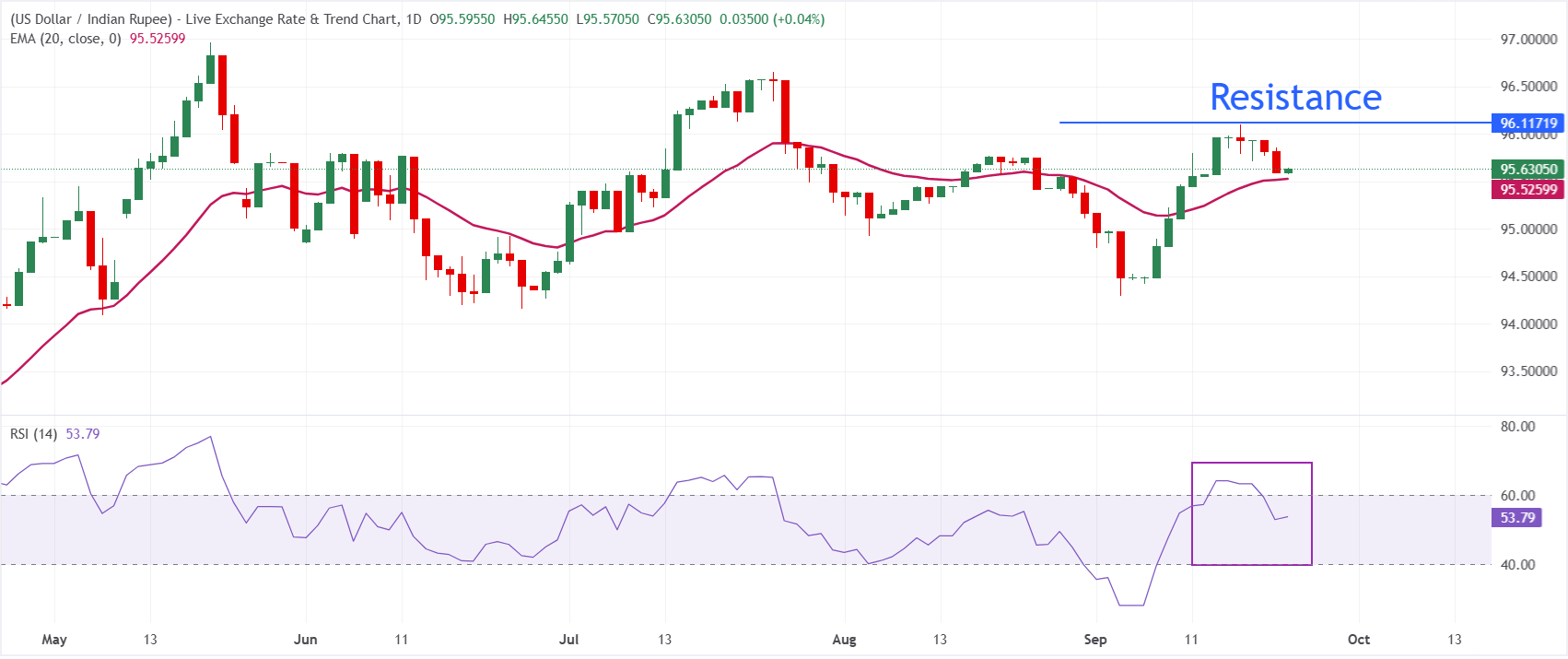
In the daily chart, USD/INR trades at 95.6305, holding a mild bullish bias as spot remains above the 20-period exponential moving average (EMA) at 95.5260. The positioning over this short-term EMA suggests underlying demand, while the Relative Strength Index (RSI) at 53.79 stays just above the neutral 50 line, hinting at steady rather than aggressive upside momentum.
On the downside, immediate support is seen at the 20-period EMA near 95.53, which reinforces the current floor under prices. As long as USD/INR defends this moving average, buyers are likely to retain control, with any pullback toward the EMA viewed as a potential dip-buying area before the pair can attempt fresh gains into uncharted resistance territory.
(The technical analysis of this story was written with the help of an AI tool. Know more.)
Indian Rupee FAQs
The Indian Rupee (INR) is one of the most sensitive currencies to external factors. The price of Crude Oil (the country is highly dependent on imported Oil), the value of the US Dollar – most trade is conducted in USD – and the level of foreign investment, are all influential. Direct intervention by the Reserve Bank of India (RBI) in FX markets to keep the exchange rate stable, as well as the level of interest rates set by the RBI, are further major influencing factors on the Rupee.
The Reserve Bank of India (RBI) actively intervenes in forex markets to maintain a stable exchange rate, to help facilitate trade. In addition, the RBI tries to maintain the inflation rate at its 4% target by adjusting interest rates. Higher interest rates usually strengthen the Rupee. This is due to the role of the ‘carry trade’ in which investors borrow in countries with lower interest rates so as to place their money in countries’ offering relatively higher interest rates and profit from the difference.
Macroeconomic factors that influence the value of the Rupee include inflation, interest rates, the economic growth rate (GDP), the balance of trade, and inflows from foreign investment. A higher growth rate can lead to more overseas investment, pushing up demand for the Rupee. A less negative balance of trade will eventually lead to a stronger Rupee. Higher interest rates, especially real rates (interest rates less inflation) are also positive for the Rupee. A risk-on environment can lead to greater inflows of Foreign Direct and Indirect Investment (FDI and FII), which also benefit the Rupee.
Higher inflation, particularly, if it is comparatively higher than India’s peers, is generally negative for the currency as it reflects devaluation through oversupply. Inflation also increases the cost of exports, leading to more Rupees being sold to purchase foreign imports, which is Rupee-negative. At the same time, higher inflation usually leads to the Reserve Bank of India (RBI) raising interest rates and this can be positive for the Rupee, due to increased demand from international investors. The opposite effect is true of lower inflation.
Recommended Articles


