

Bitcoin Giant Strategy Adds 13,927 BTC, Targets 800K Mark

Source Newsbtc

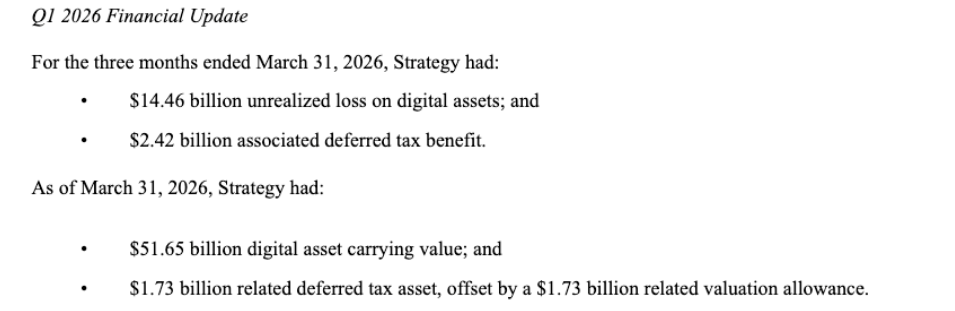
Sitting on paper losses exceeding $14 billion, Michael Saylor’s Strategy didn’t slow down last week. The company spent roughly $1 billion buying more Bitcoin — its latest move in a relentless accumulation run that has now brought its total stash to 780,897 BTC.

A Purchase Funded By Preferred Shares

That $1 billion didn’t come from operating cash. Strategy raised the money by selling 10 million shares of STRC, its perpetual preferred equity. Data shows the sale generated about $1 billion in net proceeds — and it was no small transaction.

According to reports, STRC recorded its second-largest weekly issuance on record, coming in at nearly three times the four-week average. The surge followed a rule change Strategy made in early March that loosened restrictions on STRC share sales.
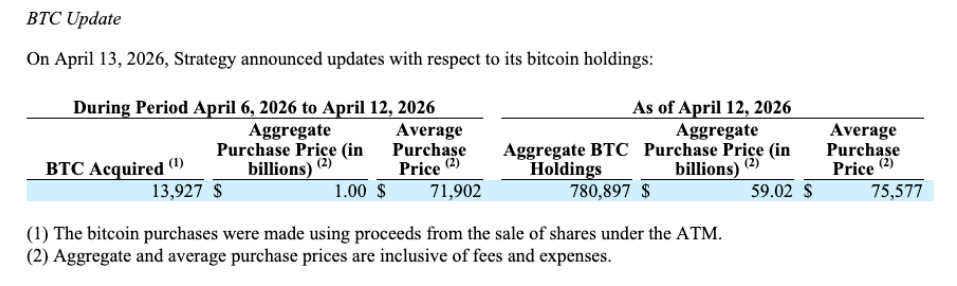
No shares of MSTR, STRK, STRF, or STRD were sold during the same period.

The 13,927 Bitcoin acquired between April 6 and 12 were purchased at an average price of $71,902 per coin. That figure sits below the company’s overall average buy price of $75,577 — meaning last week’s batch technically brought the cost basis down, not up.
A Milestone Within Reach

Strategy now needs just 19,103 more Bitcoin to cross the 800,000 BTC mark. Reports indicate the company has already bought more than 107,000 BTC in 2026 alone. All told, its holdings were acquired for a combined $59 billion — a figure that underscores just how deep the company is committed to this position.
The purchase came during a volatile stretch for Bitcoin prices. The market briefly climbed past $73,000 early last week after news broke of a US-Iran ceasefire. That rally didn’t hold.

Weekend negotiations fell apart, and an announcement of a naval blockade on April 13 pulled Bitcoin back toward $71,000. Strategy’s buying was among the signals backing the earlier rally, Nomura’s Laser Digital said, on top of solid inflows into spot Bitcoin exchange-traded funds, which took in $786 million over the same period.

Big Losses, Bigger Bets

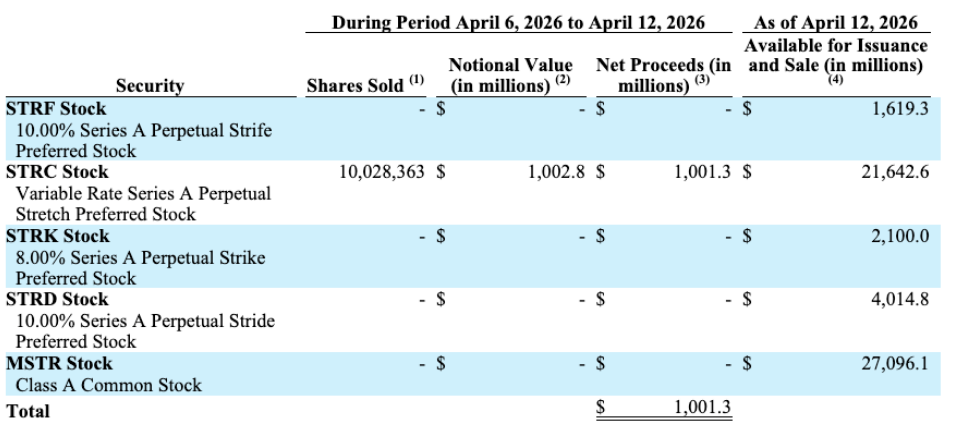
The backdrop to all of this is a balance sheet carrying $14.6 billion in unrealized losses on digital assets — a figure Strategy disclosed for the first quarter of 2026. That number reflects how far Bitcoin’s price has fallen from the highs at which much of the company’s holdings were acquired.

Still, the buying continues. SEC filings confirm the latest purchase was formally disclosed Monday in an 8-K report. There is no indication from the company of any plan to pause or reverse course.

With fewer than 20,000 BTC separating Strategy from the 800,000 milestone, the next purchase announcement may not be far off.

Featured image from Vecteezy, chart from TradingView

Disclaimer: For information purposes only. Past performance is not indicative of future results.
placeholder
Bitcoin CME gaps at $35,000, $27,000 and $21,000, which one gets filled first?Prioritize filling the $27,000 gap and even try higher.
Author  FXStreet
Aug 22, 2023
Prioritize filling the $27,000 gap and even try higher.
placeholder
Pinduoduo Earnings Incoming: Morgan Stanley Sees Long-Term Profit Potential​Insights – On November 21, Chinese e-commerce giant Pinduoduo (PDD) will release its Q3 2024 earnings.
Author  Mitrade
Nov 20, 2024
​Insights – On November 21, Chinese e-commerce giant Pinduoduo (PDD) will release its Q3 2024 earnings.
placeholder
Elon Musk’s xAI and Neuralink Launch New Funding Rounds​Billionaire Elon Musk recently raised funds for his two high-profile tech companies, xAI and Neuralink.
Author  Insights
Jun 03, 2025
​Billionaire Elon Musk recently raised funds for his two high-profile tech companies, xAI and Neuralink.
placeholder
Bitcoin briefly loses 2025 gains as crypto plunges over the weekend.Bitcoin experienced a sharp decline this weekend, briefly erasing its 2025 gains and dipping below its year-opening value of $93,507. The cryptocurrency fell to a low of $93,029 on Sunday, representing a 25% drop from its all-time high in October. Although it has rebounded slightly to around $94,209, the pressures on the market remain significant. The downturn occurred despite the reopening of the U.S. government on Thursday, which many had hoped would provide essential support for crypto markets. This year initially appeared promising for cryptocurrencies, particularly after the inauguration of President Donald Trump, who has established the most pro-crypto administration thus far. However, ongoing political tensions—including Trump's tariff strategies and the recent government shutdown, lasting a historic 43 days—have contributed to several rapid price pullbacks for Bitcoin throughout the year. Market dynamics are also being influenced by Bitcoin whales—investors holding large amounts of Bitcoin—who have been offloading portions of their assets, consequently stalling price rallies even as positive regulatory developments emerge. Despite these sell-offs, analysts from Glassnode argue that this behavior aligns with typical patterns seen among long-term investors during the concluding stages of bull markets, suggesting it is not indicative of a mass exodus. Notably, Bitcoin is not alone in its struggles, as Ethereum and Solana have also recorded declines of 7.95% and 28.3%, respectively, since the start of the year, while numerous altcoins have faced even steeper losses. Looking ahead, questions linger regarding the viability of the four-year cycle thesis, particularly given the increasing institutional support and regulatory frameworks now in place in the crypto landscape. Matt Hougan, chief investment officer at Bitwise, remains optimistic, suggesting a potential Bitcoin resurgence in 2026 driven by the “debasement trade” thesis and a broader trend toward increased adoption of stablecoins, tokenization, and decentralized finance. Hougan emphasized the soundness of the underlying fundamentals, pointing to a positive outlook for the sector in the longer term.
Author  Mitrade
Nov 17, 2025
Bitcoin experienced a sharp decline this weekend, briefly erasing its 2025 gains and dipping below its year-opening value of $93,507. The cryptocurrency fell to a low of $93,029 on Sunday, representing a 25% drop from its all-time high in October. Although it has rebounded slightly to around $94,209, the pressures on the market remain significant. The downturn occurred despite the reopening of the U.S. government on Thursday, which many had hoped would provide essential support for crypto markets. This year initially appeared promising for cryptocurrencies, particularly after the inauguration of President Donald Trump, who has established the most pro-crypto administration thus far. However, ongoing political tensions—including Trump's tariff strategies and the recent government shutdown, lasting a historic 43 days—have contributed to several rapid price pullbacks for Bitcoin throughout the year. Market dynamics are also being influenced by Bitcoin whales—investors holding large amounts of Bitcoin—who have been offloading portions of their assets, consequently stalling price rallies even as positive regulatory developments emerge. Despite these sell-offs, analysts from Glassnode argue that this behavior aligns with typical patterns seen among long-term investors during the concluding stages of bull markets, suggesting it is not indicative of a mass exodus. Notably, Bitcoin is not alone in its struggles, as Ethereum and Solana have also recorded declines of 7.95% and 28.3%, respectively, since the start of the year, while numerous altcoins have faced even steeper losses. Looking ahead, questions linger regarding the viability of the four-year cycle thesis, particularly given the increasing institutional support and regulatory frameworks now in place in the crypto landscape. Matt Hougan, chief investment officer at Bitwise, remains optimistic, suggesting a potential Bitcoin resurgence in 2026 driven by the “debasement trade” thesis and a broader trend toward increased adoption of stablecoins, tokenization, and decentralized finance. Hougan emphasized the soundness of the underlying fundamentals, pointing to a positive outlook for the sector in the longer term.
placeholder
WTI jumps roughly 8% toward $100 as US blockades Strait of HormuzWest Texas Intermediate (WTI) – the US oil benchmark – has opened the week with a bullish gap, climbing roughly 8%, looking to retarget the $100 threshold.
Author  Mitrade
Yesterday 01: 37
West Texas Intermediate (WTI) – the US oil benchmark – has opened the week with a bullish gap, climbing roughly 8%, looking to retarget the $100 threshold.
goTop
quote