


When Will Gold Rise Under the Pressure of High Oil Prices?

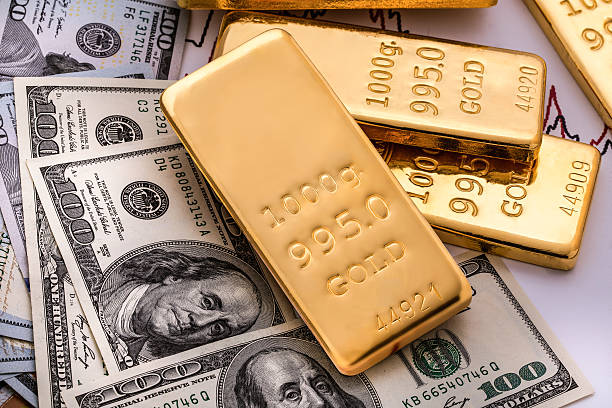
TradingKey - On April 8, spot gold ( XAUUSD) at one point surged past $4,800 per ounce, hitting a peak of $4,857; however, it fell back to $4,698 on April 9, wiping out all gains in just 48 hours. This 'roller coaster' price action is rooted not in gold itself, but in oil.
I. Why do gold prices fall when oil prices rise?
International oil prices surged in March this year, with Brent crude spot prices briefly breaching $140 per barrel, marking a new high since 2008. By early April, WTI crude futures remained above $116. The catalyst was the blockade of the Strait of Hormuz—a waterway that handles approximately 20% of global crude shipments. Any disruption immediately tightens global oil supply, transmitting energy costs across various sectors and sharply intensifying inflationary pressures.
Rising inflation has made the Federal Reserve uneasy. U.S. interest rates are currently held at 3.5% to 3.75% after two consecutive pauses. Minutes from the Fed's March meeting show that conflict in the Middle East has pushed up oil prices and short-term inflation, delaying the timing of potential rate cuts and even increasing the probability of a rate hike. This is bad news for gold: as gold yields no interest, investors prefer interest-bearing assets when rates are high. Higher oil prices drive inflation, forcing the Fed to maintain high rates, which puts downward pressure on gold—this transmission chain remains valid.
II. Recurring Geopolitical Tensions: Why the Rollercoaster Ride for Gold Prices?
On April 8, the U.S. and Iran reached a conditional two-week ceasefire, sparking hopes for a gradual reopening of the Strait of Hormuz. Oil prices plummeted nearly 20% while market expectations for a Fed rate cut quickly rebounded, with the probability surging from 14% to 43%, triggering a sharp rally in gold. However, on April 9, Iran claimed the ceasefire terms were violated and the strait was closed again. Oil prices bounced back, with Brent crude rising over 3% to $97.60 and WTI crude jumping more than 4% to $98.20.
Even if the strait reopens, restoring supply will not be an overnight process. High volatility in oil prices is likely to persist until geopolitical variables become clearer.
III. The Fed’s Dilemma is Key to Gold Prices
Geopolitical conflicts are impacting oil prices while disrupting the Federal Reserve's calculations. The March meeting minutes revealed internal divisions: only one governor supported a 25-basis-point rate cut, while others advocated for holding steady. Greater uncertainty comes from external factors—if the Middle East conflict leads to more persistent energy price increases that transmit to core inflation, "a rate hike cannot be ruled out." In other words, whether the Fed cuts rates now depends less on U.S. domestic data and more on the situation in the Middle East.
The good news is that even with oil prices remaining high, the Fed maintains its projection for one rate cut this year. Goldman Sachs economists stick to their forecast of two rate cuts in 2026, though the first cut has been delayed from June to September. For gold, the materialization of rate cuts is the most direct catalyst—as the opportunity cost of holding gold decreases, gold prices naturally stand to benefit.
IV. Some central banks sell gold; can gold prices hold their ground?
The Central Bank of the Republic of Turkey recently reduced its gold reserves by nearly 120 tons over a two-week period, and the National Bank of Poland's plan to sell some gold has also sparked concern. However, experts at Standard Chartered point out that Turkey's selling is an outlier; the country's gold reserves exceed 40%, far higher than the average of less than 10% for other emerging markets. Given that gold allocations for central banks in developed markets typically range from 25% to 50%, emerging markets still have substantial room to increase their holdings.
More significantly, the People's Bank of China's gold reserves reached 74.38 million ounces at the end of March, with a monthly increase of 160,000 ounces—the highest in nearly 13 months and the 17th consecutive month of additions. While some central bank selling is short-term in nature, the PBOC's sustained purchasing is a long-term trend, and its role in supporting gold prices is more deserving of attention.
5. What are the views of Goldman Sachs and Standard Chartered? How high can gold prices rise?
Goldman Sachs maintains its bullish stance on gold, forecasting that prices could climb to $5,400 per ounce by the end of 2026, supported primarily by sustained central bank purchases and two additional Fed rate cuts this year. Meanwhile, the bank cautioned that gold prices could see a short-term correction toward $3,800 if energy supply shocks intensify. Standard Chartered is even more optimistic, having raised its 12-month price target to $5,750. Experts at the bank noted that the 200-day moving average is situated in the $4,100-$4,200 range, adding that "the current price level of $4,200-$4,300 is actually an attractive buying opportunity." Short-term caution and long-term bullishness have become the general consensus among institutional investors.
VI. Should retail investors buy gold now?
Short-term (1-3 months) : Closely monitor the direction of U.S.-Iran negotiations. If negotiations see substantive progress and oil prices retreat, gold prices are expected to oscillate within the $4,600-$5,000 range; if conflicts flare up again, gold prices may face renewed pressure.
Medium-term (3-6 months) : Awaiting U.S. inflation data to confirm a downward trend and for the Federal Reserve to signal clear rate cuts. If rate cuts are implemented in the second half of the year, they will act as a catalyst for gold to break above $5,000.
Long-term (6-12 months) : Persistent gold purchases by global central banks and the weakening of U.S. dollar credit provide structural support for gold prices. Institutional year-end price targets sit between $5,400 and $5,750.
For retail investors, if they subscribe to the long-term logic of central bank gold buying and de-dollarization, every gold price correction triggered by oil price panic could be a window for medium-to-long-term phased positioning. After all, with recurring Middle East tensions and unstable inflation expectations, gold—the 'hard currency' for millennia—remains the most reassuring ballast.
Read more
* The content presented above, whether from a third party or not, is considered as general advice only. This article should not be construed as containing investment advice, investment recommendations, an offer of or solicitation for any transactions in financial instruments.


