


SK Hynix Shares Break 1.1 Million Won to Hit New High: How Much Longer Can AI Memory Leader Rise?
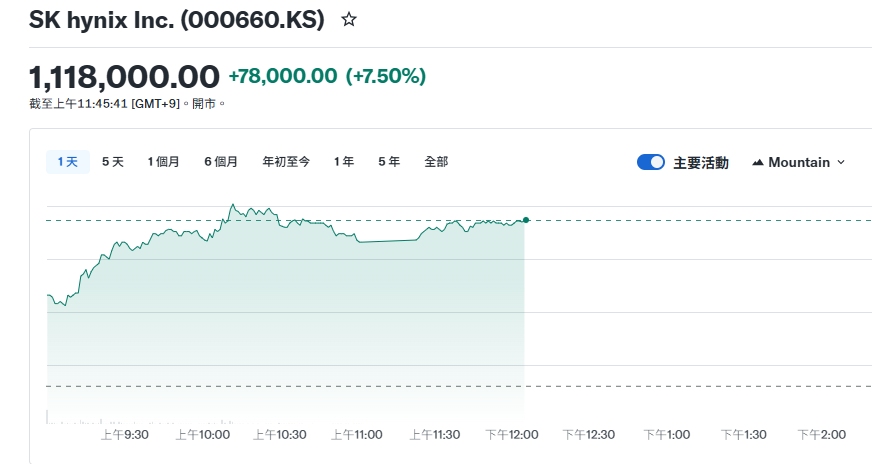
TradingKey - On the morning of April 14, 2026, SK Hynix shares extended their rally, breaking through the 1.1 million won mark intraday and hitting a record high of 1.13 million won. The company's total market capitalization climbed to approximately 110 trillion won (around $80 billion), solidifying its position as the second-most valuable company on the South Korean stock market, trailing only Samsung Electronics.
Looking back at the past few years, SK Hynix’s stock price has experienced significant volatility. When the global memory chip industry fell into a cyclical downturn in 2022, the stock dipped below 80,000 won. However, fueled by the explosive growth in demand for AI computing power, the company achieved a recovery in both earnings and valuation through its strategic positioning in the High Bandwidth Memory (HBM) sector. The rally has accelerated in 2026, with year-to-date gains exceeding 35%, significantly outperforming the benchmark KOSPI, which has risen less than 3% over the same period.
Drivers of Growth: Why is HBM in Short Supply?
The core logic behind SK Hynix's current rally lies in the significant leadership position it has established in the HBM market. HBM is an indispensable key component for AI training and inference chips. Every Nvidia ( NVDA) H100, B200, and even the next-generation Rubin platform AI accelerators require multiple HBM units. In this niche, SK Hynix has maintained a global market share of over 70%-80% for the past two years, thanks to its technological edge in being the first to mass-produce HBM3E.
From an order perspective, the company's production capacity is fully saturated. By the end of 2025, SK Hynix disclosed that its HBM capacity for 2026 had been fully booked by customers. Moving into 2026, the customer matrix expanded further: according to industry reports, the company became the HBM3E supplier for Microsoft's ( MSFT) Maia 200 AI chips; meanwhile, collaboration with Nvidia on HBM4 has entered a substantive phase. According to South Korean media reports, SK Hynix has been selected as one of the primary HBM4 suppliers for Nvidia's next-generation Rubin platform, with expectations to account for more than half of Nvidia's total HBM procurement volume in 2026.
The product upgrade path for HBM is clear. The price of HBM3E is several times that of traditional DRAM, and the unit price of HBM4 is expected to rise further. This product structure upgrade, coupled with robust demand, has led to a significant expansion in SK Hynix's profitability. The market generally expects the company to maintain strong earnings growth in 2026. Optimistic models from some analysts suggest that annual operating profit could reach approximately 50 trillion won, representing significant growth compared to 2025.
Institutional Views: Collectively Bullish?
Behind the record highs in stock price is a collective adjustment by mainstream institutions of the pricing logic for SK Hynix. Several investment banks have recently issued a flurry of target price hikes, with ratings remaining largely stable within the "Overweight" or "Buy" range.
Goldman Sachs reiterated its "Buy" rating in a report in early April, raising its target price from KRW 1.2 million to KRW 1.35 million. The report noted that SK Hynix's sustained leadership in the HBM4 market and its deep integration with top-tier AI clients will serve as core growth engines for the next two years.
Morgan Stanley recently significantly raised its earnings forecast for SK Hynix, stating: "We are in unprecedented territory—this is not an ordinary memory cycle, but a paradigm shift." The firm expects HBM penetration in AI servers to continue to rise, extending SK Hynix's earnings visibility to at least 2027.
Citi and Korea Investment & Securities have also raised their target prices over the past month, providing valuations of KRW 1.3 million and KRW 1.28 million respectively. The analyst consensus is that regardless of how the competitive landscape of the AI chip market evolves, the demand certainty for HBM as a critical upstream component is extremely high, and SK Hynix's role as the "AI pick-and-shovel provider" possesses scarcity value.
What are the risk factors?
However, as market expectations become highly consensus-driven, risks are simultaneously accumulating.
The competitive landscape is shifting. Samsung Electronics has announced that it will begin mass production of HBM4 in 2026, while Micron ( MU) is also accelerating its catch-up efforts. Morgan Stanley predicts that SK Hynix's share in Nvidia's supply chain may gradually retreat from the current level of over 85% to the 50%-60% range. While this remains a significant proportion, the erosion of its 'near-monopoly' status could exert pressure on its valuation.
Valuation levels are already in a historically high range. Based on projected 2026 earnings, some market estimates place the forward P/E ratio at approximately 18 times. Although this is still at a discount compared to AI chip designers like Nvidia, it is significantly higher than the company's own historical median. Optimistic market expectations for 2026 performance have been largely priced in. Should HBM prices soften or actual demand growth slow, the stock price faces a significant risk of a correction.
Disturbances in the macroeconomic environment also cannot be ignored. Rising DRAM prices and inflation expectations are mutually reinforcing. If major global central banks postpone interest rate cuts due to sticky inflation, the overall valuation framework for tech stocks could face a systemic adjustment; while SK Hynix possesses a structural growth narrative, it is unlikely to be completely immune.
Key areas of focus moving forward?
In the short term, the market will focus on SK Hynix's first-quarter 2026 earnings report, scheduled for release on April 23. Investors are looking beyond top- and bottom-line figures, seeking further guidance on second-half performance through management's commentary on HBM pricing, capacity utilization, and order visibility.
Over the medium to long term, SK Hynix’s ability to sustain its rally hinges on two key variables: first, whether its HBM4 mass-production timeline continues to lead its peers; and second, whether its customer base can successfully diversify from a heavy reliance on Nvidia to a broader landscape that includes self-developed chips from cloud service providers. The Microsoft Maia 200 order is a positive signal, but additional top-tier customer wins are needed to validate the sustainability of this narrative.
How much longer can the SK Hynix rally last?
SK hynix's share price breaking the 1.1 million won mark represents a landmark moment as AI hardware demand shifts from narrative to earnings realization. Leveraging its first-mover technical advantage in HBM and deep customer integration, the company has become a core beneficiary of the current wave of AI computing investment. However, as competitors catch up, valuations rise, and macro uncertainties persist, the second half of this supercycle will no longer be a broad-based rally; instead, it will serve as a comprehensive test of corporate execution, technological iteration speed, and customer relationship management.
Recommended Articles


