


New Zealand Dollar gains as traders await third-quarter inflation data
- The New Zealand Dollar holds firm as risk sentiment improves, although a steady US Dollar limits gains.
- New Zealand inflation data take centre stage as traders assess prospects for another RBNZ interest rate hike.
- NZD/USD remains below its 50-, 100- and 200-day SMAs, keeping the broader technical bias bearish.
NZD/USD trades with a mild positive bias on Monday as the New Zealand Dollar (NZD) benefits from improved risk sentiment. However, a rebound in US Treasury yields following last week’s pullback supports the US Dollar (USD), capping the pair’s upside. At the time of writing, the pair trades around 0.5663, up 0.20% on the day.
The benchmark 10-year US Treasury yield rises around 9 basis points to 5.14%, recovering from Thursday’s low of 5.03%, its lowest level since September 23. The US Dollar Index (DXY), which tracks the Greenback’s value against a basket of six major currencies, trades around 101.95 after falling to 101.58 on Friday.
The US Dollar also attracts demand from hawkish Federal Reserve (Fed) expectations after September’s Consumer Price Index and Producer Price Index reports came in hotter than expected. Traders widely expect the Fed to leave interest rates unchanged at its October 27-28 meeting but see a strong probability of another increase in December.
On the New Zealand side, the Reserve Bank of New Zealand (RBNZ) remains on a tightening path as inflation stands above its 1%-3% target range. The central bank raised the Official Cash Rate to 2.75% in September and will announce its next decision on October 28. Traders now await New Zealand’s third-quarter Consumer Price Index (CPI) data later this week, which could shape expectations for another RBNZ rate hike.
Strategists at Brown Brothers Harriman highlight that attention will focus on “New Zealand Q3 CPI (Wednesday),” with “headline CPI… expected at 0.8% q/q (RBNZ projection: 0.8%) vs. 1.5% in Q2 to be up 3.8% y/y (RBNZ projection: 3.9%) vs. 4.1% in Q2.” They stress that “above-target inflation argues for additional RBNZ rate hikes and offers NZD support,” noting that “the swaps curve prices in 80% odds of a 25bps RBNZ rate hike to 3.00% on October 28.”
Technical Analysis
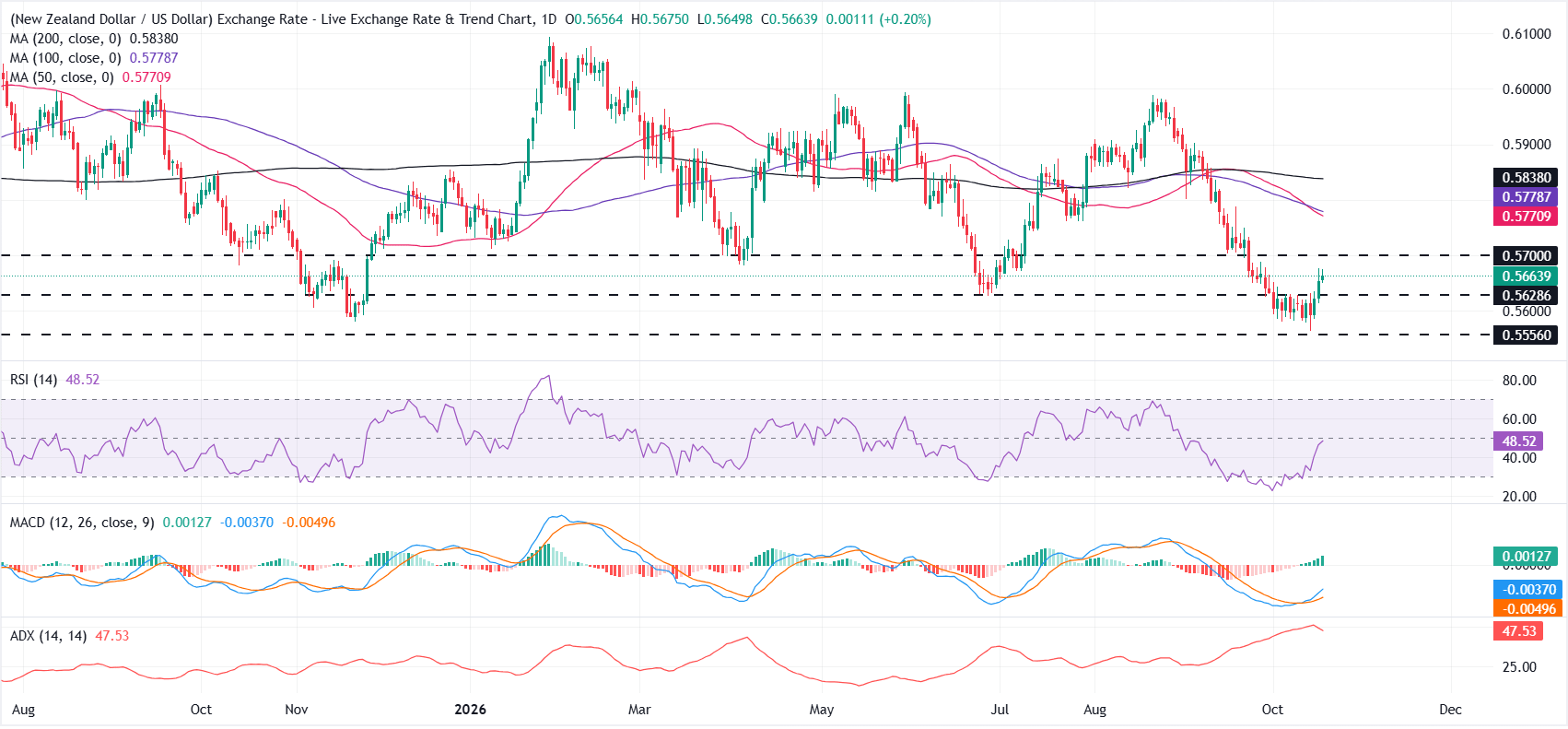
On the daily chart, NZD/USD retains a broadly capped tone as it remains under the 50-, 100- and 200-day Simple Moving Averages (SMAs) clustered between roughly 0.58 and 0.58. The Moving Average Convergence Divergence (MACD) has turned positive and the Relative Strength Index (RSI) hovers just below the 50 line, hinting that downside momentum is fading, yet the strong Average Directional Index (ADX) above 47 suggests the prevailing bearish trend is still dominant unless key overhead levels are reclaimed.
On the topside, initial resistance is located at the horizontal barrier near 0.5700, ahead of the 50-day SMA at 0.5771 and the 100-day SMA at 0.5779, while the 200-day SMA at 0.5838 marks a more substantial cap if gains extend. On the downside, immediate support emerges at 0.5629, followed by last week’s low of 0.5556. A decisive break below this level could open the door to a deeper decline.
(The technical analysis of this story was written with the help of an AI tool. Know more.)
RBNZ FAQs
The Reserve Bank of New Zealand (RBNZ) is the country’s central bank. Its economic objectives are achieving and maintaining price stability – achieved when inflation, measured by the Consumer Price Index (CPI), falls within the band of between 1% and 3% – and supporting maximum sustainable employment.
The Reserve Bank of New Zealand’s (RBNZ) Monetary Policy Committee (MPC) decides the appropriate level of the Official Cash Rate (OCR) according to its objectives. When inflation is above target, the bank will attempt to tame it by raising its key OCR, making it more expensive for households and businesses to borrow money and thus cooling the economy. Higher interest rates are generally positive for the New Zealand Dollar (NZD) as they lead to higher yields, making the country a more attractive place for investors. On the contrary, lower interest rates tend to weaken NZD.
Employment is important for the Reserve Bank of New Zealand (RBNZ) because a tight labor market can fuel inflation. The RBNZ’s goal of “maximum sustainable employment” is defined as the highest use of labor resources that can be sustained over time without creating an acceleration in inflation. “When employment is at its maximum sustainable level, there will be low and stable inflation. However, if employment is above the maximum sustainable level for too long, it will eventually cause prices to rise more and more quickly, requiring the MPC to raise interest rates to keep inflation under control,” the bank says.
In extreme situations, the Reserve Bank of New Zealand (RBNZ) can enact a monetary policy tool called Quantitative Easing. QE is the process by which the RBNZ prints local currency and uses it to buy assets – usually government or corporate bonds – from banks and other financial institutions with the aim to increase the domestic money supply and spur economic activity. QE usually results in a weaker New Zealand Dollar (NZD). QE is a last resort when simply lowering interest rates is unlikely to achieve the objectives of the central bank. The RBNZ used it during the Covid-19 pandemic.
Recommended Articles


