


Yen barely gains on a BoJ push for hikes and a Tokyo stock rout
- USD/JPY twice dips to just above 157.50 and recovers to near 158.00.
- The Yen gains less on the Dollar than the Euro or the Pound and slips on both.
- Fed Chair Warsh speaks Friday, and Japan's September CPI is due October 22.
Neither Bank of Japan (BoJ) Policy Board member Koeda's case against caution on hikes nor a near-5% fall in Tokyo stocks took USD/JPY out of its three-week range. The pair dipped to just above 157.50 twice, on her first speech and as the 10-year Treasury yield hit its low for Thursday, and is back near 158.00.
Policy Board member Koeda said in Kumamoto that the BoJ shouldn't become overly cautious about raising its 1.25% rate while financial conditions stay loose. She listed a weaker Yen that has been less of a safe haven among the risks pushing prices up, with underlying inflation becoming anchored around 2%. If the rest of the board agrees, the Japanese side of USD/JPY's rate gap has further to rise.
Tokyo's Nikkei 225 fell 4.9%, its third-largest point drop on record, as the selling in artificial intelligence stocks reached Japan's chipmakers. The Yen may still be a safe haven, but on Thursday it gained less on the Dollar than the Euro or the Pound and lost ground to both.
On the calendar
On Friday at 03:30 GMT, Fed Chair Warsh appears in Bangkok. US industrial output for September is due at 13:15 GMT, with a 0.4% rise forecast after a flat August. Both reach USD/JPY through the 10-year yield, which the pair followed to its second low of Thursday.
Japan's September trade figures come out at 23:50 GMT on Tuesday, October 20, and August's showed exports up 19.3% from a year earlier. National inflation follows at 23:30 GMT on Thursday, October 22, after 1.9% in August, close to the 2% Policy Board member Koeda says underlying inflation is anchoring at. Both are out before the BoJ decides on October 30.
On the charts
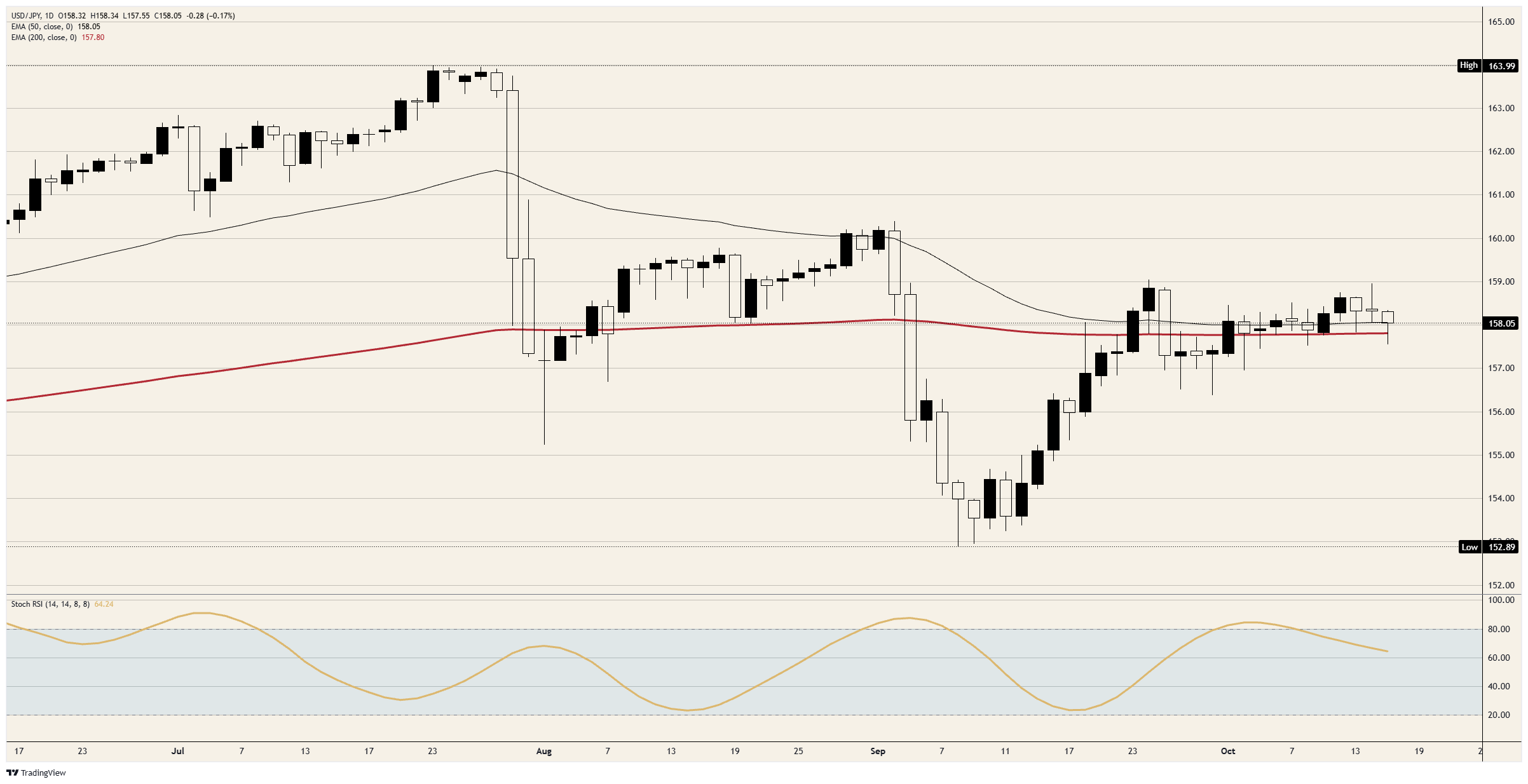
USD/JPY has traded between roughly 156.50 and 159.00 since September 24, after a climb from below 153.00 on September 8. Thursday's bar spans both the 50-day Exponential Moving Average (EMA) and the 200-day EMA, which have narrowed to about a quarter of a yen apart.
USD/JPY daily chart
Japanese Yen FAQs
The Japanese Yen (JPY) is one of the world’s most traded currencies. Its value is broadly determined by the performance of the Japanese economy, but more specifically by the Bank of Japan’s policy, the differential between Japanese and US bond yields, or risk sentiment among traders, among other factors.
One of the Bank of Japan’s mandates is currency control, so its moves are key for the Yen. The BoJ has directly intervened in currency markets sometimes, generally to lower the value of the Yen, although it refrains from doing it often due to political concerns of its main trading partners. The BoJ ultra-loose monetary policy between 2013 and 2024 caused the Yen to depreciate against its main currency peers due to an increasing policy divergence between the Bank of Japan and other main central banks. More recently, the gradually unwinding of this ultra-loose policy has given some support to the Yen.
Over the last decade, the BoJ’s stance of sticking to ultra-loose monetary policy has led to a widening policy divergence with other central banks, particularly with the US Federal Reserve. This supported a widening of the differential between the 10-year US and Japanese bonds, which favored the US Dollar against the Japanese Yen. The BoJ decision in 2024 to gradually abandon the ultra-loose policy, coupled with interest-rate cuts in other major central banks, is narrowing this differential.
The Japanese Yen is often seen as a safe-haven investment. This means that in times of market stress, investors are more likely to put their money in the Japanese currency due to its supposed reliability and stability. Turbulent times are likely to strengthen the Yen’s value against other currencies seen as more risky to invest in.
Recommended Articles


