


Gold Price Forecast: Ahead of September CPI, Will Gold Break Above $4,200 or Fall Below $4,100?


TradingKey - As of the European session on Wednesday (October 14), gold prices (XAUUSD) remained range-bound ahead of the US September CPI release, with the latest price trading near $4,150. Previously, gold's rebound faced resistance near $4,200 before falling back to around $4,150. The US inflation data to be released tonight could be a key factor determining gold's short-term trajectory.
US CPI Expected to Accelerate as Core Inflation Dictates Gold's Reaction
According to a Reuters survey, the market expects the US headline CPI to rise 0.6% month-over-month in September, up from 0.4% in August; the year-over-year rate is expected to rise from 3.4% to 3.6%. Among these, rising energy prices are the primary driver behind the rebound in headline inflation. Data from the US Energy Information Administration shows that gasoline prices surged 7.1% in September, which is expected to noticeably push up the month's CPI.
However, core CPI, which excludes food and energy prices, is expected to rise 0.2% month-over-month, down from 0.3% in August; the year-over-year rate is expected to edge up from 2.4% to 2.5%. This implies that while headline inflation may be driven by rising energy prices, core price pressures will not necessarily accelerate in tandem.
For gold, the key to this CPI report lies in whether core inflation surges beyond expectations and whether the data can alter the Federal Reserve's rate-hike path by year-end. The Fed already raised interest rates by 25 basis points in September, lifting the target range for the federal funds rate to 3.75%–4.00%. According to the CME FedWatch Tool, the market currently estimates a probability of about 22% for another rate hike in October, while the probability of a hike in December remains at 90%.
If headline CPI comes in higher than expected due to rising energy prices, but core CPI meets or falls short of expectations, the market may view the energy shock as not yet significantly spreading to other consumer sectors, solidifying expectations that the Fed will keep interest rates unchanged in October. In this scenario, the US dollar and US Treasury yields could come under pressure, creating conditions for a gold rebound.
Conversely, if core CPI also significantly exceeds expectations, signaling broader inflationary pressures, the market may raise expectations for further Fed rate hikes, driving up the US dollar and US Treasury yields, while gold prices could come under pressure again.
Gold Price Technical Analysis
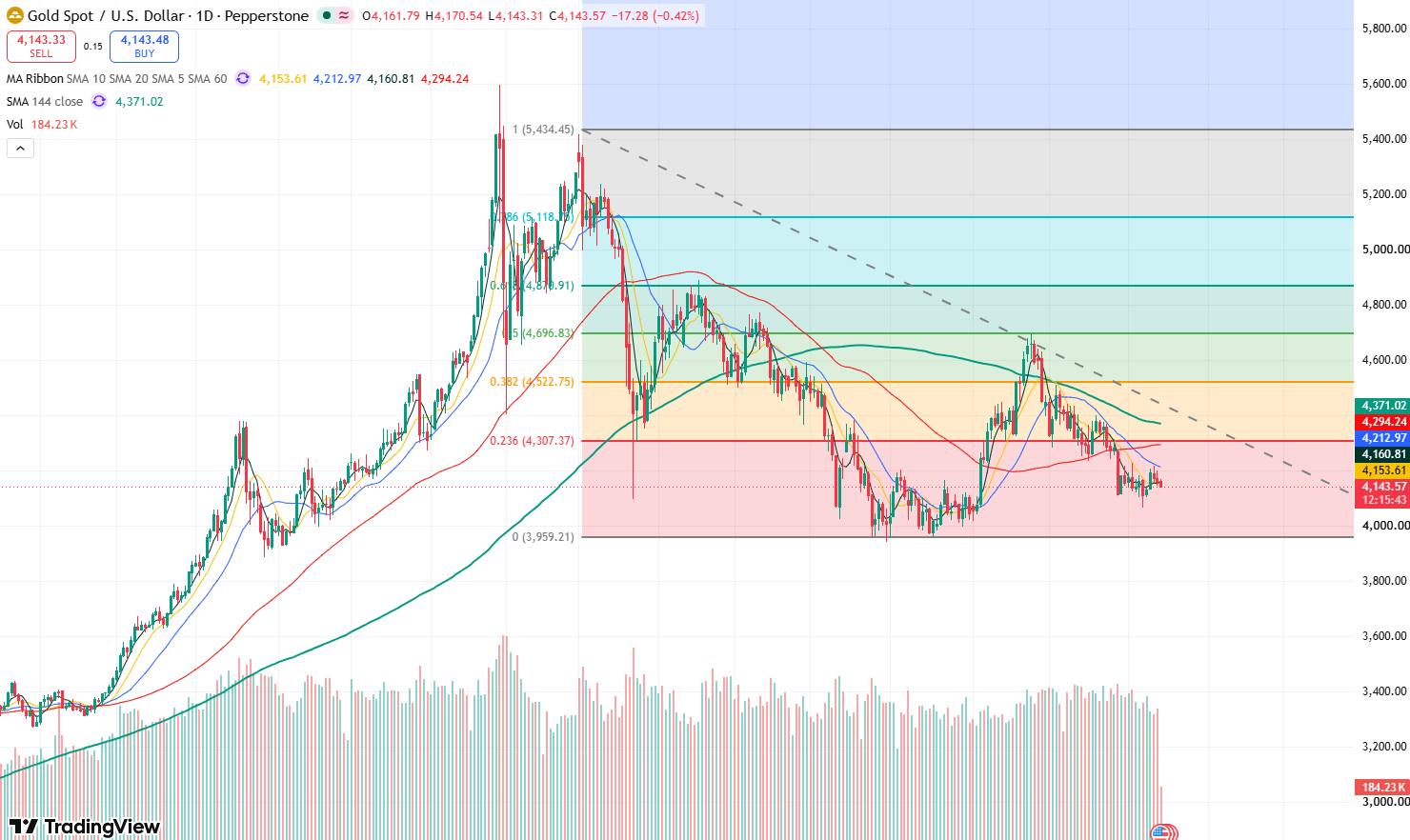
Gold price daily chart, Source: TradingView
Looking at gold's daily chart, prices have recently fluctuated repeatedly within the $4,100–$4,200 range. Early in the week, gold rebounded above $4,200 at one point, but failed to sustain the advance and subsequently fell back to near $4,150, indicating that overhead selling pressure remains.
Regarding technical indicators, the Relative Strength Index (RSI) hovers near 41.6, below the 50 centerline, indicating that short-term momentum remains weak. Meanwhile, gold prices have been consistently suppressed by the 20-day moving average recently, further confirming that bears hold the upper hand in the market.
To the upside, the initial focus is on the $4,170–$4,180 resistance zone. If tonight's CPI comes in lower than expected and pushes gold to break through this level, the next target will point to the $4,200–$4,230 range. If it further consolidates above $4,230, the short-term rebound room could expand to around $4,250.
To the downside, the initial focus is on the $4,140–$4,150 support zone. If gold drops below this level, it may further test the $4,100 psychological level. If $4,100 gives way, the next key support will be located near $4,066, followed by the $4,000 mark.
Read more
* The content presented above, whether from a third party or not, is considered as general advice only. This article should not be construed as containing investment advice, investment recommendations, an offer of or solicitation for any transactions in financial instruments.


