


New Zealand Dollar resumes decline against US Dollar ahead of FOMC minutes
- NZD/USD declines to near 0.5609 as the US Dollar bounces back.
- Hawkish Fed remarks and signs of recovery in oil prices support the US Dollar.
- Investors keenly await FOMC minutes releasing later in the day.
The New Zealand Dollar (NZD) faces selling pressure while attempting to extend the two-day recovery move above 0.5628 against the US Dollar. In the Asian trade on Wednesday, the NZD/USD pair is down 0.23% to near 0.5609.
The Kiwi pair falls back as the US Dollar rebounds strongly after a sharp correction on Tuesday. The Federal Reserve (Fed) signaling the need of more interest rate hikes due to persistent inflationary fears and a recovery move in oil prices have lend strength to the US Dollar.
As of writing, the US Dollar Index (DXY), which gauges the Greenback’s value against six major currencies, trades 0.18% higher to near 102.03.
On Tuesday, Kansas City Fed President Jeffrey Schmid said that inflation is “frustrating”, adding it has put central bank’s credibility on stake.
Fed’s Schmid flags AI-driven price pressures, keeps Dollar bulls focused on inflation fight
Fed’s Schmid delivers a slightly more hawkish tone relative to the historical average, with the FXS Speechtracker score at 8/10 versus a 7.5/10 baseline. The emphasis that the labor force “remains in a good place” alongside the insistence that “inflation is frustrating, must be fixed” and that “AI is now one of the largest drivers of inflation” underscores a firm commitment to further tightening if needed, especially with the short rate still seen as a key tool despite higher long-term yields. The explicit reference to the Fed’s credibility being at stake in beating inflation reinforces a bias toward keeping policy restrictive, a backdrop that tends to support the Dollar over time.
The FXS Fed Sentiment Index rises by 0.34 points to 137.91, signaling a modest hawkish reinforcement in line with the stronger-than-baseline speech score. With the index firmly above the neutral 100 mark, the combination of elevated sentiment and Schmid’s focus on persistent inflation and AI-driven price pressures keeps the Fed narrative skewed toward tighter policy, a configuration that typically underpins Dollar resilience against the Euro and Yen.
Meanwhile, investors await Federal Open Market Committee (FOMC) minutes of the September meeting, which will be published at 18:00 GMT.
NZD/USD Technical Analysis
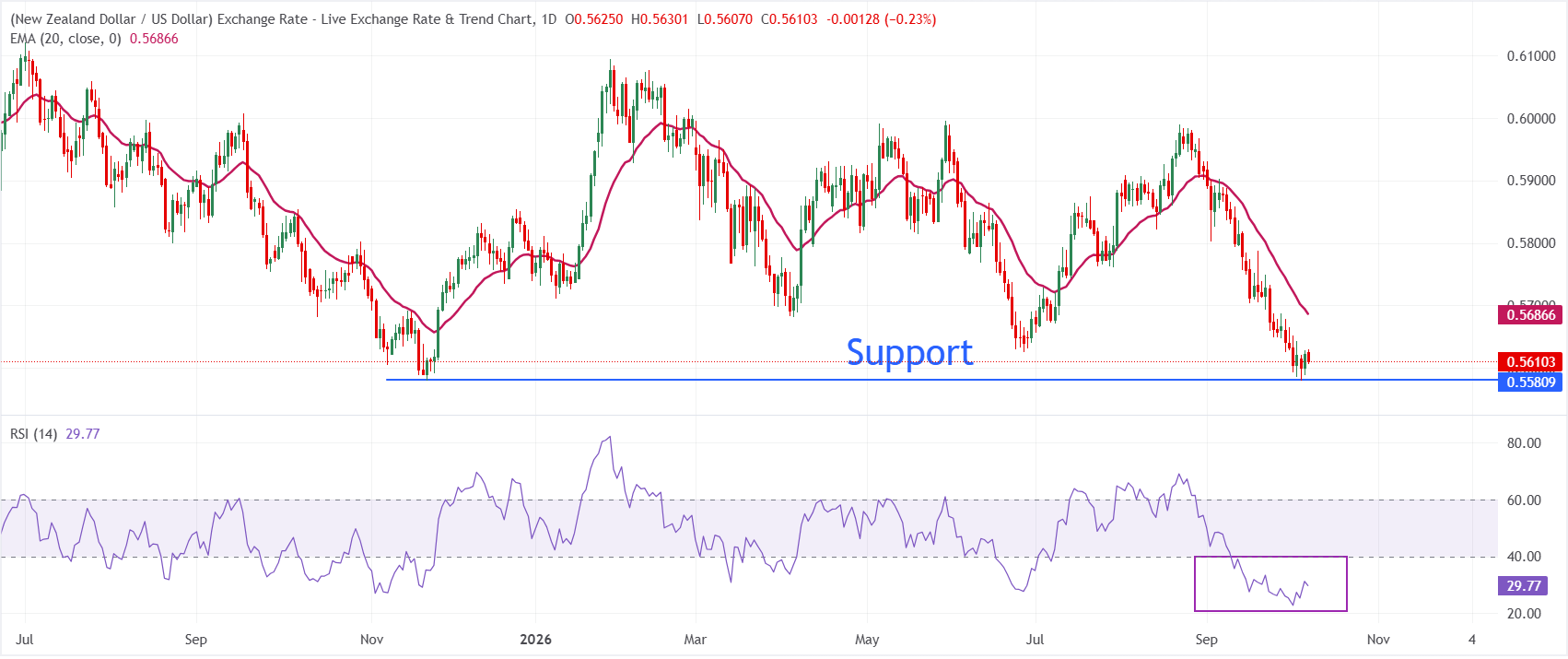
In the daily chart, NZD/USD trades at 0.5610, maintaining a bearish near-term bias as price holds beneath the 20-day exponential moving average (EMA) at 0.5687. The pair continues to slide after failing to reclaim that dynamic resistance, while the Relative Strength Index (14) at 29.7 sits in oversold territory, hinting that downside pressure is stretched but not yet decisively reversing.
On the topside, immediate resistance is located at the 20-day EMA near 0.5687, which caps any recovery attempts and reinforces the broader bearish structure while it remains overhead. With no nearby structural support levels in the dataset, the focus stays on whether sellers can keep the pair anchored below the EMA, or if an oversold bounce in momentum allows NZD/USD to challenge and potentially reclaim that barrier.
(The technical analysis of this story was written with the help of an AI tool. Know more.)
US Dollar FAQs
The US Dollar (USD) is the official currency of the United States of America, and the ‘de facto’ currency of a significant number of other countries where it is found in circulation alongside local notes. It is the most heavily traded currency in the world, accounting for over 88% of all global foreign exchange turnover, or an average of $6.6 trillion in transactions per day, according to data from 2022. Following the second world war, the USD took over from the British Pound as the world’s reserve currency. For most of its history, the US Dollar was backed by Gold, until the Bretton Woods Agreement in 1971 when the Gold Standard went away.
The most important single factor impacting on the value of the US Dollar is monetary policy, which is shaped by the Federal Reserve (Fed). The Fed has two mandates: to achieve price stability (control inflation) and foster full employment. Its primary tool to achieve these two goals is by adjusting interest rates. When prices are rising too quickly and inflation is above the Fed’s 2% target, the Fed will raise rates, which helps the USD value. When inflation falls below 2% or the Unemployment Rate is too high, the Fed may lower interest rates, which weighs on the Greenback.
In extreme situations, the Federal Reserve can also print more Dollars and enact quantitative easing (QE). QE is the process by which the Fed substantially increases the flow of credit in a stuck financial system. It is a non-standard policy measure used when credit has dried up because banks will not lend to each other (out of the fear of counterparty default). It is a last resort when simply lowering interest rates is unlikely to achieve the necessary result. It was the Fed’s weapon of choice to combat the credit crunch that occurred during the Great Financial Crisis in 2008. It involves the Fed printing more Dollars and using them to buy US government bonds predominantly from financial institutions. QE usually leads to a weaker US Dollar.
Quantitative tightening (QT) is the reverse process whereby the Federal Reserve stops buying bonds from financial institutions and does not reinvest the principal from the bonds it holds maturing in new purchases. It is usually positive for the US Dollar.
Recommended Articles


