


The Japanese Yen flatlines through a BoJ speech that changed nothing
- USD/JPY flatlines just above 158.00 through BoJ Governor Ueda's speech.
- Futures price a BoJ hike on October 30 at about 25%.
- IMF meetings in Bangkok run October 12-18, the next likely stage for Tokyo.
On Tuesday, Bank of Japan (BoJ) Governor Ueda gave his first major speech since the September 18 hike, and USD/JPY's whole range stayed inside Monday's. The pair trades just above 158.00, with futures still pricing about a 25% chance of a hike at the October 29-30 meeting.
Governor Ueda repeated that the BoJ will keep raising rates in line with the economy, prices and financial conditions, and said financial conditions are still accommodative. He added that if upside risks to prices outweigh downside risks to growth, even with the Middle East unclear, the board would need to thoroughly discuss the pros and cons of a hike. Discussing the pros and cons of a hike is what a rate meeting is for.
Tokyo calls reflation over, which means it wants a firmer Yen
Finance Minister Katayama said on October 2 that Prime Minister Takaichi's government agrees reflation is over, backing the BoJ as Tokyo pushes back on the weak Yen. Japan bought a record ¥11.73 trillion of Yen between April 30 and May 27 and stepped in again at the end of July, when the US Treasury joined it.
Both rounds came with USD/JPY well above where it trades now, so the warnings have more room to work than the money. The International Monetary Fund (IMF) and World Bank meetings run in Bangkok from October 12 to 18, so the next joint message from Tokyo and Washington already has a venue.
A smaller pay rise would hand the BoJ its case for waiting
Japan's August wage figures land on Tuesday at 23:30 GMT, with growth forecast at 3.7% YoY after 4.7%. Governor Ueda said after the September hike that recent wage data had been strong and that wage pressures were broadening, and the forecast has the next figure slowing by a full point.
The Federal Open Market Committee (FOMC) minutes on Wednesday at 18:00 GMT are the main US event for the pair. Minutes that lean toward another Fed hike would widen the rate gap the BoJ is trying to narrow, and push USD/JPY toward the top of its recent range.
Yen levels inside Monday's range
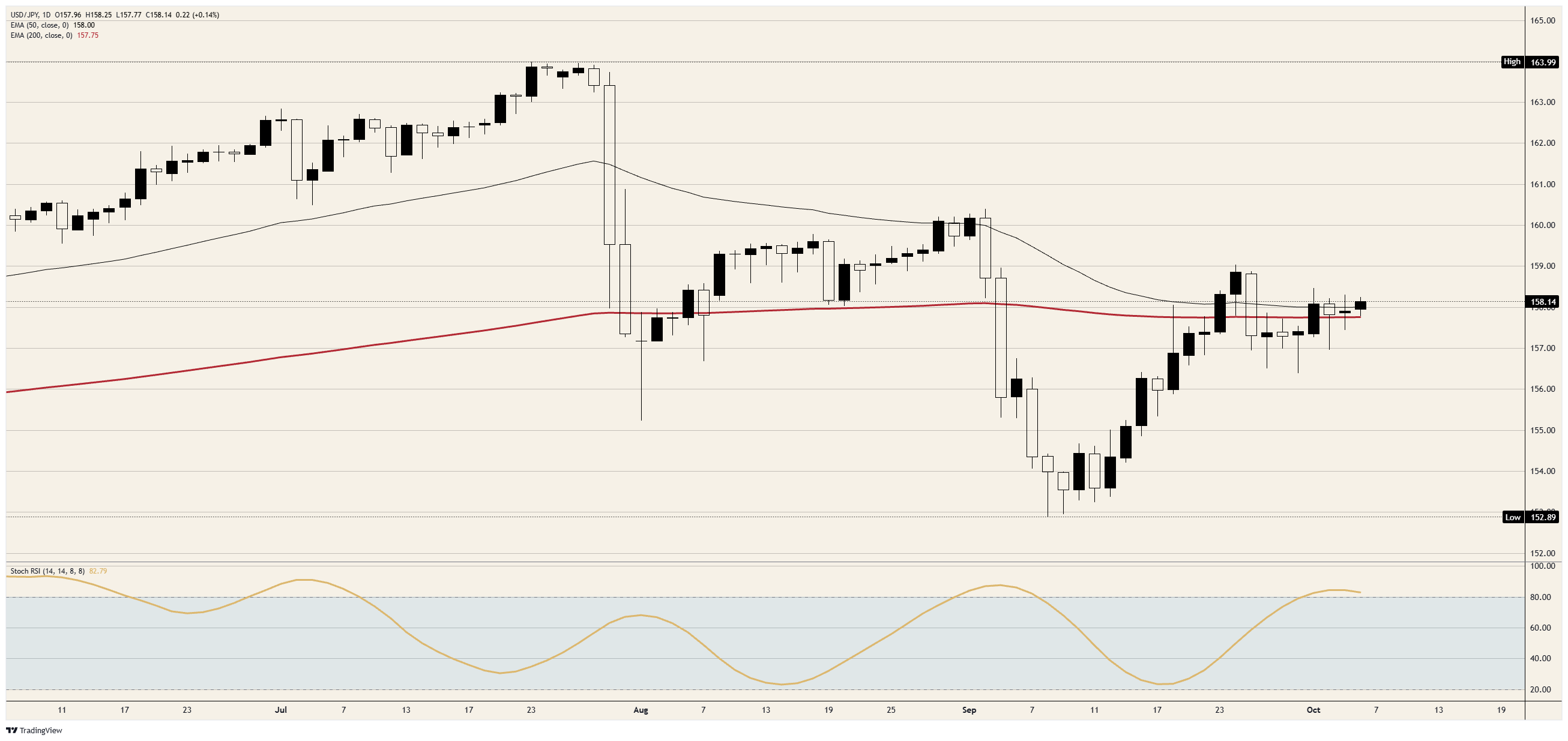
Resistance: No session since September 24 has traded above 158.50, and October 1 stopped just under it. 159.00 is the September 24 high.
Support: Monday's low, just under 157.50, is the first floor. Friday's low, just under 157.00, is the next.
Bias: Risk-reward tilts higher while daily closes hold above 157.50, targeting 158.50 first and 159.00 after. The daily Stochastic Relative Strength Index (Stoch RSI) is near 83 and has turned down above 80, so the push to 158.50 may need help from the minutes. A daily close below 157.00 ends the call.
USD/JPY daily chart
Japanese Yen FAQs
The Japanese Yen (JPY) is one of the world’s most traded currencies. Its value is broadly determined by the performance of the Japanese economy, but more specifically by the Bank of Japan’s policy, the differential between Japanese and US bond yields, or risk sentiment among traders, among other factors.
One of the Bank of Japan’s mandates is currency control, so its moves are key for the Yen. The BoJ has directly intervened in currency markets sometimes, generally to lower the value of the Yen, although it refrains from doing it often due to political concerns of its main trading partners. The BoJ ultra-loose monetary policy between 2013 and 2024 caused the Yen to depreciate against its main currency peers due to an increasing policy divergence between the Bank of Japan and other main central banks. More recently, the gradually unwinding of this ultra-loose policy has given some support to the Yen.
Over the last decade, the BoJ’s stance of sticking to ultra-loose monetary policy has led to a widening policy divergence with other central banks, particularly with the US Federal Reserve. This supported a widening of the differential between the 10-year US and Japanese bonds, which favored the US Dollar against the Japanese Yen. The BoJ decision in 2024 to gradually abandon the ultra-loose policy, coupled with interest-rate cuts in other major central banks, is narrowing this differential.
The Japanese Yen is often seen as a safe-haven investment. This means that in times of market stress, investors are more likely to put their money in the Japanese currency due to its supposed reliability and stability. Turbulent times are likely to strengthen the Yen’s value against other currencies seen as more risky to invest in.
Recommended Articles


