


Japanese Yen flatlines as Friday's rebound on Trump's concern holds
- USD/JPY flatlines just under 157.50 after Friday's drop from 159.00 on Trump's yen concern.
- Tokyo core CPI forecast at 2.4% YoY for September, up from 1.8%.
- Tankan large manufacturers' index forecast at 25, up from 22.
Japan's Ministry of Finance (MoF) reports on Wednesday how much Yen it bought between August 27 and September 28, which will show whether the rate check reported on September 18 turned into real money. USD/JPY closed just under 157.50 on Monday, a flat session that held most of Friday's drop from 159.00. The pair dipped to 156.50 during the day and recovered.
A week of Japanese warnings did less than one reported sentence from Washington
Finance Minister Katayama said on Friday that President Trump raised concerns about the Yen's weakness at his New York summit with Prime Minister Takaichi on Tuesday, and Takaichi confirmed that he said the weak currency was making trade difficult for the US. Katayama added that further joint intervention with the US had not been ruled out and that the leaders affirmed that stance. Japan and the US bought Yen together in late July, so a US president on the record makes another joint operation easier to believe.
USD/JPY reached 159.00 on Thursday after Katayama had spent the week repeating that the principles behind July's joint intervention still exist. Friday's disclosure took the pair under 157.00 within the day.
Katayama said she will keep in close contact with Treasury Secretary Bessent on exchange rates. The MoF figures on Wednesday cover the period of the September 18 rate check and the rise toward 159.00, so a zero would mean Tokyo has so far relied on words and a call to Washington, and a large number would put its line somewhere near 159.00.
Tokyo core inflation is forecast to cross the BoJ's target
Japan's quarterly Tankan survey on Wednesday at 23:50 GMT is forecast to show the large manufacturers' index at 25, up from 22, with their outlook at 22 from 17. Tokyo's Consumer Price Index (CPI) for September follows on Thursday at 23:30 GMT, with inflation excluding fresh food forecast at 2.4% YoY, up from 1.8%. The Bank of Japan (BoJ) raised its policy rate to 1.25% on September 18, and on that forecast it would still sit more than a point below Tokyo's core inflation.
A strong Tankan and a Tokyo reading above 2% would make another BoJ hike this year easier to argue for. The US calendar pulls the other way, with core Personal Consumption Expenditures (PCE) inflation forecast at 3.4% on Wednesday and payrolls on Friday, both feeding the case for a Fed hike on October 28 from the current 3.75%-4.00%.
What the chart shows into the MoF figures
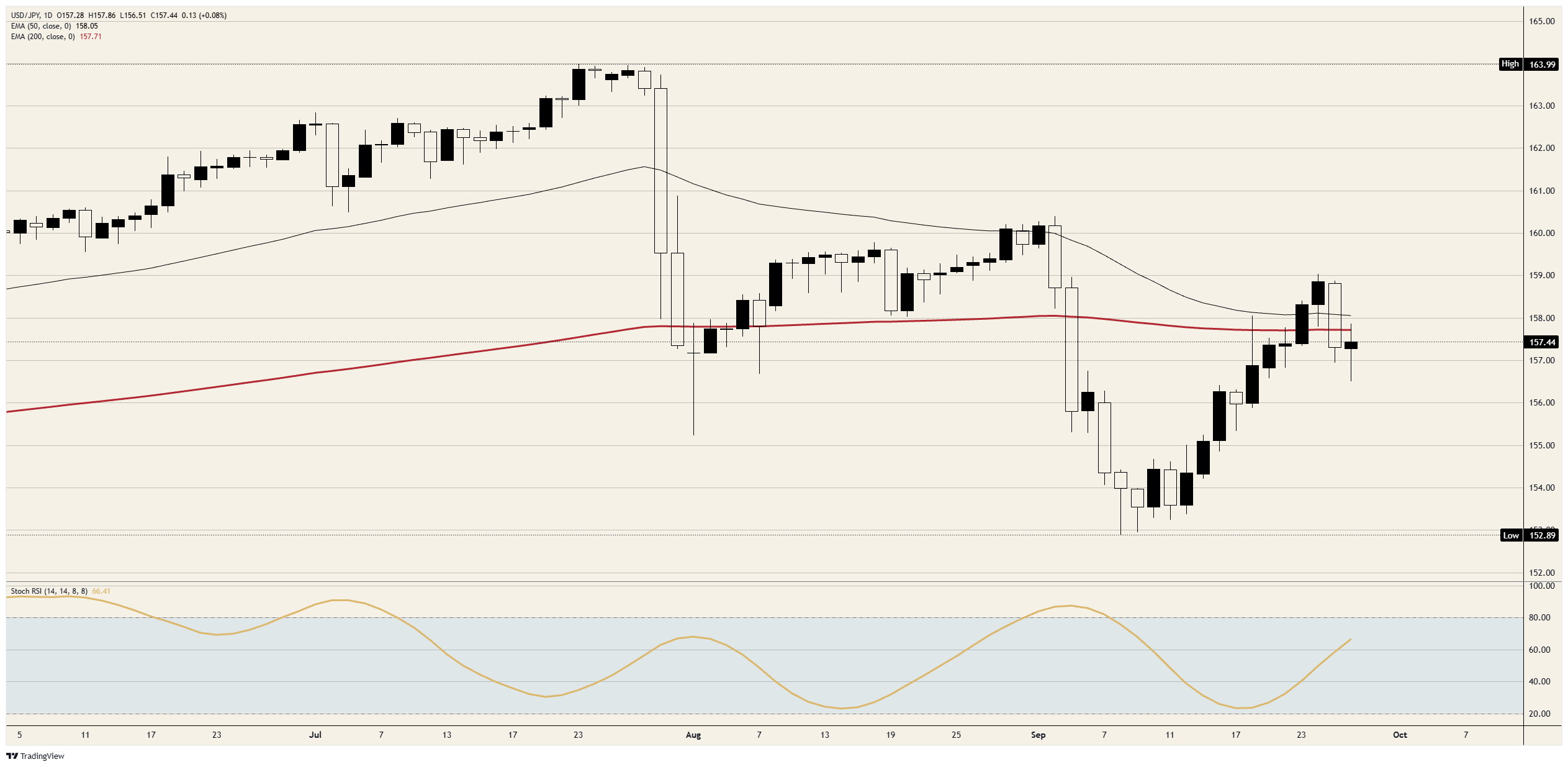
Resistance: The 50-day Exponential Moving Average (EMA) near 158.00 is the first cap. USD/JPY closed above it on September 23 and September 24, then fell back under it on Friday. Above that, Thursday's high just above 159.00 is where Friday's reversal began.
Support: Monday's low near 156.50 held the dip. Below it, the September 18 low just under 156.00 is the next floor.
Bias: Long above 156.50, aiming for 158.00 and then 159.00, with the rate gap to the US unchanged by anything said on Friday. The daily Stochastic Relative Strength Index (Stoch RSI) stands near 66, rising from the low 20s in mid-September. Intervention risk caps the trade at 159.00, and a daily close below 156.50 flips the call.
USD/JPY daily chart
Japanese Yen FAQs
The Japanese Yen (JPY) is one of the world’s most traded currencies. Its value is broadly determined by the performance of the Japanese economy, but more specifically by the Bank of Japan’s policy, the differential between Japanese and US bond yields, or risk sentiment among traders, among other factors.
One of the Bank of Japan’s mandates is currency control, so its moves are key for the Yen. The BoJ has directly intervened in currency markets sometimes, generally to lower the value of the Yen, although it refrains from doing it often due to political concerns of its main trading partners. The BoJ ultra-loose monetary policy between 2013 and 2024 caused the Yen to depreciate against its main currency peers due to an increasing policy divergence between the Bank of Japan and other main central banks. More recently, the gradually unwinding of this ultra-loose policy has given some support to the Yen.
Over the last decade, the BoJ’s stance of sticking to ultra-loose monetary policy has led to a widening policy divergence with other central banks, particularly with the US Federal Reserve. This supported a widening of the differential between the 10-year US and Japanese bonds, which favored the US Dollar against the Japanese Yen. The BoJ decision in 2024 to gradually abandon the ultra-loose policy, coupled with interest-rate cuts in other major central banks, is narrowing this differential.
The Japanese Yen is often seen as a safe-haven investment. This means that in times of market stress, investors are more likely to put their money in the Japanese currency due to its supposed reliability and stability. Turbulent times are likely to strengthen the Yen’s value against other currencies seen as more risky to invest in.
Recommended Articles


