


Brent edges toward $99 as Trump rejects Iran's Hormuz proposal — why the war-risk premium won't rebuild

Mitrade Insights — A geo-political headline that would once have added five dollars to a barrel of crude added less than one on Monday. Brent crude rose 0.92% to $98.51 and WTI gained 1.15% to $93.51 after President Trump rejected Iran's latest proposal to reopen the Strait of Hormuz — and yet both benchmarks remain roughly 12% below their early-September peaks. That gap between the headline and the price is the story: the market is no longer paying for a supply outage that has not happened.
1. The move
| Benchmark | Level | Change |
|---|---|---|
| Brent crude (TVC:UKOIL) | $98.51 | +$0.90 (+0.92%) |
| WTI crude (TVC:USOIL) | $93.51 | +$1.06 (+1.15%) |
| Brent–WTI spread | ~$5.00 | near its historical norm |
| Brent vs early-September peak | about −12% | peak above $110 |
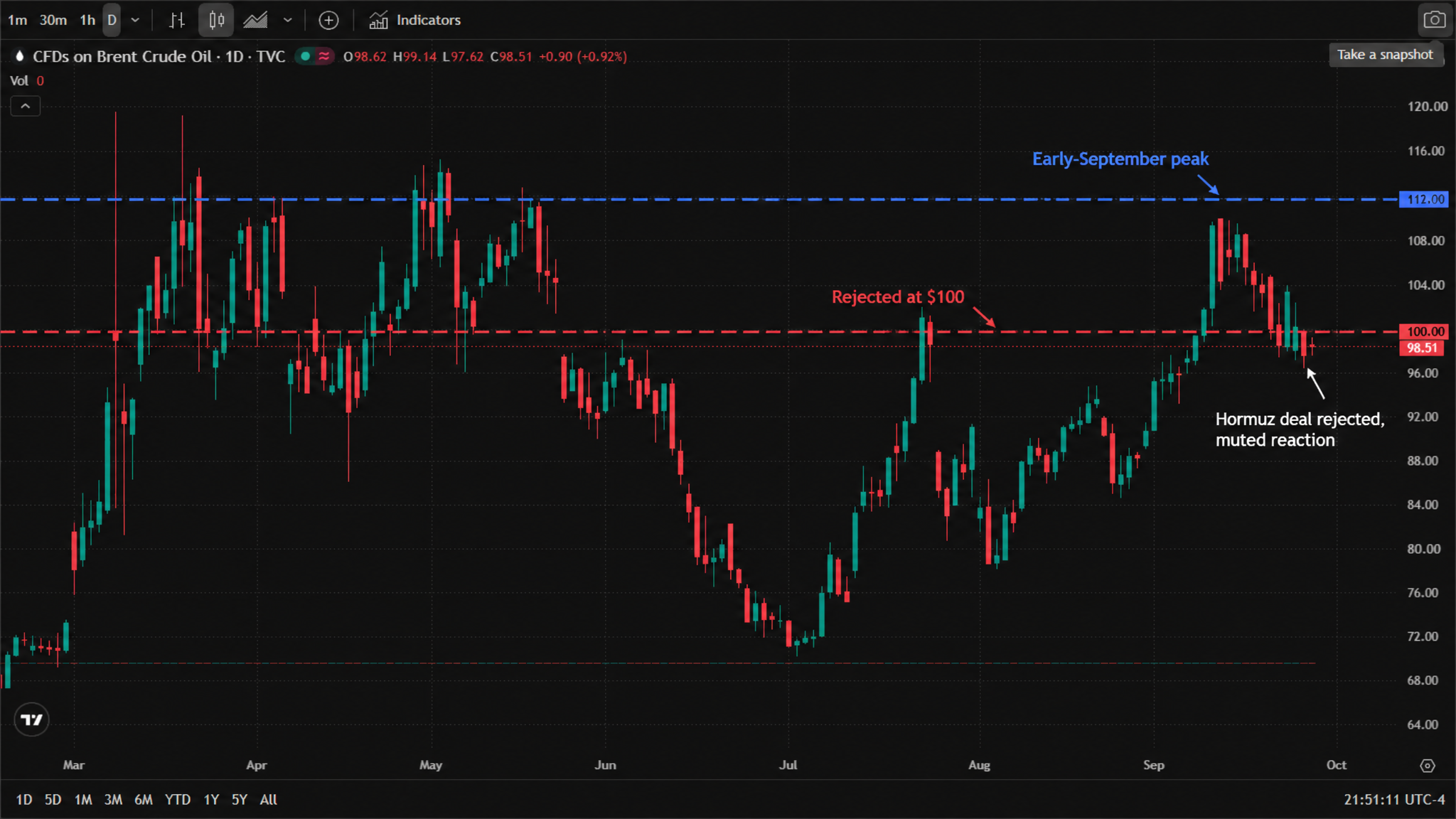
Both contracts opened higher in Asia and held the gains through the session, but neither came close to retesting the levels reached in the first week of September. Brent's failure to reclaim $100 is the technical fact that matters most on the chart this week.
2. Why the risk premium won't rebuild
First, the supply never actually stopped. The Strait of Hormuz handled 33.7 million barrels this week — in line with the previous week, not below it. Tanker traffic has been reduced from pre-conflict norms, but it has been steady for weeks. Saudi Arabia's East–West pipeline also restarted on September 22 after the mid-September drone-related closure, restoring a key bypass route.
Second, the market is pricing diplomacy, not escalation. Iran's foreign minister presented a seven-day plan at the UN: if Washington unfreezes at least $12 billion in assets, lifts oil sanctions and ends the naval blockade within four to five days, Tehran would reopen the strait on day six and begin final talks on day seven. Trump rejected it — but he also told Axios he expects negotiations to resume this week, and Iran says it is waiting for a formal US response through Qatari mediators. Traders are treating the rejection as a negotiating position, not a terminal breakdown.
Third, demand-side anxiety is now the dominant driver. US equity market breadth has deteriorated — eight of eleven S&P sectors fell in September and the equal-weight index is down about 4% — while credit stress in AI-related names (Oracle bond yields above 8%) has become its own macro story. When demand expectations are softening, a supply scare has a shorter half-life.
3. The flows behind the price
A proposed US diesel export ban is cutting the other way. Reports that the White House is considering a 90-day restriction on diesel exports — intended to cool domestic fuel prices ahead of the November midterms — would, if enacted, reduce US crude demand from refineries rather than add to it. Heating oil futures are up 104% year-on-year and gasoline 77%, so the political incentive is real; the market read is bearish for crude.
On the supply side, sanctions are tightening but slowly. A new US law targeting Russian energy and its "shadow fleet" — passed by the House 262–159 — raises compliance and freight costs for Russian barrels. Analysts see the impact as structural rather than an immediate barrel-for-barrel loss: Russian exports have been disrupted at the margin by refinery strikes, not halted.
4. Levels
* Chart source: TradingView official chart screenshot (TVC:UKOIL).
The levels that matter: $100 is the rejection line — Brent has now failed at the round number twice in two weeks. Below, $96 is the first support, with the $92–93 zone (where WTI is currently trading) as the deeper floor. A daily close above $100 would be the first genuine shift in the trend since early September.
Scenario A — talks resume and produce a framework. Trump has said negotiations could restart as soon as this week, with Qatar mediating. Any phased "Hormuz-for-sanctions" outline would push the risk premium lower again and open a move toward $92–93. The supply side is already normalising; only the politics is holding prices up.
Scenario B — talks collapse and the blockade tightens. A formal Iranian rejection, or renewed strikes on Saudi energy infrastructure, would be the trigger that finally rebuilds the premium. In that case $104–106 is the first target, with the early-September peak beyond it.
The swing factor in both scenarios is demand. This week's US PCE reading on Wednesday and the September payrolls on Friday will do more to set the oil price than anything that happens in the Strait of Hormuz — because the thing that would make a supply scare matter again is an economy strong enough to need the barrels.
Read more
Before making any trading decisions, it is important to equip yourself with sufficient fundamental knowledge, have a comprehensive understanding of market trends, be aware of risks and hidden costs, carefully consider investment targets, level of experience, risk appetite, and seek professional advice if necessary.
Furthermore, the content of this article is solely the author's personal opinion and does not necessarily constitute investment advice. The content of this article is for reference purposes only, and readers should not use this article as a basis for any investment decisions.
Investors should not rely on this information as a substitute for independent judgment or make decisions solely based on this information. It does not constitute any trading activity and does not guarantee any profits in trading.
If you have any inquiries regarding the data, information, or content related to Mitrade in this article, please contact us via email: insights@mitrade.com. The Mitrade team will carefully review the content to continue improving the quality of the article.


