


Indian Rupee gains ground despite fears of more Fed interest rate hikes
- The Indian Rupee counters strong US Dollar’s upside move due to RBI’s intervention.
- The Fed raised interest rates on Wednesday and signaled more this year.
- Financial markets expect the RBI to start the interest rate hike cycle soon.
The Indian Rupee (INR) finds some buying interest against the US Dollar in the early session after a weak opening on Thursday. According to a Reuters report, the Indian central bank has likely intervened to limit the decline in the Indian Rupee. The report also showed that traders said the state-run banks were spotted offering US dollars, most likely on behalf of the Reserve Bank of India (RBI).
The RBI’s intervention was highly likely as the USD/INR pair was anticipated to open strongly, following Federal Reserve’s (Fed) hawkish interest rate decision on Wednesday that led to a sharp rally in the US Dollar.
As of writing, the US Dollar Index (DXY), which gauges the Greenback’s value against six major currencies, trades firmly near its six-week high of 100.37.
What happened at the Fed meeting
On Wednesday, the Fed broke its five-meeting hold streak and hiked interest rates by 25 basis points (bps) to the 3.75%-4.00% range. The Fed was widely anticipated to tighten the monetary policy as the latest Consumer Price Index (CPI) readings signaled stickiness in inflationary pressures.
As expected, Fed Chairman Kevin Warsh didn’t deliver any remarks regarding the monetary policy outlook, but warned of high inflationary pressures. “Inflation is too high and has been for too long,” Warsh said.
However, the Fed’s dot plot that shows where policymakers collectively see Federal Fund Rates heading in the medium and long term signaled that 16 of 18 policymakers expected at least one interest rate hike this year.
Fed hike reinforces higher-for-longer stance
Economists at NBC Economics and Strategy argue that the updated dot plot pointing to “relatively broad support for more restrictive monetary policy for a significant period of time.” In their view, the Fed “doesn’t see a return to a 3.5%-3.75% range until the end of 2029,” underscoring a higher-for-longer policy bias.
NBC’s team sees “a 4.25% upper bound target representing the peak of what could be a brief tightening cycle,” with the timing and scale of eventual cuts likely to be “dictated by the sustainability of the economic expansion (i.e., the AI boom).”
RBI’s monetary tightening fears come into picture as inflation accelerates
Financial markets start pricing in the possibility that the RBI could tilt to starting a monetary tightening cycle to counter rising inflationary pressures. India’s retail Consumer Price Index (CPI) has been growing at a faster pace consistently from last 10 months and has reached 4.82% Year-on-Year (YoY) in August, strengthening the case of an interest rate hike in the near term.
Analysts at MUFG said that “a gradual broadening of price pressures is likely to keep headline inflation above 5% in second half of the fiscal year, underscoring the need for a tighter policy bias.”
MUFG adds that “recent developments, including a sustained rise in crude prices, tightening global financial conditions, firm domestic growth and signs of broadening in core pressures, strengthen the case for a shallow 50-bp hike in second half of FY27, making October’s meeting a live one.”
USD/INR Technical Analysis
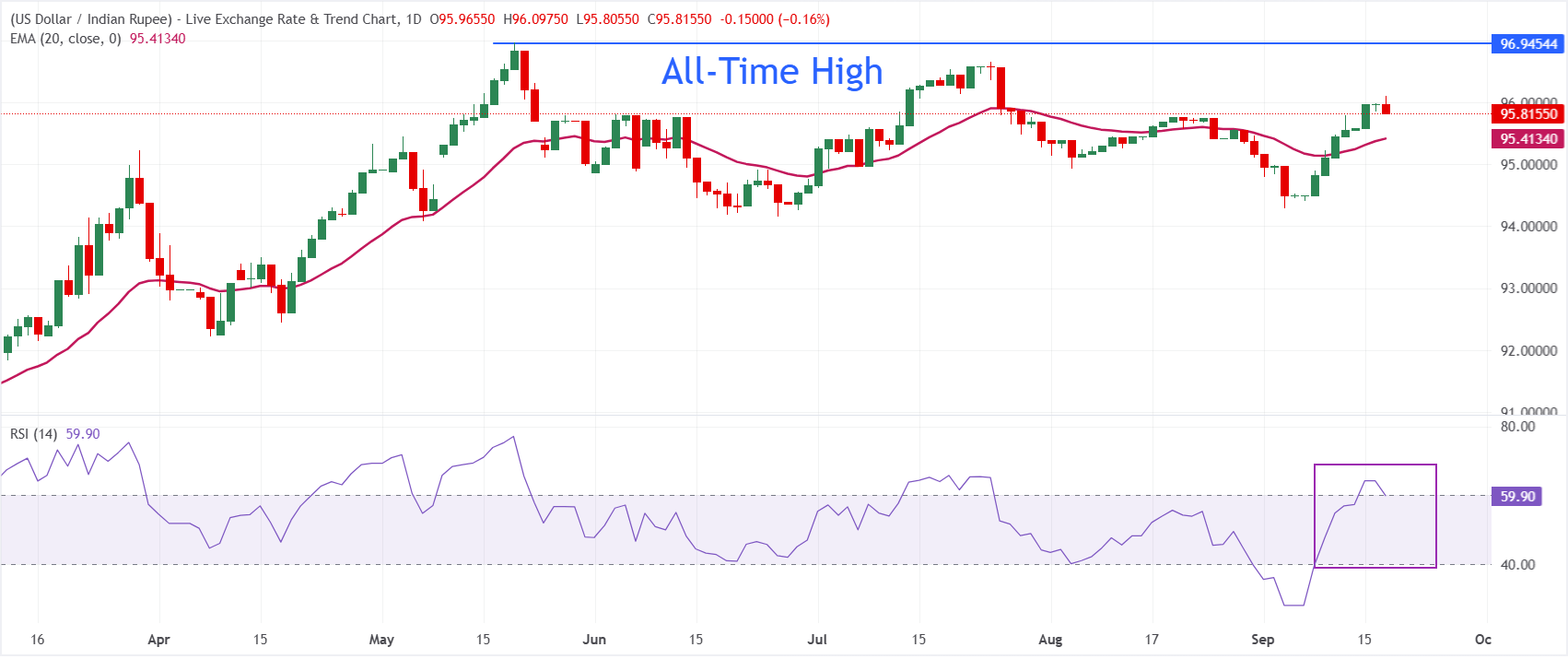
In the daily chart, USD/INR trades at 95.82. The pair holds above the 20-day exponential moving average (EMA) at 95.41, keeping the near-term bias bullish as price grinds higher from last week’s lows.
The Relative Strength Index (RSI) at 59.9 sits in positive but not overbought territory, which hints at constructive upside momentum without signs of exhaustion yet.
On the downside, immediate support is seen at the 95.80 area, where the current price acts as a short-term pivot, followed by stronger demand near the 20-day EMA at 95.41. Looking up, the pair aims to revisit the all-time high near 97.00.
(The technical analysis of this story was written with the help of an AI tool. Know more.)
Indian Rupee FAQs
The Indian Rupee (INR) is one of the most sensitive currencies to external factors. The price of Crude Oil (the country is highly dependent on imported Oil), the value of the US Dollar – most trade is conducted in USD – and the level of foreign investment, are all influential. Direct intervention by the Reserve Bank of India (RBI) in FX markets to keep the exchange rate stable, as well as the level of interest rates set by the RBI, are further major influencing factors on the Rupee.
The Reserve Bank of India (RBI) actively intervenes in forex markets to maintain a stable exchange rate, to help facilitate trade. In addition, the RBI tries to maintain the inflation rate at its 4% target by adjusting interest rates. Higher interest rates usually strengthen the Rupee. This is due to the role of the ‘carry trade’ in which investors borrow in countries with lower interest rates so as to place their money in countries’ offering relatively higher interest rates and profit from the difference.
Macroeconomic factors that influence the value of the Rupee include inflation, interest rates, the economic growth rate (GDP), the balance of trade, and inflows from foreign investment. A higher growth rate can lead to more overseas investment, pushing up demand for the Rupee. A less negative balance of trade will eventually lead to a stronger Rupee. Higher interest rates, especially real rates (interest rates less inflation) are also positive for the Rupee. A risk-on environment can lead to greater inflows of Foreign Direct and Indirect Investment (FDI and FII), which also benefit the Rupee.
Higher inflation, particularly, if it is comparatively higher than India’s peers, is generally negative for the currency as it reflects devaluation through oversupply. Inflation also increases the cost of exports, leading to more Rupees being sold to purchase foreign imports, which is Rupee-negative. At the same time, higher inflation usually leads to the Reserve Bank of India (RBI) raising interest rates and this can be positive for the Rupee, due to increased demand from international investors. The opposite effect is true of lower inflation.
Recommended Articles


