

USD/CHF Price Forecast: 100-day SMA tested as US Dollar tanks

Source Fxstreet
  • USD/CHF breaks below 50-day SMA after Treasury buyback shock.
  • RSI drop signals sellers are gaining near-term momentum.
  • Break below 0.7975 exposes 0.7932 and 0.7900 next.

The USD/CHF tumbles nearly 2% on Wednesday as a US Treasury announcement of a buyback sent the Greenback into a tailspin, as US Treasury yields also dive. The pair trades at 0.7979 after reaching a high of 0.8128.

USD/CHF Price Forecast: Technical Outlook

From a technical perspective, the USD/CHF is upward-biased after it bottomed at 0.7604 in February of 2026. Since then, the pair has rallied towards a yearly high above 0.8200, before the US Treasury unveiled its bond buyback. This pushed the USD/CHF below key support levels, including the 50-day Simple Moving Average (SMA) at 0.8084, and towards the 100-day SMA at 0.7975.

In the short term, momentum shifted bearish as the Relative Strength Index (RSI) fell from around 51 to 36.48. This suggests that sellers are gaining steam.

For a bearish continuation, USD/CHF must clear the 100-day SMA, followed by the 200-day SMA, at 0.7932. On further weakness, the next stop is 0.7900.

On the flip side, buyers must reclaim the 0.8000 level before challenging the March 31 high of 0.8042. Above lies the 50-day SMA at 0.8084, followed by the August 13 high of 0.8147.

USD/CHF Price Chart – Daily
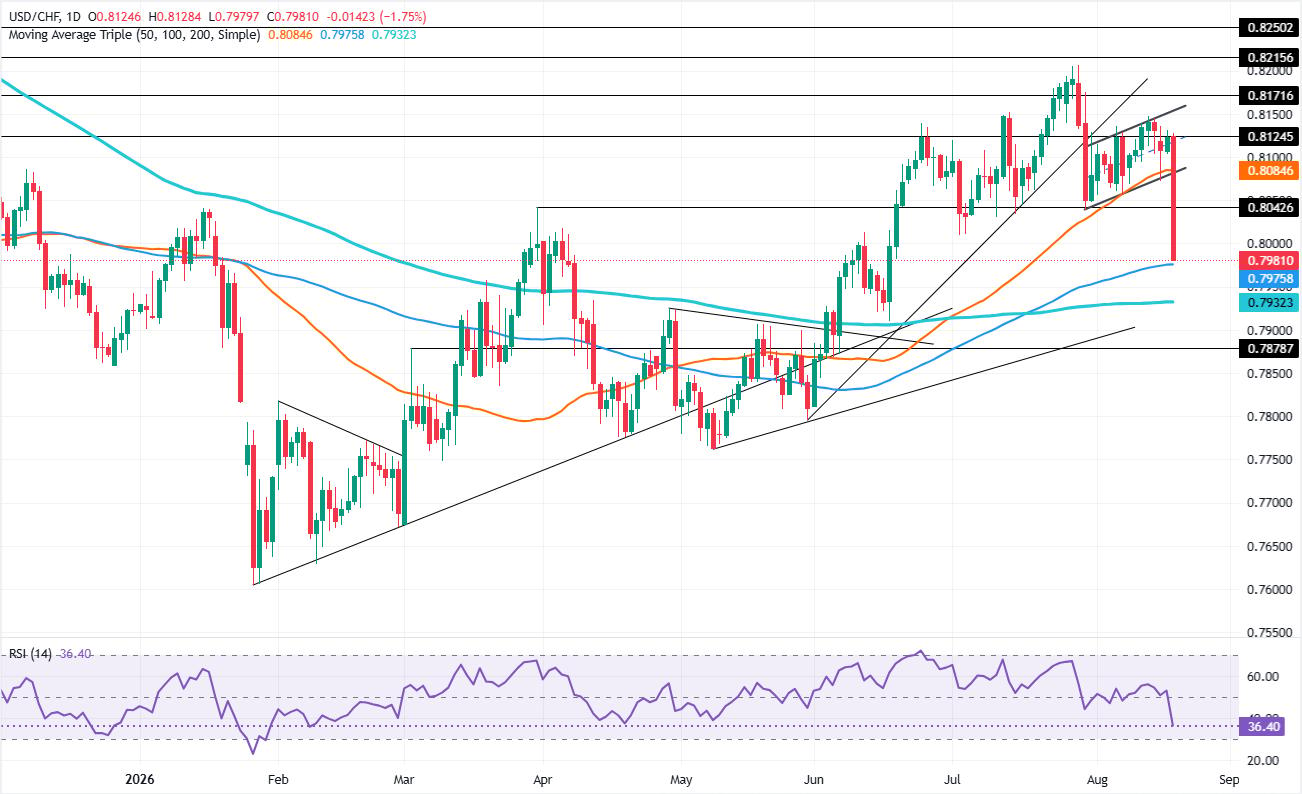
USD/CHF daily chart

Swiss Franc FAQs

The Swiss Franc (CHF) is Switzerland’s official currency. It is among the top ten most traded currencies globally, reaching volumes that well exceed the size of the Swiss economy. Its value is determined by the broad market sentiment, the country’s economic health or action taken by the Swiss National Bank (SNB), among other factors. Between 2011 and 2015, the Swiss Franc was pegged to the Euro (EUR). The peg was abruptly removed, resulting in a more than 20% increase in the Franc’s value, causing a turmoil in markets. Even though the peg isn’t in force anymore, CHF fortunes tend to be highly correlated with the Euro ones due to the high dependency of the Swiss economy on the neighboring Eurozone.

The Swiss Franc (CHF) is considered a safe-haven asset, or a currency that investors tend to buy in times of market stress. This is due to the perceived status of Switzerland in the world: a stable economy, a strong export sector, big central bank reserves or a longstanding political stance towards neutrality in global conflicts make the country’s currency a good choice for investors fleeing from risks. Turbulent times are likely to strengthen CHF value against other currencies that are seen as more risky to invest in.

The Swiss National Bank (SNB) meets four times a year – once every quarter, less than other major central banks – to decide on monetary policy. The bank aims for an annual inflation rate of less than 2%. When inflation is above target or forecasted to be above target in the foreseeable future, the bank will attempt to tame price growth by raising its policy rate. Higher interest rates are generally positive for the Swiss Franc (CHF) as they lead to higher yields, making the country a more attractive place for investors. On the contrary, lower interest rates tend to weaken CHF.

Macroeconomic data releases in Switzerland are key to assessing the state of the economy and can impact the Swiss Franc’s (CHF) valuation. The Swiss economy is broadly stable, but any sudden change in economic growth, inflation, current account or the central bank’s currency reserves have the potential to trigger moves in CHF. Generally, high economic growth, low unemployment and high confidence are good for CHF. Conversely, if economic data points to weakening momentum, CHF is likely to depreciate.

As a small and open economy, Switzerland is heavily dependent on the health of the neighboring Eurozone economies. The broader European Union is Switzerland’s main economic partner and a key political ally, so macroeconomic and monetary policy stability in the Eurozone is essential for Switzerland and, thus, for the Swiss Franc (CHF). With such dependency, some models suggest that the correlation between the fortunes of the Euro (EUR) and the CHF is more than 90%, or close to perfect.


Disclaimer: For information purposes only. Past performance is not indicative of future results.
placeholder
Dollar index tops 100 for the first time since July as the Fed's hawkish dot plot sinks inThe U.S. dollar index broke back above 100 for the first time since 31 July after the Fed delivered its first rate hike since 2023, with the dot plot showing 16 of 18 officials expect at least one more increase this year. Here are the levels that matter for DXY, the currencies feeling it most, and what to watch next.
Author  Irene Q.
Sep 17, Thu
The U.S. dollar index broke back above 100 for the first time since 31 July after the Fed delivered its first rate hike since 2023, with the dot plot showing 16 of 18 officials expect at least one more increase this year. Here are the levels that matter for DXY, the currencies feeling it most, and what to watch next.
placeholder
Gold ends three-week slide at the $4,400 line — eight straight days of ETF inflows vs a 5% 10-year and a 100 dollarSpot gold closed Friday at $4,378.39, up 0.84% on the day and about 0.8% for the week — its first weekly gain in four weeks — with the intraday high of $4,399.67 leaving it 33 cents shy of the $4,400 line. Gold ETFs have now logged eight straight sessions of inflows, but with the 10-year back above 5% and the dollar index near 100, here is what decides whether this is a reversal or a bounce.
Author  Suzie
Sep 20, Sun
Spot gold closed Friday at $4,378.39, up 0.84% on the day and about 0.8% for the week — its first weekly gain in four weeks — with the intraday high of $4,399.67 leaving it 33 cents shy of the $4,400 line. Gold ETFs have now logged eight straight sessions of inflows, but with the 10-year back above 5% and the dollar index near 100, here is what decides whether this is a reversal or a bounce.
placeholder
Dollar holds above 100 near a 3-month high — three Fed speakers and a $69 billion auction land tonightThe dollar index closed at 100.43 on Monday, its highest close since late July, after a weekly gain of about 1% — the best in more than three months — and is holding above the 100.00 handle in Asia. Three Fed officials speak tonight alongside a $69 billion two-year note auction, the first leg of $183 billion of Treasury supply this week.
Author  Suzie
Yesterday 06: 34
The dollar index closed at 100.43 on Monday, its highest close since late July, after a weekly gain of about 1% — the best in more than three months — and is holding above the 100.00 handle in Asia. Three Fed officials speak tonight alongside a $69 billion two-year note auction, the first leg of $183 billion of Treasury supply this week.
placeholder
October hike odds climb toward 60% as Goldman and BofA both flip — what Warsh's "dose of accommodation" really changedRate futures now price roughly 55% to 62% for a 25bp hike at the October 27-28 FOMC, up from about 30% before Chair Warsh's post-meeting framing that the Fed is merely "removing some accommodation." Goldman Sachs has added an October hike to its forecast and Bank of America now sees moves in both October and December. Here is the repricing, the language behind it, and the two data points that decide it.
Author  Irene Q.
5 hours ago
Rate futures now price roughly 55% to 62% for a 25bp hike at the October 27-28 FOMC, up from about 30% before Chair Warsh's post-meeting framing that the Fed is merely "removing some accommodation." Goldman Sachs has added an October hike to its forecast and Bank of America now sees moves in both October and December. Here is the repricing, the language behind it, and the two data points that decide it.
placeholder
Memory chips surge, Nasdaq notches a second straight record close — why the Dow fell 185 points anywayMicron gained 5%, SanDisk 6.8%, Seagate 4% and Western Digital 3% as the memory complex led the Nasdaq Composite to a second consecutive record close of 27,244.28. But the Dow fell 185 points as JPMorgan, Wells Fargo and Schwab slid more than 3% each — a split tape that says more about positioning than about the economy.
Author  Irene Q.
4 hours ago
Micron gained 5%, SanDisk 6.8%, Seagate 4% and Western Digital 3% as the memory complex led the Nasdaq Composite to a second consecutive record close of 27,244.28. But the Dow fell 185 points as JPMorgan, Wells Fargo and Schwab slid more than 3% each — a split tape that says more about positioning than about the economy.
Related Instrument
goTop
quote