


Indian Rupee trades calm while oil prices correct
- The Indian Rupee consolidates at around 95.40 against the US Dollar in the opening session on Friday.
- Oil prices are expected to rebound due to the closure of the Strait of Hormuz and the Bab al-Mandab Strait.
- The Fed is expected to hold interest rates again in the September policy meeting.
The Indian Rupee (INR) opens on a flat note at around 95.40 against the US Dollar (USD) on Friday. The USD/INR pair trades sideways as investors seek fresh cues regarding the reopening of the Strait of Hormuz, a vital passage to almost one-fifth of global energy supply, which is keeping oil prices higher.
In the opening session, the MCX Crude Oil contract expiring on August 19 trades 0.85% lower at around Rs. 7,755. Oil prices are facing slight selling pressure in the past two days after posting a fresh weekly high at Rs. 8,075 on Tuesday. However, the restricted energy supply due to the closure of the Strait of Hormuz and the Bab al-Mandab Strait, which together account for almost 27% of global energy supply, could result in a resumption of the oil price rally.
Oil momentum cools, but TD Securities still sees upside ahead
According to TD Securities, the recent loss of steam in the rally has seen “easing near-term momentum” and has “also catalyzed modest selling in WTI crude on the day.” However, the bank’s commodity strategists “continue to highlight that fundamental tightness across crude and product markets should ultimately support further upside,” suggesting that the latest bout of selling is viewed as a temporary setback within an otherwise constructive medium-term outlook for oil prices.
Meanwhile, analysts have warned that higher oil prices could be a drag on India's economic growth and the government's investment expenditure, and boost inflation in the near term.
India fuel-price cuts seen unlikely as losses mount and geopolitical risks persist
Analysts at Standard Chartered have removed their earlier assumption of a retail fuel price cut in FY27, arguing that “lingering geopolitical uncertainty is likely to push inflation higher” and complicate the policy backdrop. The bank notes that “geopolitical uncertainty, crude oil price volatility and rising losses for public-sector oil companies and the government” have led it to drop the projected “INR 2.5 per liter reduction in retail fuel prices from September 2026.”
According to Standard Chartered, “losses were already around 0.3% of GDP in Q1-FY27, according to the oil minister, and could reach 0.4-0.5% by H1-FY27 if crude stays at USD 85-90/bbl, especially with the INR 10/liter excise-duty cut still in place.” In this context, the bank concludes that “with geopolitical tensions lingering and oil companies still reporting losses on retail fuel sales (including cooking gas), fuel-price cuts look unlikely in FY27 (see India – How the energy supply shock was managed).”
US Dollar edges down as traders pare hawkish Fed bets
The US Dollar trades subduedly in the Asian session, with fears of Federal Reserve (Fed) interest rate hike easing are supporting a bearish near-term bias in the near term. At press time, the US Dollar Index, which gauges the Greenback’s value against six major currencies, trades marginally lower to near 99.89.
The CME FedWatch tool shows that the odds of the Fed holding policy rates steady in September have increased to almost 65%. This is a sharp turnaround from a 75% chance favoring the Fed to deliver two interest rate hikes by the end of the September policy meeting, recorded a month ago.
Technical Analysis: USD/INR wobbles near 20-day EMA
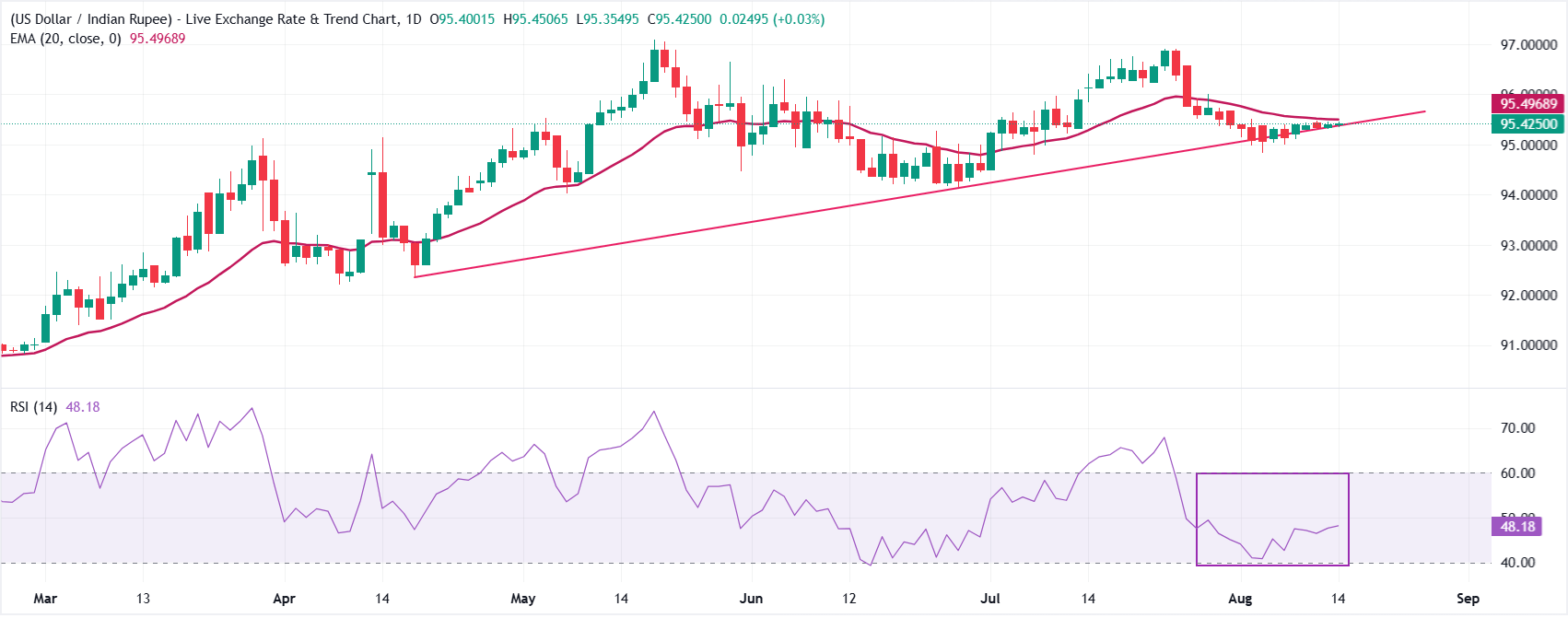
USD/INR trades at 95.42, close to the upward support trendline at 95.36, which coincides with the 20-day exponential moving average.
This configuration reflects a volatility contraction, with the Relative Strength Index (RSI) hovering steadily near 48.
On the topside, major resistances are the July 29 high near 96.00 and the all-time high at around 97.10. On the downside, the first layer of support is the upward-sloping trendline at 95.36, where a decisive breakdown would reinforce the bearish tone and expose the pair to the June 26 low at 94.15.
(The technical analysis of this story was written with the help of an AI tool. Know more.)
Indian Rupee FAQs
The Indian Rupee (INR) is one of the most sensitive currencies to external factors. The price of Crude Oil (the country is highly dependent on imported Oil), the value of the US Dollar – most trade is conducted in USD – and the level of foreign investment, are all influential. Direct intervention by the Reserve Bank of India (RBI) in FX markets to keep the exchange rate stable, as well as the level of interest rates set by the RBI, are further major influencing factors on the Rupee.
The Reserve Bank of India (RBI) actively intervenes in forex markets to maintain a stable exchange rate, to help facilitate trade. In addition, the RBI tries to maintain the inflation rate at its 4% target by adjusting interest rates. Higher interest rates usually strengthen the Rupee. This is due to the role of the ‘carry trade’ in which investors borrow in countries with lower interest rates so as to place their money in countries’ offering relatively higher interest rates and profit from the difference.
Macroeconomic factors that influence the value of the Rupee include inflation, interest rates, the economic growth rate (GDP), the balance of trade, and inflows from foreign investment. A higher growth rate can lead to more overseas investment, pushing up demand for the Rupee. A less negative balance of trade will eventually lead to a stronger Rupee. Higher interest rates, especially real rates (interest rates less inflation) are also positive for the Rupee. A risk-on environment can lead to greater inflows of Foreign Direct and Indirect Investment (FDI and FII), which also benefit the Rupee.
Higher inflation, particularly, if it is comparatively higher than India’s peers, is generally negative for the currency as it reflects devaluation through oversupply. Inflation also increases the cost of exports, leading to more Rupees being sold to purchase foreign imports, which is Rupee-negative. At the same time, higher inflation usually leads to the Reserve Bank of India (RBI) raising interest rates and this can be positive for the Rupee, due to increased demand from international investors. The opposite effect is true of lower inflation.
Recommended Articles


